

Portfolio Manager


• インサイト
Systematic fixed income: bringing diversification benefits to credit portfolios
Systematic credit is still a small part of fixed income, but its portfolio role is growing. For credit allocators, it can offer a disciplined and differentiated source of diversification.
執筆者




クオンツ債券共同責任者、リード・ポートフォリオ・マネジャー
まとめ
- A differentiated return stream for credit allocations
- Broad coverage to identify relative winners and losers
- Systematic selection, portfolio construction and human oversight combined
Systematic investing is well established in equity allocations, but fixed income has seen slower adoption. Within fixed income, systematic investment grade credit and high yield credit remain a relatively small part of the product universe. eVestment data show that quant strategies accounted for 6.5% of fixed income AuM in 2026, based on product and self-reported investment style. This highlights that systematic approaches remain a relatively small part of the broader fixed income universe, but also points to meaningful growth potential for systematic credit strategies.
This creates meaningful opportunity, particularly as the same broad portfolio benefits that have supported systematic equity investing such as discipline, breadth, diversification, customizability and repeatability also apply to systematic credit investing. Even though the underlying principles are shared across stocks and bonds, the complexity of corporate bond markets should not be underestimated. Models and their implementation need to be tailored to the specific characteristics of credit markets.
Table 1: Share of fixed income AuM classified as quant
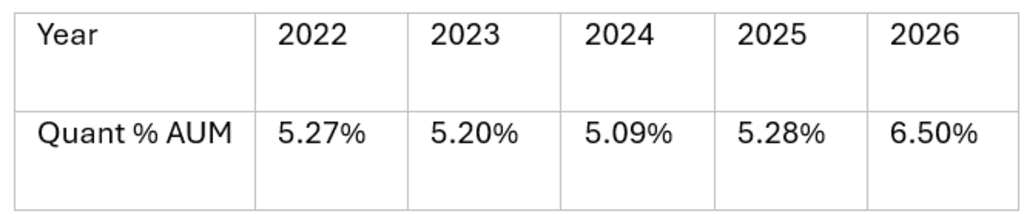
Source: eVestment, July 2026. *Dates are as of 30 June each year.
The value of systematic credit investing lies in translating fundamental investment ideas and experience into rules that can be applied consistently and efficiently in actual bond portfolios. This approach differs from one that uses simple factors that derive from theory rather than practice.
A generic value screen, for example, might identify bonds with wider spreads and conclude that they look cheap. A more precise, credit-specific and implementation-aware question is whether that spread is attractive relative to the issuer's fundamental risk profile, taking into account the bond's rating, maturity and other characteristics.
By defining and historically testing a broad set of decision rules, one can design long-term value-added investment processes. Combining tested rules into a selection model for investment decisions allows large universes to be evaluated efficiently on a daily basis. This expands the opportunity set and enables new opportunities to be identified and implemented more rapidly than traditional, more manual approaches to credit investing. A systematic, model-based approach also supports transparent portfolio oversight, as investment decisions can be traced back to the underlying decision rules.
クレジットの最新動向は?
クレジット運用の最新情報を先取りするニュースレター(英文)に登録しましょう。
How systematic credit works in practice
Systematic investing should not be viewed as a black box. On the contrary, our approach can be understood as systematizing fundamental investment principles into transparent decision rules. It starts by identifying the characteristics that can make a bond attractive – such as valuation, balance sheet quality, momentum and issuer risk – and then applies those rules consistently across a broad universe. The result is a transparent, repeatable approach to bond selection rather than one driven primarily by individual judgment or case-by-case decisions.
In practice, the process can be thought of as having two main quantitative engines within the broader investment process. The ranking engine assesses the investable universe and ranks issuers and bonds according to their attractiveness. The portfolio construction engine then converts those rankings into a diversified portfolio while taking account of benchmark alignment, liquidity, risk limits and client-specific constraints.
Figure 1: Investment process
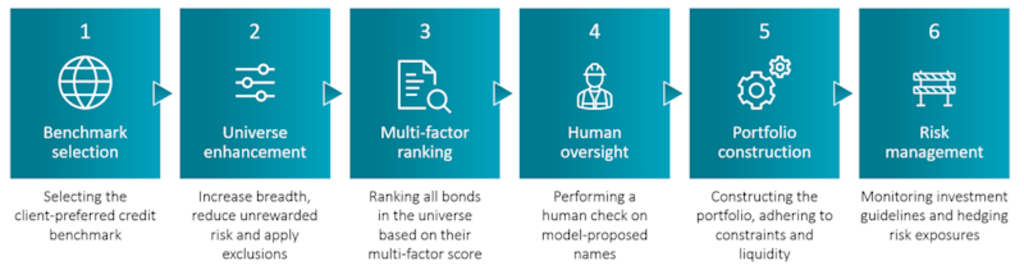
Source: Robeco, September 2026.
Why breadth and oversight matter
Breadth is central to the case. A systematic approach is most powerful when the investment universe is large enough for a repeatable edge to be applied across many decisions. Depending on the mandate, the systematic selection model can range from around 1,600 issuers and 5,000 bonds in global high yield to 2,600 issuers and more than 26,000 bonds in global investment grade. This breadth helps expand the opportunity set and identify relative winners and losers while maintaining a disciplined portfolio construction framework.
Human oversight is also an important part of a successful systematic process. Robeco’s approach includes input from more than 20 analysts, who screen buy candidates for material risks the model may have missed. In corporate bond markets, issuer-specific risks can develop quickly and the return profile is very asymmetric. A bond may look attractive because spreads have widened and the latest balance sheet still appears strong, while a major lawsuit, regulatory issue, large acquisition or other event sits outside the model’s scope. In such cases, portfolio managers and fundamental credit analysts can challenge the model where downside risk is not adequately reflected.
A different return stream within credit allocations
One of the strongest reasons to consider systematic credit is its ability to complement traditional fundamental credit managers. Many allocators already have exposure to active corporate bond managers. Adding another traditional manager may provide some diversification, but overlap can still exist in the investment process, positioning and return drivers. A systematic approach introduces a different decision-making framework within the same asset class, providing valuable style diversification.
Another source of differentiation is the risk profile. Many traditional active credit managers use a broad toolkit, including active credit beta, curve and duration positions. In Robeco’s systematic credit approach, the aim is to keep first-order risks, such as rates and credit beta, close to the benchmark, so that relative returns are driven primarily by credit returns from bottom-up issuer and bond selection.
This makes the approach well suited to enhanced-index-like objectives, where investors seek moderate alpha potential at low tracking error while keeping first-order risks close to the benchmark. It can also provide an alternative to passive exposure, particularly for investors looking to retain benchmark awareness while incorporating client-specific considerations and aiming for better-than-benchmark returns.
Figure 2: Style diversification
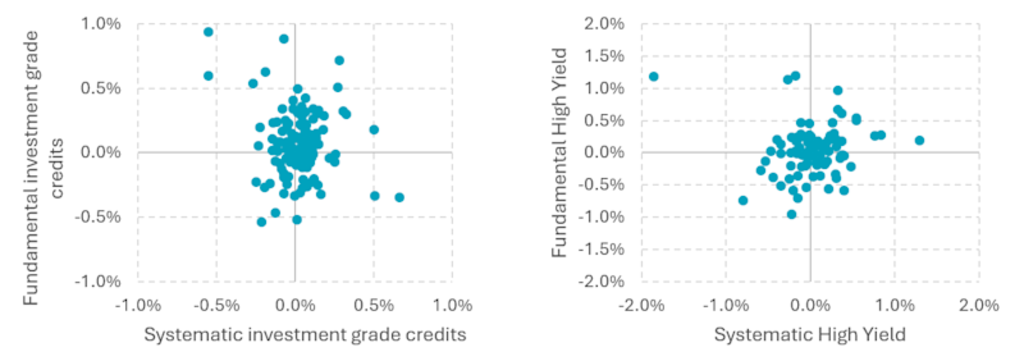
Past performance is no guarantee of future results. The value of your investments may fluctuate. Source: Robeco, September 2026
Why experience matters
As more systematic credit managers enter the market and apply quantitative or systematic techniques to credit, we believe experience is critical, since successful implementation requires more than building a model. Robeco Quant Fixed Income grew out of two established capabilities: fundamental fixed income investing and quantitative equity investing. Robeco has one of the longest live systematic credit track records in the market, with the Multi-Factor High Yield strategy dating back to 2018, Multi-Factor Credits strategy to 2015 and long-dated US credits since 2021. In a market where many systematic credit strategies are still relatively new, this live experience provides evidence of how the process has been applied across different market environments.
重要事項
当資料は情報提供を目的として、ロベコ・ジャパン株式会社(以下「当社」)が独自に作成、または当社のグループ会社(Robeco Institutional Asset Management B.V.およびその関連会社を含む)から提供された資料を当社が編集・翻訳したものです。資料中の個別の金融商品の売買の勧誘や推奨等を目的とするものではありません。記載された情報は十分信頼できるものであると考えておりますが、その正確性、完全性を保証するものではありません。意見や見通しはあくまで作成日における弊社の判断に基づくものであり、今後予告なしに変更されることがあります。運用状況、市場動向、意見等は、過去の一時点あるいは過去の一定期間についてのものであり、過去の実績は将来の運用成果を保証または示唆するものではありません。また、記載された投資方針・戦略等は全ての投資家の皆様に適合するとは限りません。当資料は法律、税務、会計面での助言の提供を意図するものではありません。 ご契約に際しては、必要に応じ専門家にご相談の上、最終的なご判断はお客様ご自身でなさるようお願い致します。 運用を行う資産の評価額は、組入有価証券等の価格、金融市場の相場や金利等の変動、及び組入有価証券の発行体の財務状況による信用力等の影響を受けて変動します。また、外貨建資産に投資する場合は為替変動の影響も受けます。運用によって生じた損益は、全て投資家の皆様に帰属します。したがって投資元本や一定の運用成果が保証されているものではなく、投資元本を上回る損失を被ることがあります。弊社が行う金融商品取引業に係る手数料または報酬は、締結される契約の種類や契約資産額により異なるため、当資料において記載せず別途ご提示させて頂く場合があります。具体的な手数料または報酬の金額・計算方法につきましては弊社担当者へお問合せください。 当資料及び記載されている情報、商品に関する権利は弊社に帰属します。したがって、弊社の書面による同意なくしてその全部もしくは一部を複製またはその他の方法で配布することはご遠慮ください。 商号等: ロベコ・ジャパン株式会社 金融商品取引業者 関東財務局長(金商)第2780号 加入協会: 一般社団法人 資産運用業協会