

Client Portfolio Manager


• インサイト
AI in credit markets as investment races ahead of corporate profits
Almost four years into the generative-AI boom, the money has certainly arrived. But the profits, at least across much of the corporate universe, have been slower to follow.
執筆者

Ward Poirters

Client Portfolio Manager

Analyst

Analyst
まとめ
- AI-related funding is reshaping credit markets faster than corporate profits
- In financials and consumer, AI is improving processes but not yet credit profiles
- Fundamentals over hype as AI winners and losers are yet to emerge
We went into our conversations with Robeco’s sector analysts expecting to hear about changing business models, widening competitive gaps and clear winners and losers. What we found was rather more surprising. Or rather, more mundane. And perhaps more interesting because of it.
AI adoption is widespread. Companies are spending money and experimenting with the technology and as a result processes are changing. But outside the sectors directly exposed to the infrastructure buildout or disruption, there is still surprisingly little evidence that AI is materially changing companies’ bottom lines.
The funding boom is already here
That is striking given what is already happening in credit markets. A dominant theme has been the marked uptick in hyperscalers coming to market to fund development. Data center buildouts are expensive projects, and a significant share of the financing is expected to come from investment grade markets and, increasingly, high yield.
The impact is already visible in investment grade benchmarks, where technology and AI-linked issuers are becoming a much larger part of the universe. Hyperscalers alone now account for just over 5% of the US IG benchmark, while the share is considerably higher once AI-related infrastructure and utilities are included.
The money has certainly arrived. The profits, at least across much of the corporate universe, have been slower to follow
Figure 1 – AI-linked issuers account for around 19% of the US investment grade non-financial index in June 2026, rising from roughly 4% in 2022
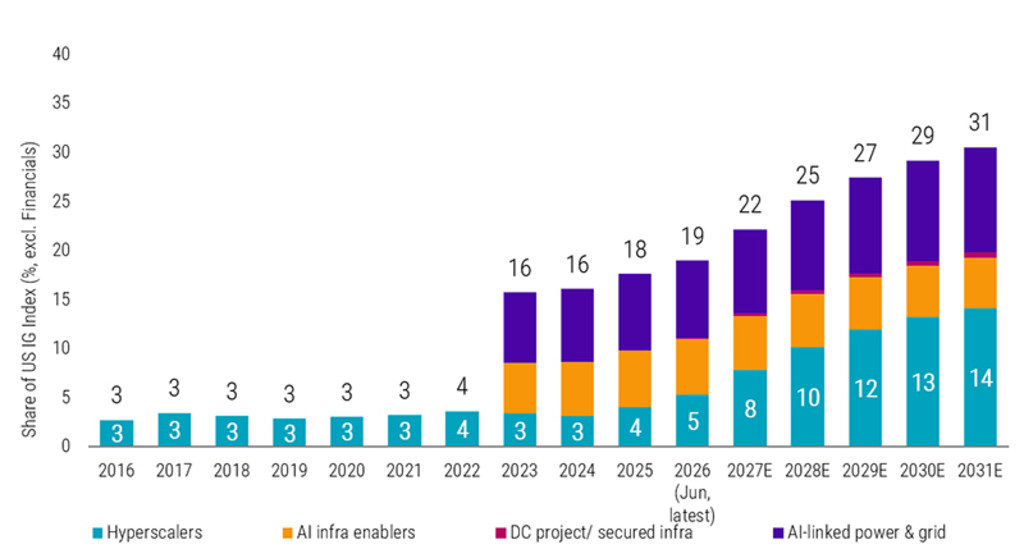
Index exposure is based on market-value weight of US IG constituents (C0A0 Index), excluding Financials. Categories reflect Robeco issuer classifications. Only utilities/gencos with credit data-center load, grid-capex or power-demand exposure are included (Dominion, Duke, Southern, Entergy, AEP, Exelon, NextEra, Sempra, PG&E, Edison Intl, PPL, Xcel, PSEG, Constellation, First Energy1 ). The forward view is driven by the funding gap assumptions (operating cash flow minus shareholder returns minus capex forecasts) and expected net issuance. Source: ICE BofA, Bloomberg, company filings, CreditSights, CNBC, MUFG, Morgan Stanley, S&P Global, Reuters, GlobalCapital, RBC Capital Markets, Utility Dive, T&D World, DCD, Robeco. Forward view is a Robeco scenario.
Perhaps none of this is particularly remarkable. The money being committed to AI is enormous, but so are the expectations. We have been told AI will transform business models and replace large parts of the workforce. Employees everywhere have been left wondering which jobs will still exist in a few years’ time, while companies are under increasing pressure to explain their AI strategy.
Behind all that investment and borrowing sits the assumption that eventually, the money will show up in company bottom lines. So far, that is proving much harder to see. What is obvious is that the AI funding cycle is already reshaping bond markets, but the transformation of the companies within them is proving much slower.
To understand why, we spoke with our financials and consumer analysts about what they are actually seeing at company level. Their experience suggests that, for now at least, the impact of AI is less about wholesale disruption and more about gradual changes in efficiency, customer interaction and the way existing businesses operate.
クレジットの最新動向は?
クレジット運用の最新情報を先取りするニュースレター(英文)に登録しましょう。
Financials: efficiency gains, but little credit disruption – yet
In financials, AI spending is already visible, but so far it is concentrated largely on improving existing processes rather than creating new sources of revenue. According to Robeco credit analyst Atif Ali, banks are applying AI across many areas from software development to know-your-customer processes, with the immediate opportunity primarily about efficiency and cost reduction.
Scale matters. Larger US banks have considerably greater capacity to invest than smaller European peers, potentially giving them an early advantage in modernizing systems and lowering costs. Atif expects some of that advantage to accrue to the largest players, particularly where competitors are constrained by legacy technology or smaller investment budgets. But for bondholders, the significance is much less dramatic: a bank generating somewhat higher profits as a result of AI does not necessarily become a materially different credit.
There are also natural brakes on disruption. Financials is highly regulated, meaning areas such as automated underwriting need to satisfy rules around fairness and model risk before adoption can accelerate. This is likely to make change more gradual than in less regulated industries.
That is reflected in Atif’s credit research today. AI spending and strategy are increasingly part of the discussion with companies, but the benefits have yet to come through materially in earnings or credit quality. Even where AI delivers meaningful cost savings, Atif expects much of this to be competed away rather than retained as higher profits, with customers ultimately benefiting through better pricing. For now, he does not view the absence of a leading AI strategy as a reason in itself to avoid a bank or insurer.
Consumer: changing how customers interact, rather than the credit story
The picture is similar across consumer-facing companies. Machine learning is not new to the sector: hotels, cruise operators and other businesses have long used it for pricing, recommendations and demand forecasting. The more recent development is generative AI, which is starting to change how consumers research products and services and interact with companies.
Travel provides a good example. Booking and Expedia2 are integrating with AI platforms, while hotel groups are introducing AI-powered trip-planning and customer-service tools. The customer journey is already fragmented across search engines, social media, online travel agencies (OTAs) and companies’ own channels. Generative AI and increasingly agents that can complete bookings themselves, could change the interface through which consumers research and arrange travel, but it is not yet clear whether this will materially alter existing competitive positions or simply provide another route into established platforms. While agents rely on existing platforms for supply, the likelier outcome is a reallocation of marketing and distribution spend rather than a material change in the sector’s underlying economics.
Credit analyst Yadeesh Moorthy sees no significant impact on the credit profiles of consumer-facing companies so far. AI adoption is beginning to generate measurable efficiencies at some of the larger platforms, mainly through the automation of customer service, but the overall financial contribution remains difficult to isolate and returns on wider adoption remain uncertain. There is not yet clear credit differentiation between winners and losers. Over time, companies with stronger balance sheets and greater financial flexibility may be better placed to invest and adapt, potentially widening the gap with smaller or more highly leveraged competitors.
Looking beyond the AI hype
At this point, much about the impact of AI remains unknown. But almost four years into the generative-AI boom, the money has certainly arrived. The profits, at least across much of the corporate universe, have been slower to follow. It is still early days, but so far, the corporate impact has been almost the opposite of the upheaval many expected. Rather than widespread disruption, rapidly widening competitive gaps and clear winners and losers, our analysts are seeing a much more gradual evolution. For many companies, it remains largely business as usual, with AI improving existing processes rather than fundamentally changing business models or credit profiles.
So what does this mean for credit investors? As fundamental investors, we prefer to look beyond the hype and assess the actual impact. For bondholders, where upside is limited but downside risk matters, identifying where AI may weaken fundamentals can be more important than trying to identify the biggest winners. That picture may change as adoption deepens and more companies begin to translate AI investment into measurable financial gains. If it does, we expect the shift to show up first in company fundamentals, giving bottom-up research an early indication of where AI is genuinely strengthening or weakening credit quality. For now, contrary to what the headlines might suggest, its impact on credit investors remains modest.
Footnotes
1 The companies shown here are for illustrative purposes only. No inference can be made on the future development of the company. This is not a buy, sell, or hold recommendation.
2 The companies shown here are for illustrative purposes only. No inference can be made on the future development of the company. This is not a buy, sell, or hold recommendation.
重要事項
当資料は情報提供を目的として、ロベコ・ジャパン株式会社(以下「当社」)が独自に作成、または当社のグループ会社(Robeco Institutional Asset Management B.V.およびその関連会社を含む)から提供された資料を当社が編集・翻訳したものです。資料中の個別の金融商品の売買の勧誘や推奨等を目的とするものではありません。記載された情報は十分信頼できるものであると考えておりますが、その正確性、完全性を保証するものではありません。意見や見通しはあくまで作成日における弊社の判断に基づくものであり、今後予告なしに変更されることがあります。運用状況、市場動向、意見等は、過去の一時点あるいは過去の一定期間についてのものであり、過去の実績は将来の運用成果を保証または示唆するものではありません。また、記載された投資方針・戦略等は全ての投資家の皆様に適合するとは限りません。当資料は法律、税務、会計面での助言の提供を意図するものではありません。 ご契約に際しては、必要に応じ専門家にご相談の上、最終的なご判断はお客様ご自身でなさるようお願い致します。 運用を行う資産の評価額は、組入有価証券等の価格、金融市場の相場や金利等の変動、及び組入有価証券の発行体の財務状況による信用力等の影響を受けて変動します。また、外貨建資産に投資する場合は為替変動の影響も受けます。運用によって生じた損益は、全て投資家の皆様に帰属します。したがって投資元本や一定の運用成果が保証されているものではなく、投資元本を上回る損失を被ることがあります。弊社が行う金融商品取引業に係る手数料または報酬は、締結される契約の種類や契約資産額により異なるため、当資料において記載せず別途ご提示させて頂く場合があります。具体的な手数料または報酬の金額・計算方法につきましては弊社担当者へお問合せください。 当資料及び記載されている情報、商品に関する権利は弊社に帰属します。したがって、弊社の書面による同意なくしてその全部もしくは一部を複製またはその他の方法で配布することはご遠慮ください。 商号等: ロベコ・ジャパン株式会社 金融商品取引業者 関東財務局長(金商)第2780号 加入協会: 一般社団法人 資産運用業協会