

Head of Exchange Traded Funds


• Active ETF in focus
Active Emerging Markets ETF: Stock selection for core EM exposure
3D EM Equity ETF
Active ETFs are giving investors a more flexible way to access active strategies, combining the transparency and tradability of an ETF with the ability to move beyond a purely passive approach.
In this series, we look at where that active element may be especially useful. This edition focuses on emerging market equities: a complex and often inefficient asset class where disciplined stock selection and portfolio construction can make a meaningful difference.
執筆者




Portfolio Manager
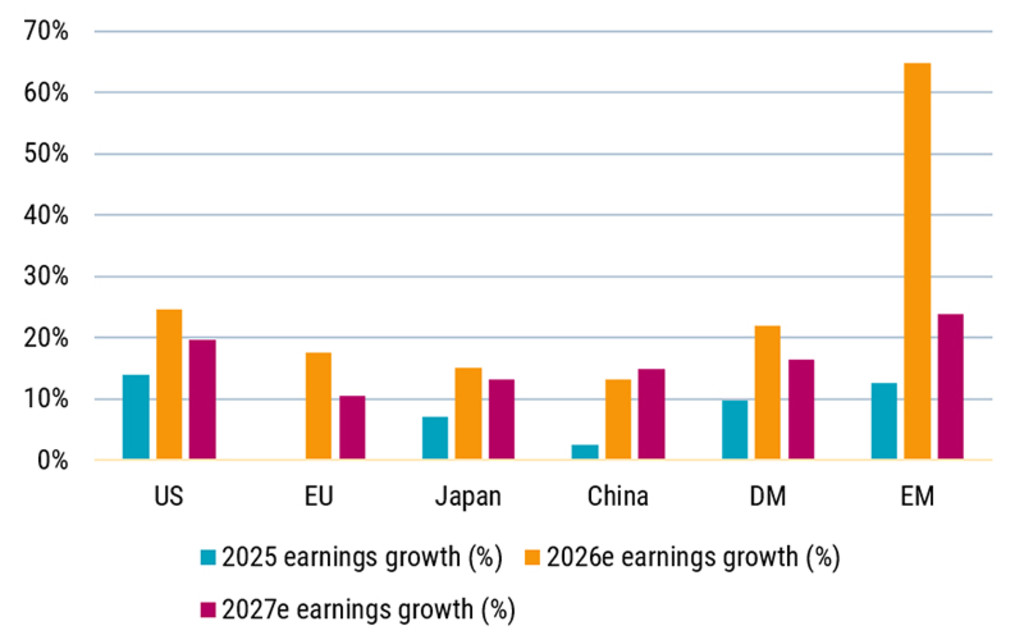
Emerging markets are an important part of the global equity conversation. The asset class offers access to long-term growth, innovation leadership and broadening domestic demand, while many EM economies are also supported by stronger fundamentals than in previous cycles.
Figure 1 | Third year in a row of earnings growth for EM
Source: MSCI, IBES, 30 July 2026. All expressions of opinion are subject to change. This information is intended for educational purposes, and it is not to be construed as an offer, solicitation, recommendation, or endorsement of any particular security, products or services.
These factors help explain why EM remains a core allocation question. But the next question is how investors should access that opportunity. Emerging markets are not one single story: they bring together countries, sectors and companies with very different growth drivers, risks and market dynamics. At the same time, the index itself has changed considerably, making the composition of EM exposure increasingly important.
Figure 2 | MSCI EM index weights 2008 vs. 2025

Source: MSCI, December 2025.
The shift from resource-heavy sectors toward technology, consumer and communication services shows how much index composition has changed. For investors, this makes benchmark awareness important: the opportunity set has become more dynamic, but so have the risks of unintended country, sector or stock concentrations.
Why EM rewards stock selection
This is where a benchmark-aware active approach can be especially useful, with the opportunity lying in selecting the right stocks within the countries and sectors that make up that benchmark, because even within a single theme, outcomes can vary widely.
Take the EM tech sector, for example. AI hardware, semiconductors, platforms and digital infrastructure may all sit within the broader EM innovation story, but individual stock returns, valuations, earnings momentum and quality can diverge sharply. That dispersion creates room for active stock selection, even when country and sector positioning remains controlled.
Figure 3 | Wide dispersion creates room for stock selection

Past performance does not guarantee future results. The value of investments may fluctuate. All companies named are for illustrative purposes only. No inference can be made on the future development of any company. This is not a buy, sell or hold recommendation.
Source: Bloomberg, Robeco. As of 3 September 2026. Local total stock returns for Taiwanese and Korean tech stocks in Robeco’s EM Active universe.
For a core EM allocation, the key question for investors is whether their portfolio is built to use stock-level dispersion while keeping country and sector exposures under control.
Why Robeco’s 3D approach fits EM
Robeco’s 3D EM Equity ETF is designed as a systematic alternative to passive EM exposure: broad market access, but with a disciplined active edge.
Instead of making large country or sector calls, the strategy invests in a diversified portfolio of EM stocks using many small overweight and underweight positions versus the benchmark. This keeps the portfolio aligned with the role investors typically expect from a core EM allocation, while seeking to improve outcomes over time.
The 3D framework means the portfolio is not optimized for return alone. Return potential, benchmark-relative risk and sustainability profile are considered together, so the strategy can seek attractive stocks while managing active risk and targeting sustainability characteristics better than the benchmark. In EM, where companies can differ widely in governance standards, environmental footprints and long-term risks, that integrated approach is especially relevant.
The ETF has a long-term information ratio target of 0.6, reflecting its aim to deliver disciplined excess return while managing some of the risks that can come with broad passive exposure. Since inception, the ETF has also delivered positive gross excess returns versus the benchmark.
Figure 4 | Track record

Past performance is no guarantee of future results. The value of your investments may fluctuate. Source: Robeco, MSCI. Portfolio: Robeco 3D EM Equity UCITS ETF USD Acc Share Class. Index: MSCI Emerging Markets Index (Net Return) (net dividends reinvested). All figures in EUR. Data end of 31 July 2026. If the currency in which the past performance is displayed differs from the currency of the country in which you reside, then you should be aware that due to exchange rate fluctuations the performance shown may increase or decrease if converted into your local currency. Performance since inception is as of the first full month. Periods shorter than one year are not annualized. Returns gross of fees, based on gross asset value. Values and returns indicated here are before cost; the performance data does not take account of the commissions and costs incurred
Although the ETF’s track record is short, the strategy builds on Robeco’s broader enhanced indexing capability, which has been developed over more than 20 years.
How the investor benefits

1. Core EM equity exposure, actively enhanced
The ETF gives investors broad EM exposure in a transparent and flexible active ETF wrapper. It is designed for investors looking for a practical core EM allocation, but with more than simple market-cap-weighted access.

2. Diversified active edge
Because the strategy is built from many small active positions, investors are not dependent on a single theme or stock to drive returns. This can be especially useful in EM, where outcomes can vary widely even within the same sector or theme.

3. Benchmark-aware portfolio construction
The strategy is designed to manage concentration, volatility, liquidity and implementation costs while staying close to the benchmark. For investors, this means the EM allocation can retain its core portfolio role, while being actively shaped through Robeco’s integrated 3D process.
For investors seeking core EM exposure, Robeco's 3D EM Equity ETF combines the efficiency of the ETF wrapper with long-standing quantitative research and an integrated 3D investment process. This reflects the wider Robeco active ETF approach: systematic, research-driven and designed to evolve with investor needs.
Our core strengths



重要事項
当資料は情報提供を目的として、ロベコ・ジャパン株式会社(以下「当社」)が独自に作成、または当社のグループ会社(Robeco Institutional Asset Management B.V.およびその関連会社を含む)から提供された資料を当社が編集・翻訳したものです。資料中の個別の金融商品の売買の勧誘や推奨等を目的とするものではありません。記載された情報は十分信頼できるものであると考えておりますが、その正確性、完全性を保証するものではありません。意見や見通しはあくまで作成日における弊社の判断に基づくものであり、今後予告なしに変更されることがあります。運用状況、市場動向、意見等は、過去の一時点あるいは過去の一定期間についてのものであり、過去の実績は将来の運用成果を保証または示唆するものではありません。また、記載された投資方針・戦略等は全ての投資家の皆様に適合するとは限りません。当資料は法律、税務、会計面での助言の提供を意図するものではありません。 ご契約に際しては、必要に応じ専門家にご相談の上、最終的なご判断はお客様ご自身でなさるようお願い致します。 運用を行う資産の評価額は、組入有価証券等の価格、金融市場の相場や金利等の変動、及び組入有価証券の発行体の財務状況による信用力等の影響を受けて変動します。また、外貨建資産に投資する場合は為替変動の影響も受けます。運用によって生じた損益は、全て投資家の皆様に帰属します。したがって投資元本や一定の運用成果が保証されているものではなく、投資元本を上回る損失を被ることがあります。弊社が行う金融商品取引業に係る手数料または報酬は、締結される契約の種類や契約資産額により異なるため、当資料において記載せず別途ご提示させて頂く場合があります。具体的な手数料または報酬の金額・計算方法につきましては弊社担当者へお問合せください。 当資料及び記載されている情報、商品に関する権利は弊社に帰属します。したがって、弊社の書面による同意なくしてその全部もしくは一部を複製またはその他の方法で配布することはご遠慮ください。 商号等: ロベコ・ジャパン株式会社 金融商品取引業者 関東財務局長(金商)第2780号 加入協会: 一般社団法人 資産運用業協会