


Client Portfolio Manager

• インサイト
How dynamic high yield responds when spreads widen
High yield offers attractive income, but how can investors stay invested if tight spreads widen? Dynamic high yield uses market signals to adjust risk as conditions change.
執筆者

Ward Poirters

Portfolio Manager
まとめ
- Dynamic high yield has shown resilience in past periods of spread widening
- Its systematic process adjusts exposure as signals strengthen or weaken
- Its portfolio structure allows it to reposition quickly
Investors are facing no shortage of reasons for concern. Geopolitical tensions, energy-price risks and uncertainty over central bank policy continue to cloud the outlook. Although spreads have widened in recent weeks, they remain close to historically tight levels.
This suggests that investors are still demanding relatively little extra compensation for taking credit risk. For investors who want to keep earning income from high yield, this creates a challenge: staying invested while managing the risk of a market reversal.
A high yield bond usually pays more interest than a government bond because there is more risk that the company borrowing the money will struggle to repay it. The spread is that extra yield. If a government bond yields 3% and a high yield bond yields 6%, the spread is three percentage points.
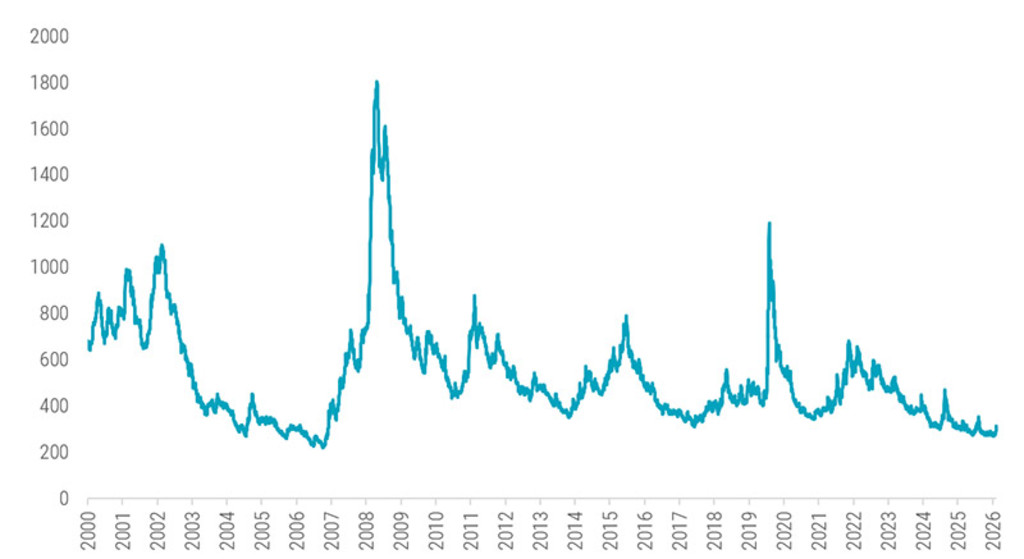
Today, spreads are tight, meaning investors receive relatively little extra yield for taking additional company risk. If confidence in companies weakens, investors may demand more compensation. Spreads then widen, and the prices of existing high yield bonds generally fall. Figure 1 puts today’s position in context: spreads rose sharply during past periods of concern, but are now near the low end of the range shown.
Figure 1 - How the spread on high yield bonds has changed over time
Past performance is no guarantee of future results. The value of your investments may fluctuate.
Source: Bloomberg Global High Yield Index, until the end of September 2026.
Why stay invested in high yield?
Despite tight credit spreads, high yield continues to offer attractive income, with yields around levels not seen for more than two decades. Those yields provide a stronger starting point for returns. The income earned can also help offset some decline in bond prices. Fundamentals across the asset class remain relatively strong. The high yield market has become higher-quality over time, with BB-rated bonds now representing a record share of both the US and European markets.1
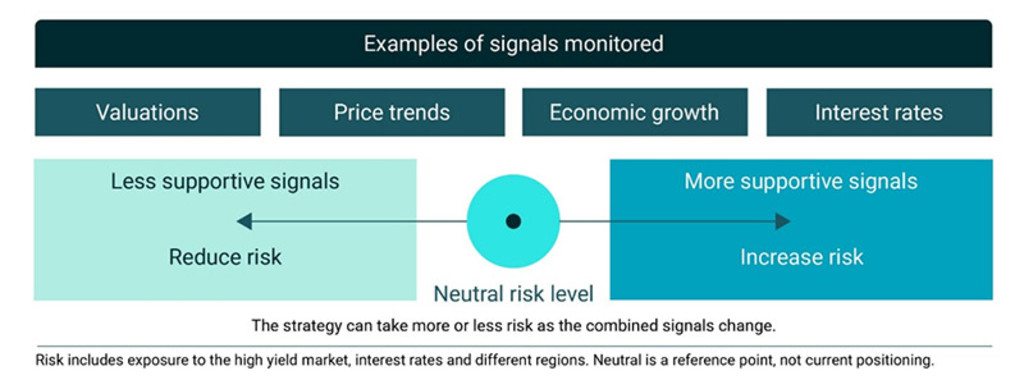
When conditions become less supportive, the strategy can reduce exposure; when they improve, it can increase exposure again
High yield can also add diversification to a broader bond portfolio because it behaves differently from more interest-rate-sensitive bonds. Attractive income, relatively solid fundamentals and diversification therefore continue to make a case for staying invested. But tight spreads mean investors also need to be prepared if market conditions worsen. This is where a more flexible approach can help.
クレジットの最新動向は?
クレジット運用の最新情報を先取りするニュースレター(英文)に登録しましょう。
How does dynamic high yield operate in difficult markets?
Traditional high yield strategies generally stay invested so they can earn income and benefit when the market rises. But that also leaves them exposed when high yield bonds fall in value. Dynamic high yield has a different approach: it can adjust how much high yield risk it takes. It does this by monitoring signals such as the extra yield bonds offer, price trends, economic growth and interest rates.
These signals are combined systematically to determine the strategy's level of high yield exposure. When conditions become less supportive, the strategy can reduce exposure to help limit downside risk. But the flexibility also works in the other direction: when conditions are more favorable, it can increase exposure above its neutral level to capture more of the income and return potential available from high yield.
Figure 2 - Market signals guide high yield risk exposure – the aim is not to predict every market turning point perfectly, but to adapt as conditions change
Source: Robeco, October 2026.
Why consider dynamic high yield today?
Today's combination of attractive yields and tight spreads makes flexibility particularly relevant. Dynamic high yield seeks to capture that income while adjusting risk as conditions change. This allows investors to remain in the asset class without having to decide for themselves when to exit or re-enter the market.
Footnote
1Source: KKR, August 2026. BB-rated bonds account for approximately 57% of the US high yield market and 68% of the European high yield market, both record levels.
重要事項
当資料は情報提供を目的として、ロベコ・ジャパン株式会社(以下「当社」)が独自に作成、または当社のグループ会社(Robeco Institutional Asset Management B.V.およびその関連会社を含む)から提供された資料を当社が編集・翻訳したものです。資料中の個別の金融商品の売買の勧誘や推奨等を目的とするものではありません。記載された情報は十分信頼できるものであると考えておりますが、その正確性、完全性を保証するものではありません。意見や見通しはあくまで作成日における弊社の判断に基づくものであり、今後予告なしに変更されることがあります。運用状況、市場動向、意見等は、過去の一時点あるいは過去の一定期間についてのものであり、過去の実績は将来の運用成果を保証または示唆するものではありません。また、記載された投資方針・戦略等は全ての投資家の皆様に適合するとは限りません。当資料は法律、税務、会計面での助言の提供を意図するものではありません。 ご契約に際しては、必要に応じ専門家にご相談の上、最終的なご判断はお客様ご自身でなさるようお願い致します。 運用を行う資産の評価額は、組入有価証券等の価格、金融市場の相場や金利等の変動、及び組入有価証券の発行体の財務状況による信用力等の影響を受けて変動します。また、外貨建資産に投資する場合は為替変動の影響も受けます。運用によって生じた損益は、全て投資家の皆様に帰属します。したがって投資元本や一定の運用成果が保証されているものではなく、投資元本を上回る損失を被ることがあります。弊社が行う金融商品取引業に係る手数料または報酬は、締結される契約の種類や契約資産額により異なるため、当資料において記載せず別途ご提示させて頂く場合があります。具体的な手数料または報酬の金額・計算方法につきましては弊社担当者へお問合せください。 当資料及び記載されている情報、商品に関する権利は弊社に帰属します。したがって、弊社の書面による同意なくしてその全部もしくは一部を複製またはその他の方法で配布することはご遠慮ください。 商号等: ロベコ・ジャパン株式会社 金融商品取引業者 関東財務局長(金商)第2780号 加入協会: 一般社団法人 資産運用業協会


