
Client Portfolio Manager


• インサイト
Quant chart: Same manager, different alpha
Allocating to one manager across developed and emerging markets can still provide meaningful diversification of active return.
執筆者

Asset owners often allocate to multiple managers to diversify sources of active return. That logic is sound: if one manager underperforms, another may offset it, especially when their investment styles, processes, or opportunity sets differ.
But diversification doesn’t only exist between managers. It can also exist within a single manager, when a comparable investment philosophy is applied across different market universes.
This raises an important question around portfolio construction: if an investor allocates to the same manager in developed markets (DM) and emerging markets (EM), are they simply doubling up on the same source of alpha – or can they still achieve meaningful diversification?
Our analysis suggests they can. Even when the same manager runs comparable strategies in both DM and EM, the alpha generated in those portfolios tends to be only weakly correlated. In other words, the same manager does not necessarily mean the same return pattern.
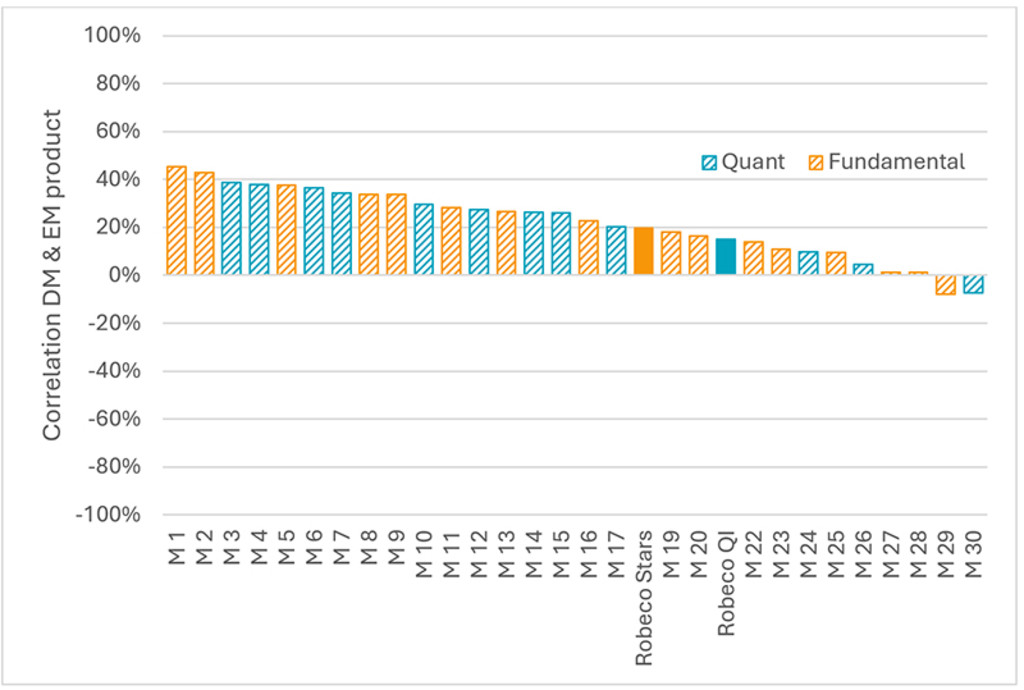
Using eVestment data, we examine whether comparable DM and EM strategies from the same asset manager deliver similar alpha. We analyze 30 managers, covering both quantitative strategies (e.g. Robeco QI DM Enhanced Indexing versus Robeco QI EM Enhanced Indexing) and fundamental strategies (e.g. Robeco Global Stars versus Robeco EM Stars). For each DM–EM pair, we compute the alpha correlation using the maximum available overlapping history between 2005 and 2025.
Figure 1 | Alpha correlation between EM and DM products per manager
Past performance does not guarantee future results. The value of your investments may fluctuate.
Source: Robeco, eVestment, 2005-2025. For illustrative purposes only.
Quant Charts
The results show that the average alpha correlation across managers is approximately 0.2, with correlations ranging from close to 0.0 to around 0.4. This indicates some commonality, but limited overlap in alpha generation. Importantly, the pattern is similar for both quant and fundamental managers.
That finding is intuitive once we consider the underlying opportunity sets. DM and EM equity markets differ materially in market structure, liquidity, sector composition, analyst coverage, governance regimes, and the way information is incorporated into prices. As a result, even when a manager applies a similar philosophy or research framework across both universes, the actual sources of excess return are often not the same.
For quant strategies, investment signals may remain conceptually consistent across markets, but their strength, persistence, and implementation can vary significantly. For fundamental strategies, company selection opportunities, market inefficiencies, and macro sensitivities also differ. The result is that active returns can follow meaningfully different paths across DM and EM, even under one investment house.
Low alpha correlation also suggests that periods of underperformance may not coincide. In practice, this means a manager’s DM and EM strategies may experience drawdowns at different times and for different reasons. For asset owners, that can help smooth the overall experience of active returns across a broader equity allocation.
Diversification without fragmentation
This matters because many asset owners face a trade-off between diversification and complexity. Adding more managers can broaden return sources, but it can also increase governance burden, due diligence requirements, reporting complexity, and the risk of unintended inconsistencies across portfolios.
Allocating to one manager across multiple universes may offer a different route: operational simplicity without necessarily giving up diversification of alpha. Where relevant, this can also support greater consistency in portfolio design, e.g. in the treatment of sustainability preferences or climate objectives, while still allowing the active return profile to differ across markets.
This may be particularly relevant for asset owners considering broader global equity structures, including combinations of DM and EM within an overall ACWI-oriented allocation.
Bottom line: same manager does not mean same alpha
Even when the investment process and the manager are the same, DM and EM strategies tend to generate largely distinct alpha. Allocating across universes can therefore provide meaningful diversification, without the need to change managers or philosophies.
For asset owners, that means manager consolidation does not automatically imply return concentration. In some cases, a single manager relationship can offer a combination of diversified active return streams, implementation consistency, and lower operational complexity.
重要事項
当資料は情報提供を目的として、ロベコ・ジャパン株式会社(以下「当社」)が独自に作成、または当社のグループ会社(Robeco Institutional Asset Management B.V.およびその関連会社を含む)から提供された資料を当社が編集・翻訳したものです。資料中の個別の金融商品の売買の勧誘や推奨等を目的とするものではありません。記載された情報は十分信頼できるものであると考えておりますが、その正確性、完全性を保証するものではありません。意見や見通しはあくまで作成日における弊社の判断に基づくものであり、今後予告なしに変更されることがあります。運用状況、市場動向、意見等は、過去の一時点あるいは過去の一定期間についてのものであり、過去の実績は将来の運用成果を保証または示唆するものではありません。また、記載された投資方針・戦略等は全ての投資家の皆様に適合するとは限りません。当資料は法律、税務、会計面での助言の提供を意図するものではありません。 ご契約に際しては、必要に応じ専門家にご相談の上、最終的なご判断はお客様ご自身でなさるようお願い致します。 運用を行う資産の評価額は、組入有価証券等の価格、金融市場の相場や金利等の変動、及び組入有価証券の発行体の財務状況による信用力等の影響を受けて変動します。また、外貨建資産に投資する場合は為替変動の影響も受けます。運用によって生じた損益は、全て投資家の皆様に帰属します。したがって投資元本や一定の運用成果が保証されているものではなく、投資元本を上回る損失を被ることがあります。弊社が行う金融商品取引業に係る手数料または報酬は、締結される契約の種類や契約資産額により異なるため、当資料において記載せず別途ご提示させて頂く場合があります。具体的な手数料または報酬の金額・計算方法につきましては弊社担当者へお問合せください。 当資料及び記載されている情報、商品に関する権利は弊社に帰属します。したがって、弊社の書面による同意なくしてその全部もしくは一部を複製またはその他の方法で配布することはご遠慮ください。 商号等: ロベコ・ジャパン株式会社 金融商品取引業者 関東財務局長(金商)第2780号 加入協会: 一般社団法人 資産運用業協会