
Portfolio Manager


• インサイト
Quant chart: Beyond TSMC – Mapping Taiwan’s AI technology ecosystem
TSMC* may dominate emerging market technology exposure, but Taiwan’s AI value chain extends far beyond a single company. This edition of the quant chart explores how and where.
執筆者



For emerging market investors, Taiwan Semiconductor Manufacturing Company, or TSMC, has become impossible to ignore. As the world’s leading advanced semiconductor foundry and a critical supplier to companies such as Nvidia, Apple and AMD, it sits at the center of the global AI value chain. Its market capitalization has surged to USD 1.66 trillion, giving it a 14.2% weight in the MSCI Emerging Markets Index. 1
That creates an interesting challenge. For many active UCITS strategies, single-stock exposure is constrained by diversification rules, meaning investors often need to look beyond TSMC for additional exposure to the AI theme. But while TSMC is a unique company with no obvious one-to-one substitute, Taiwan’s broader technology ecosystem offers a surprisingly deep bench of companies linked to the same structural trends.
* TSMC and all other companies named in this article are for illustrative purposes only. No inference can be made on the future development of the company. This is not a buy, sell or hold recommendation.
Taiwan’s technology sector includes a wide range of highly specialized companies operating across the AI supply chain. Some are directly involved in semiconductors and advanced chip design. Others provide the servers, power systems, cooling infrastructure, substrates, printed circuit boards, assembly, testing and networking equipment needed to scale AI deployment.
For this edition of the quant chart, we focused on 60 Taiwanese technology stocks2 and classified them according to their relevance to the AI value chain. The three categories are deliberately simple: AI Core companies are those with products or services that are central to AI infrastructure or represent a potential bottleneck in the value chain. AI Enablers support the wider AI build-out, even if they are not themselves the most performance-critical layer. Finally, companies with more limited or indirect exposure are classified as AI Low.
As with any framework of this kind, there is room for debate. The aim is not to create a definitive taxonomy but to show that AI exposure is not binary. Taiwan’s technology ecosystem includes both obvious beneficiaries and less obvious supporting players.3
クオンツ運用の価値を探求
最先端クオンツ戦略の情報やインサイトを定期的にお届けします。
What the chart shows
The results are striking. Figure 1 shows the 12-month returns of the selected companies across the three categories. While TSMC’s rise has been remarkable (its market capitalization is still roughly 40% larger than the combined value of the other 59 names), much of the real excitement has actually happened beyond TSMC itself.
This is not necessarily surprising. Markets reward not only absolute importance but also the rate of change in expectations. Some AI enablers have delivered very strong returns because their role in the AI infrastructure build-out has become more visible. At the same time, some of the more obvious AI core names have already experienced a strong bull market in previous years.4
Examples can be found across the value chain. Delta Electronics supplies critical power and cooling systems for data centers. Quanta, Hon Hai Precision, Wiwynn and Wistron are major AI server manufacturers. Accton plays a crucial role in connecting GPUs across AI clusters and data centers. Nanya Tech produces memory chips, while ASPEED is the main player in server management chips. ASE, Powertech and King Yuan are key players in assembly and testing. Companies such as Unimicron, Elite Material and Zhen Ding produce (elements of) substrates and printed circuit boards, while Alchip, Global Unichip and increasingly MediaTek are active in customized chip design.5
Figure 1 | The Taiwanese Tech Landscape: 12-month returns
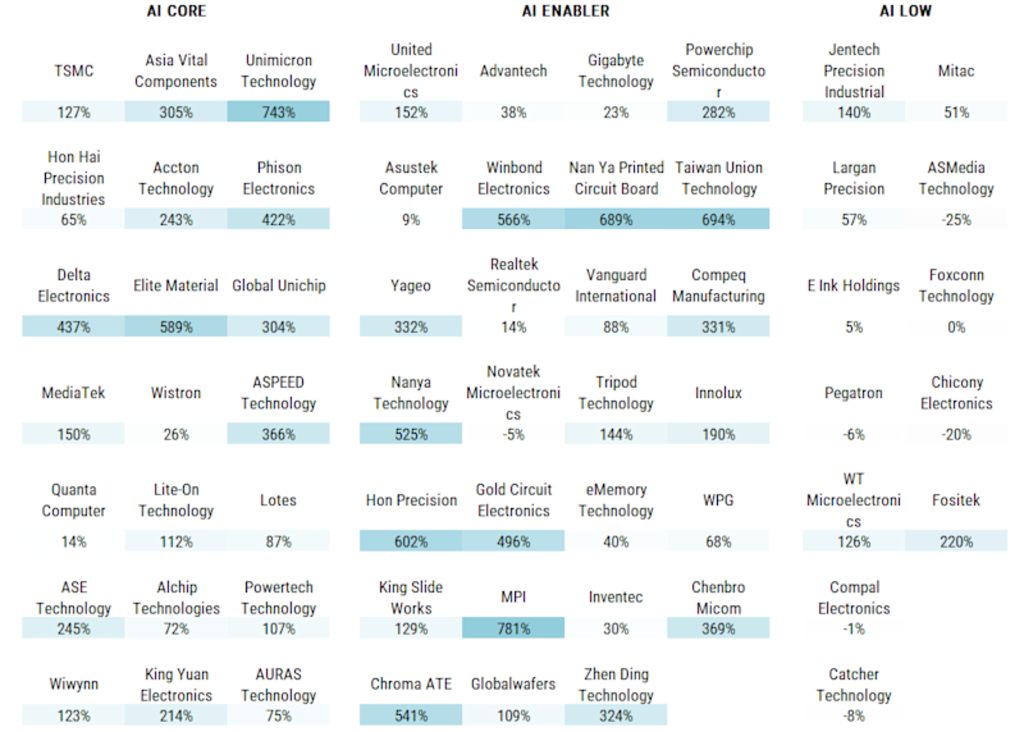
Source: Robeco analysis; Bloomberg. 12-month returns as of 19 May 2026. The companies shown in this graph are for illustrative purposes only. No inference can be made on the future development of the company. This is not a buy, sell or hold recommendation.
Why breadth still matters
The broader lesson is that Taiwan’s AI opportunity is not limited to one dominant company. It is a layered, fast-moving ecosystem in which different firms benefit from different parts of the AI infrastructure cycle.
For us quantitative investors, that breadth is important. A large universe of specialized companies creates scope to compare opportunities systematically across valuation, momentum, quality, analyst revisions and short-term signals. It also reinforces the importance of diversification. As exciting as the AI boom may be, not every AI-linked company will benefit equally, and strong recent performance does not remove the need for discipline.
This is why our EM quant strategies aim to maintain a diversified view of the opportunity set, with active overweights and underweights across the categories shown in Figure 1. The point is not to find ‘the next TSMC’, but to understand the wider ecosystem, and to assess where expectations, fundamentals and valuations still leave room for opportunity.
Footnotes
1All data as at 19 May 2026.
2Selecting the current largest 60 names on (investable) market cap creates a large hindsight bias, as well-performing stocks will enter the list because of a recent rise in the stock price. Hence, we took the investable market cap mid-period, six months ago, to establish the largest 60 names. In our EM Active strategies, as mentioned, our investment universe is much larger, typically leading to active overweights in smaller companies as well; however, these smaller companies are not part of our analysis of the top 60 Taiwanese tech stocks.
3Several AI enablers could be seen as AI Core, and several AI Low names could be classified as AI Enablers. Simply put, the Taiwanese tech ecosystem is at the heart of the AI boom.
4 For instance, some important AI names, particularly AI server builders such as Quanta, Hon Hai Precision, Wiwynn and Wistron, delivered somewhat less spectacular returns over the past 12 months, but mainly because these stocks had already enjoyed massive rallies during 2023 and 2024.
5We excluded Korean AI core names from this analysis, but adding companies such as SK Hynix (+773% over the past 12 months), Samsung (+397%), Leeno Industrial (+210%), Hanmi Semiconductors (+401%) and Wonik IPS (+480%) would of course tell a very similar story.
Quant Charts
重要事項
当資料は情報提供を目的として、ロベコ・ジャパン株式会社(以下「当社」)が独自に作成、または当社のグループ会社(Robeco Institutional Asset Management B.V.およびその関連会社を含む)から提供された資料を当社が編集・翻訳したものです。資料中の個別の金融商品の売買の勧誘や推奨等を目的とするものではありません。記載された情報は十分信頼できるものであると考えておりますが、その正確性、完全性を保証するものではありません。意見や見通しはあくまで作成日における弊社の判断に基づくものであり、今後予告なしに変更されることがあります。運用状況、市場動向、意見等は、過去の一時点あるいは過去の一定期間についてのものであり、過去の実績は将来の運用成果を保証または示唆するものではありません。また、記載された投資方針・戦略等は全ての投資家の皆様に適合するとは限りません。当資料は法律、税務、会計面での助言の提供を意図するものではありません。 ご契約に際しては、必要に応じ専門家にご相談の上、最終的なご判断はお客様ご自身でなさるようお願い致します。 運用を行う資産の評価額は、組入有価証券等の価格、金融市場の相場や金利等の変動、及び組入有価証券の発行体の財務状況による信用力等の影響を受けて変動します。また、外貨建資産に投資する場合は為替変動の影響も受けます。運用によって生じた損益は、全て投資家の皆様に帰属します。したがって投資元本や一定の運用成果が保証されているものではなく、投資元本を上回る損失を被ることがあります。弊社が行う金融商品取引業に係る手数料または報酬は、締結される契約の種類や契約資産額により異なるため、当資料において記載せず別途ご提示させて頂く場合があります。具体的な手数料または報酬の金額・計算方法につきましては弊社担当者へお問合せください。 当資料及び記載されている情報、商品に関する権利は弊社に帰属します。したがって、弊社の書面による同意なくしてその全部もしくは一部を複製またはその他の方法で配布することはご遠慮ください。 商号等: ロベコ・ジャパン株式会社 金融商品取引業者 関東財務局長(金商)第2780号 加入協会: 一般社団法人 資産運用業協会