

Reassessing regional allocations: Opportunities in emerging markets
Over the past 12 months, a shift has begun to take shape among large asset allocators, with exposure to emerging markets assets seen as increasingly attractive for long-term investors.
まとめ
- Emerging markets are central to global growth
- EM equities remain at a discount to global markets
- EM bond yields are attractive given robust macro backdrop
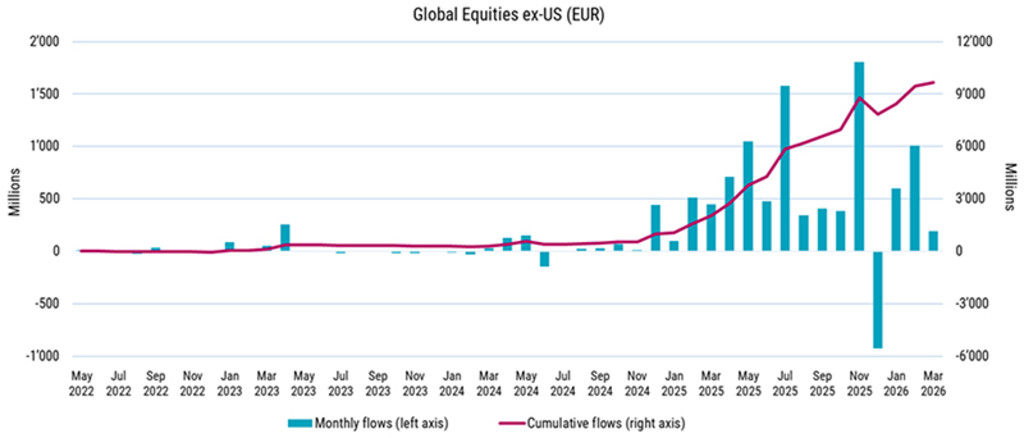
After more than a decade of US equity outperformance, investor flows are gradually rotating toward a broader opportunity set. This is not driven by a loss of confidence in the US, but the increasing attractiveness of opportunities elsewhere. Valuation gaps, rising concentration risk, and uncertainty around the sustainability of current market leadership are prompting investors to look beyond a narrow set of dominant stocks.
Global markets are becoming more diverse in their drivers of returns, with differences in policy, economic structure and sector composition creating a wider dispersion of outcomes. In this environment, where leadership is less predictable and more fragmented, alongside questions around how AI investment will be funded and how it will reshape industries, accessing a broader universe is becoming increasingly important.
Figure 1 – Equity flows are moving out of the US and across the globe

Source: Broadridge, Robeco, May 2026.
Moreover, the growing dominance of US asset managers means a significant share of global capital allocation is increasingly influenced by US-based institutions. This can reinforce home bias and crowding, leaving opportunities in other regions underexplored.1 At the same time, the architecture of the global economy is changing with emerging markets becoming central to global growth, innovation and wealth creation. Here we spotlight just a few of Robeco’s emerging market strategies which are capturing these seismic shifts on the global landscape.
Robeco Emerging Markets Equities
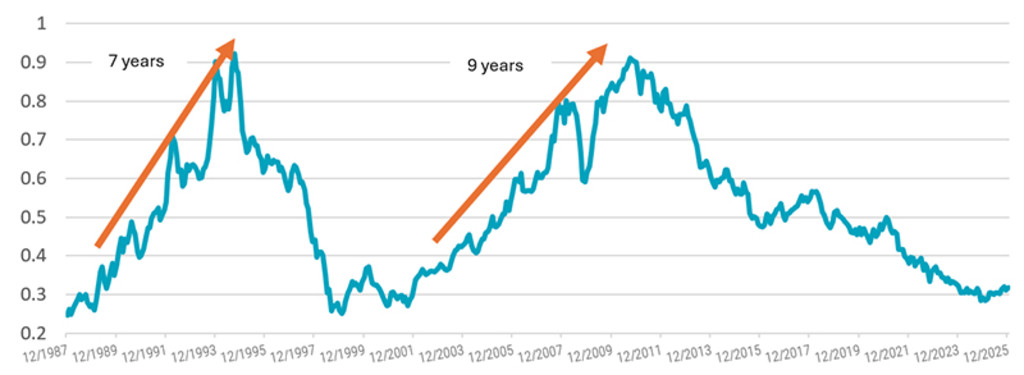
For investors seeking to diversify beyond the US, emerging markets offer a broad set of growth drivers at a significant valuation discount. In many cases, investors in equities are being paid EM type risk premiums for balance sheets and cash flow profiles that increasingly resemble those of developed markets. Robeco’s Emerging Markets Equities team believes emerging economies offer superior long-term investment opportunities compared to developed peers.
Figure 2 – EM Equities have historically enjoyed long periods of outperformance

Past performance is no guarantee of future results. The value of your investments may fluctuate.
Source: MSCI. All figures in EUR. Data end of December 2025. The ratio in the chart above divides the MSCI Emerging Markets Price Index by the MSCI World Price Index in USD. When the ratio rises, emerging markets outperform developed markets - and when it falls, developed markets outperform emerging markets. If the currency in which the past performance is displayed differs from the currency of the country in which you reside, then you should be aware that due to exchange rate fluctuations the performance shown may increase or decrease if converted into your local currency. Performance since inception is as of the first full month. Periods shorter than one year are not annualized. Returns gross of fees, based on gross asset value. Values and returns indicated here are before cost; the performance data does not take account of the commissions and costs incurred on the issue and redemption of units. These have a negative effect on the returns shown.
We offer a comprehensive range of emerging markets equities solutions including the high-conviction Emerging Stars Equities strategy, country-specific strategies and an ex-China strategy.
Robeco’s fundamental EM team focuses on selective stock picking and deep local insight to uncover long-term opportunities across this complex universe. Our disciplined investment process starts with top-down country selection and targets what we call ‘value with a future’. It enables us to harness the inefficiencies resulting from market biases in emerging markets where investors are prone to overpaying for perceived high-quality growth. Our fundamental stock selection analysis focuses on attractively valued companies with an underappreciated earnings outlook. We overlay our fundamental analysis with a quantitative model as a tool to exploit the behavioral biases of market participants such as overconfidence and herd behavior.
Robeco Emerging Markets Quant Equities
For quantitative investors, we see factor premiums in EM tend to be strong and persistent and this has underpinned our long-term investment in quantitative EM strategies. This is especially the case using our proprietary definitions, making EM a fertile ground for our disciplined, risk-managed quant strategies. Our range of strategies includes QI EM 3D Active Equities, QI EM Conservative Equities, and our new 3D Emerging Markets ETF.
EM markets tend to be less correlated with one another, offering natural diversification benefits across regions. While developed markets often move in sync, EM economies like India, Brazil, and Taiwan each respond to distinct local dynamics. Our quant strategies thrive on this dispersion, applying many small, deliberate tilts rather than large macro bets, creating opportunities for relative outperformance and cushioning volatility.
EM markets tend to be less correlated with one another… and our quant strategies thrive on this dispersion
All portfolios are carefully managed for risk, are regionally diversified, and use data-driven insights including machine learning and natural language processing tools. This enables dynamic and cost-efficient exposure to EM alpha.
Our 3D strategies integrate sustainability alongside risk and return using a proprietary framework. Portfolios dynamically seek the best trade-offs between these dimensions based on real-time conditions and set targets. This enhances long-term potential by managing ESG risks while capturing opportunities in companies driving the transition to a more sustainable future, without locking in a fixed sustainability outcome.
Robeco Emerging Markets Debt
Emerging markets are evolving into more resilient, competitive economies, shaped by financial inclusion, rising domestic wealth, and stronger intra-EM trade. Higher trend economic growth means the creditworthiness of many emerging markets2 is converging on the levels enjoyed by developed countries, while yields often remain higher, making EM bonds a compelling opportunity for investors seeking diversification.
The creditworthiness of many emerging markets is converging on the levels enjoyed by developed countries
Robeco combines a high-conviction, active investment style with in-depth, proprietary research that balances top-down macro insights with bottom-up sovereign and currency selection with both hard and local currency products. Sustainability and transition risks are fully integrated into the framework to mitigate downside risk and enhance resilience.
Top-down positioning sets the portfolio’s risk allocation across market cycles. We analyze global financial and risk conditions next to valuation and technical factors specific to EM hard currency and EM local currency debt.
This is complemented by bottom-up issuer and country selection, which assesses sovereign creditworthiness trends using our proprietary Sovereign Ratings Model, driven by both quantitative and qualitative inputs. The model evaluates key indicators of liquidity and solvency, helping us anticipate improvements or deteriorations in credit quality and in extreme cases, identify signs of severe distress or potential default.
Conclusion
Shifting part of an asset allocation from the US to emerging markets is about recognizing how the global opportunity set has evolved. EM offers a combination of higher structural growth, improved policy frameworks, attractive valuations and underowned status that is difficult to replicate elsewhere. At the same time, the risks are better understood and more appropriately priced than in past cycles, and can be managed through diversified, research-driven approaches. For long-term investors prepared to look beyond the recent past, rebalancing from the US into emerging markets is a pragmatic step toward a more forward-looking portfolio.
Footnotes
1Schoenmaker, D. (2026) Risks for Europe of US dominance of global asset management, Policy Brief 07/2026, Bruegel.
2Emerging markets face Iran shocks with more debt, and less danger – Financial Times – 15 May 2026

Is it time to diversify beyond the US?
This article is part of a three-part investment series aimed at exploring regional alternatives to US-centric growth.
重要事項
当資料は情報提供を目的として、ロベコ・ジャパン株式会社(以下「当社」)が独自に作成、または当社のグループ会社(Robeco Institutional Asset Management B.V.およびその関連会社を含む)から提供された資料を当社が編集・翻訳したものです。資料中の個別の金融商品の売買の勧誘や推奨等を目的とするものではありません。記載された情報は十分信頼できるものであると考えておりますが、その正確性、完全性を保証するものではありません。意見や見通しはあくまで作成日における弊社の判断に基づくものであり、今後予告なしに変更されることがあります。運用状況、市場動向、意見等は、過去の一時点あるいは過去の一定期間についてのものであり、過去の実績は将来の運用成果を保証または示唆するものではありません。また、記載された投資方針・戦略等は全ての投資家の皆様に適合するとは限りません。当資料は法律、税務、会計面での助言の提供を意図するものではありません。 ご契約に際しては、必要に応じ専門家にご相談の上、最終的なご判断はお客様ご自身でなさるようお願い致します。 運用を行う資産の評価額は、組入有価証券等の価格、金融市場の相場や金利等の変動、及び組入有価証券の発行体の財務状況による信用力等の影響を受けて変動します。また、外貨建資産に投資する場合は為替変動の影響も受けます。運用によって生じた損益は、全て投資家の皆様に帰属します。したがって投資元本や一定の運用成果が保証されているものではなく、投資元本を上回る損失を被ることがあります。弊社が行う金融商品取引業に係る手数料または報酬は、締結される契約の種類や契約資産額により異なるため、当資料において記載せず別途ご提示させて頂く場合があります。具体的な手数料または報酬の金額・計算方法につきましては弊社担当者へお問合せください。 当資料及び記載されている情報、商品に関する権利は弊社に帰属します。したがって、弊社の書面による同意なくしてその全部もしくは一部を複製またはその他の方法で配布することはご遠慮ください。 商号等: ロベコ・ジャパン株式会社 金融商品取引業者 関東財務局長(金商)第2780号 加入協会: 一般社団法人 資産運用業協会