
Portfolio Manager
• インサイト
How to invest in resource scarcity, AI and industrial innovation
AI, electrification and industrialization are driving structural demand while straining resources and supply chains. At the same time, innovation across materials and manufacturing is creating new opportunities. By investing across the value chain, the Smart Materials strategy seeks to benefit from supply constraints, trade shifts and industrial breakthroughs.
執筆者




Co-Portfolio Manager
まとめ
- Structural trends are converging, intensifying demand for critical minerals
- Scarcity, bottlenecks and innovation continually shift sources of growth
- Capturing value from scarcity and innovation creates a competitive edge
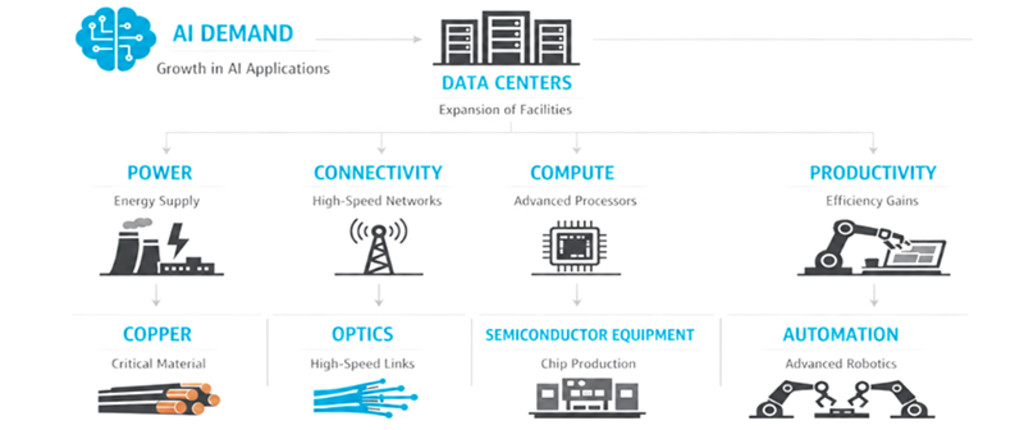
The global economy is entering a more material-intensive phase as the AI boom drives investment into data centers and digital infrastructure. These facilities require vast amounts of copper for power distribution, cabling, circuit boards and networking equipment, along with aluminum and steel for structural and electrical components. Cooling systems also rely on copper, stainless steel and other specialty alloys, while servers consume silicon semiconductors and smaller quantities of tin, silver and gold.
The sheer scale of volumes is unprecedented. Large AI hyperscaler campuses can contain up to 50,000 metric tons of copper and 200,000 metric tons of steel, roughly three to ten times the material intensity of a traditional data center.1
Figure 1 - Artificial intelligence meets ‘material’ demand
Source: Robeco
The metals behind electrification
Electrification is creating a second powerful source of materials demand. As transportation, industry and buildings shift from fossil fuels to electricity, investment is flowing into transmission lines, transformers, grid infrastructure, batteries, electric vehicles and charging networks. Basic metals like copper, aluminum and steel remain central to this buildout.
Copper wiring is critical for conducting electricity from grids to an exploding data center boom. Aluminum is increasingly used in transmission networks and electrical steel is essential for transformers and motors. Meanwhile, battery storage systems which complement renewable energy generation require substantial quantities of lithium, nickel, cobalt, graphite and manganese.
Over the long term, the energy transition should reduce resource use. Yet, ironically, building the infrastructure required to achieve it will be more material intensive. Experts project global copper demand to rise by around 50% by 2040.2 Supply, however, is projected to fall far short, creating a significant demand-supply deficit of nearly 25%.3
Figure 2 - Energy technologies are driving structural demand for critical minerals
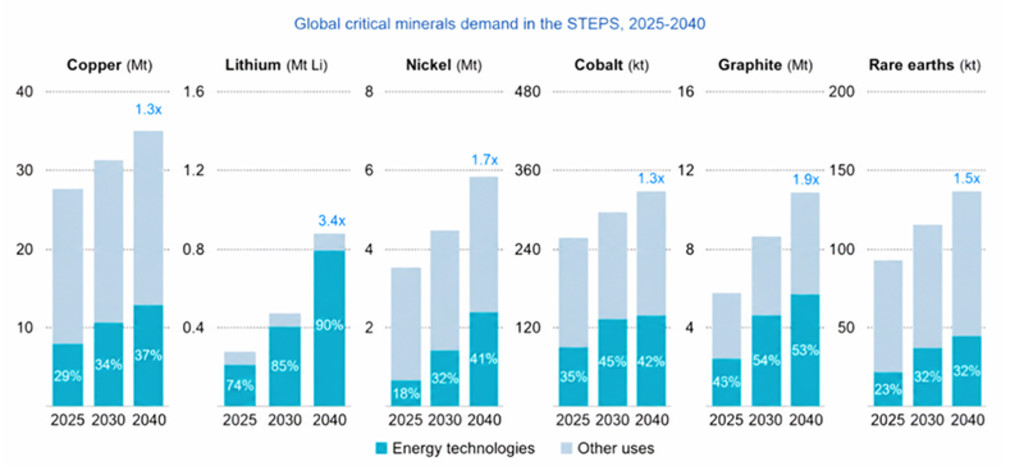
Global critical minerals demand in the IEA’s stated policy scenario (STEPS). Notes: kt = kilotonnes, Mt=million tons, STEPS = Stated Policies Scenario. The figures for copper are based on refined copper demand (excluding direct-use scrap). Rare earths refer to magnet rare earth elements only. Growth rate multiples (in blue) are between 2024-2040.
Source: Robeco, IEA, Global Critical Minerals Report, 2026.
Tiny volumes, significant impact
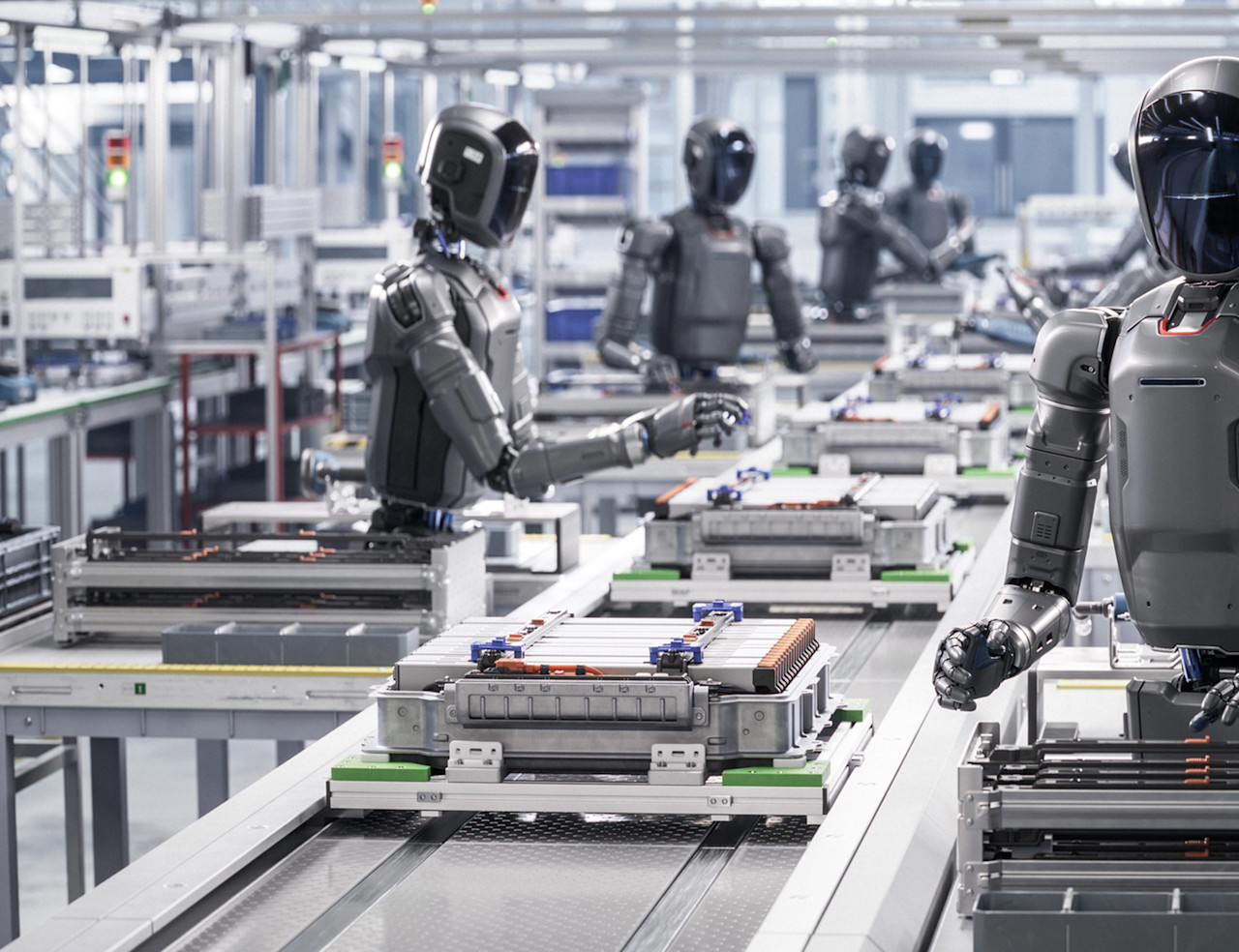
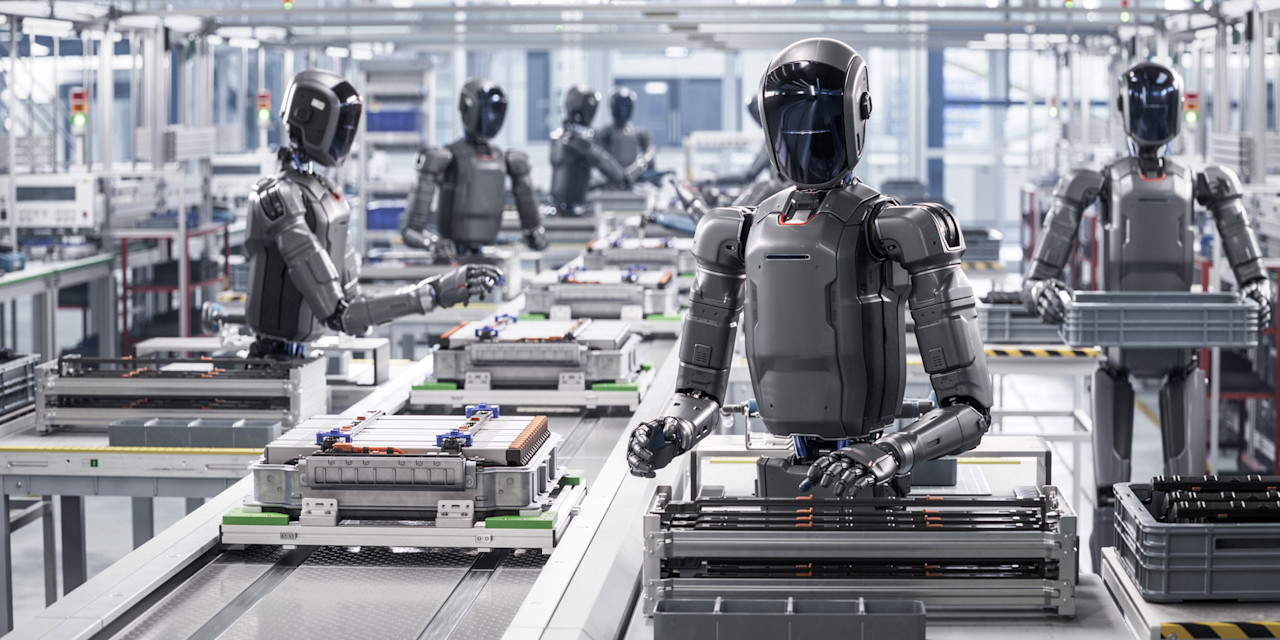
While copper, aluminum and steel account for the bulk of material volumes, a smaller group of specialty metals are stealing headlines and investor attention. Rare earth elements such as neodymium and praseodymium are essential for the high-performance permanent magnets in EVs, drones, industrial automation systems as well as humanoids – the next manufacturing revolution.
Meanwhile, strategic minerals like gallium are used in advanced power semiconductors and radio-frequency technologies, while germanium supports fiber-optic networks, infrared systems and specialized semiconductor applications. Tungsten also merits mention. Its hardness and thermal properties make it important for aerospace, defense and industrial tooling applications.
Although these materials represent only a small proportion of overall metal demand, they’re essential for many industries including national defense, which only amplifies their economic and strategic value.
More scarcity and imbalances create price swings
The consequences of scarcity and demand-supply imbalances are already visible in pricing. This year, copper and aluminum reached record highs, while steel prices have climbed 25% over the past year.4,5 In addition, lithium prices more than doubled as energy-storage demand strengthened and supply tightened. Prices for tungsten increased six-fold, and European import prices for gallium and the heavy rare earths dysprosium and terbium rose around five times relative to Chinese domestic price levels.6
Figure 3 - Copper prices hit record highs in 2026 in response to supply shortages
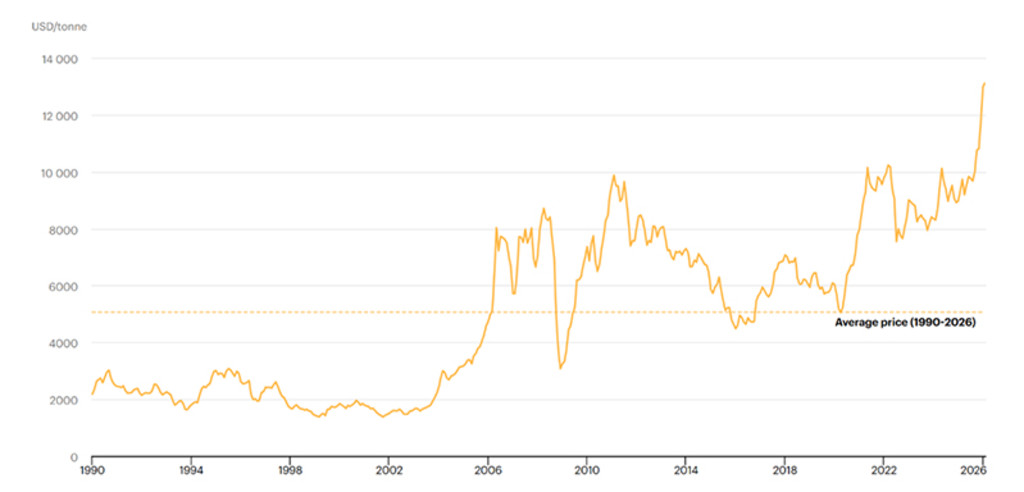
Copper monthly average price vs historic average price (1990-2026).
Source: IEA analysis based on SP Capital IQ data, 2026.
No ordinary cycle
Anyone who follows commodity price markets can attest to their highly cyclical nature. Shortages can drive up prices and stimulate additional production capacity. But they can eventually become tomorrow’s surpluses which put downward pressure on prices. What makes today’s cycles different is that demand is simultaneously surging, driven by overlapping structural drivers as far-ranging as AI and data centers, national defense and industrial policy, electrification and the energy transition.
New mines are time- and capital-intensive, taking years to permit, finance and build. And getting a mine operational is the first hurdle; finding high-quality raw materials is another. Declining ore grades mean that more rock may have to be mined, crushed and processed to produce the same quantity of metal. Supply will eventually expand but not immediately, meaning bottlenecks could mean persistently elevated prices.
Leave a bottleneck, enter a chokepoint
Even when natural production bottlenecks are resolved, chokepoints create another risk. China’s control over processing and refining means it dominates large parts of the critical mineral supply chain, and it has repeatedly applied export controls for political leverage. These have led to squeezed supplies, price surges and production delays in diverse sectors around the globe.7 The IEA estimates that if fully implemented, export controls could endanger USD 6.5 trillion in downstream production across automotive, semiconductors, aerospace, defense and energy sectors.8
For the Smart Materials strategy, this creates opportunities to invest in companies using innovative solutions to circumvent chokeholds. Those include refiners outside of China as well as companies focused on recovering and recycling scrap metal.
Figure 4 - China continues to impose export controls on strategic minerals
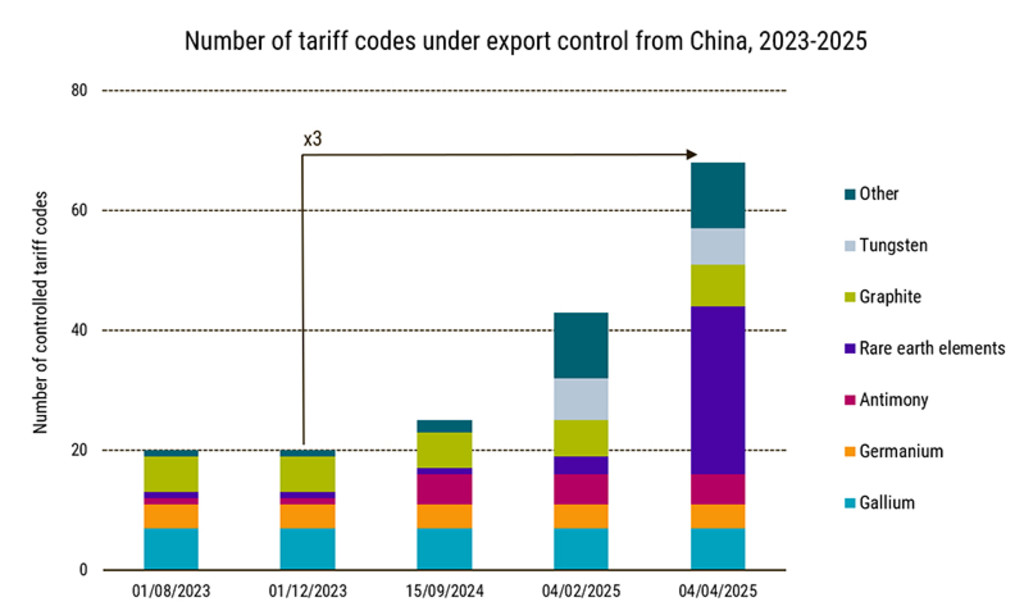
Number of tariff codes under export control from China, 2023-2025.
Source: Robeco, IEA analysis based on Chinese Customs data. IEA Global Critical Minerals Outlook, 2026.
Solutions to reduce dependence
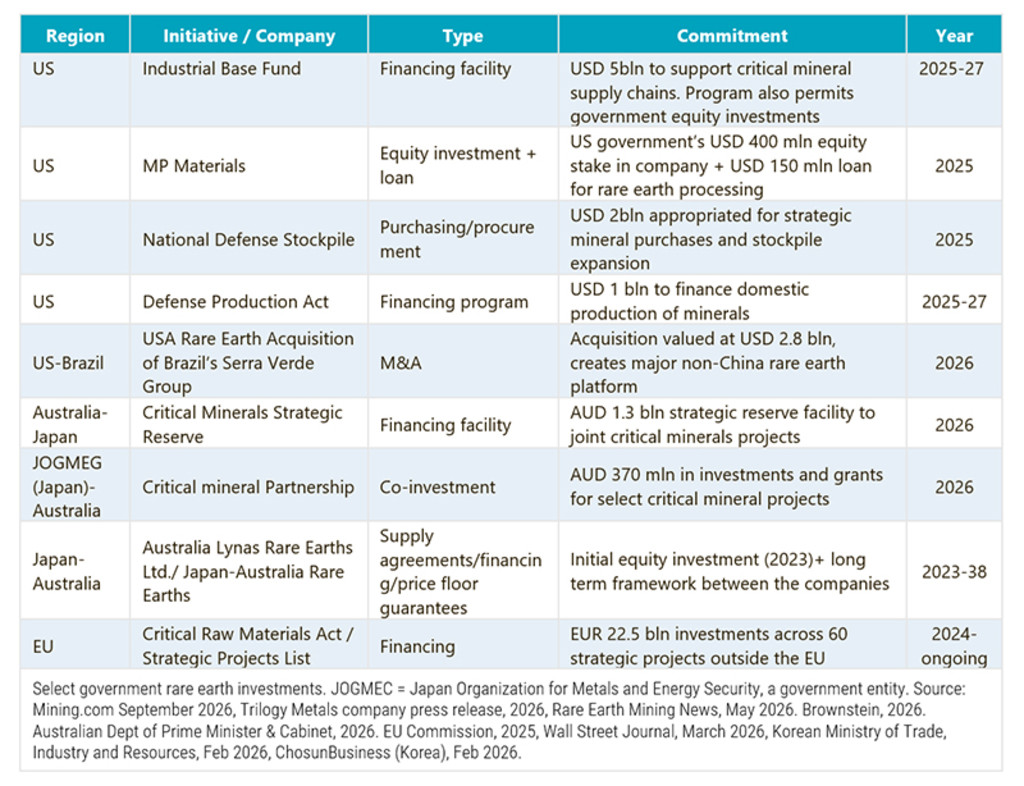
Minerals are being heralded as the new oil and governments are feverishly working to secure access to these critical resources. The EU Critical Raw Materials Act sets 2030 targets to mine 10%, process 40% and recycle 25% of the EU’s needs, while capping reliance on any single foreign supplier at 65%.
Across the Atlantic, private and public partnerships are also building. In 2025, Apple and MP Materials announced a USD 500 million deal to create a US rare-earth magnet supply chain using recycled feedstock, with the blessing of the Defense Department which has a 15% equity stake.
The Department of Energy also established the Office of Critical Minerals and Energy Innovation with several billion earmarked for FY 27 to help bolster domestic mining, refining and recycling for copper, rare-earths and allied metals.9
Table 1 – Illustrative examples of governments’ significant investments to secure and reshore strategic minerals (list is not exhaustive)
Scarcity often creates its own solutions
Higher costs encourage material substitution, recycling and greater processing efficiencies. A well-known episode is when automakers switched to platinum for catalytic converters after a period of sustained palladium deficits and high prices (2010-2020).10 More recently, major EV makers are adopting lithium-iron-phosphate batteries to reduce dependence on nickel and cobalt. And a recent price surge in silver is pushing PV manufacturers to reduce silver with more copper in solar panels. 11
And scarcity of know-how and skilled labor can create bottlenecks just as powerful as those of materials. We’ve seen this in semiconductors as chip architectures become more complex. Manufacturers increasingly rely on inspection, metrology and testing systems to improve yields and reduce waste. Meanwhile, labor shortages and supply-chain regionalization are driving investment in factory automation and warehouse robotics.
For the Smart Materials strategy, productivity-enhancing technologies are an important investment channel, as they represent another way to benefit from scarcity.
トレンド投資とは?
ニュースレター(英文)に登録して、テーマ型投資の最新動向を入手しましょう。
Investing in resource constraints, innovation and disruption
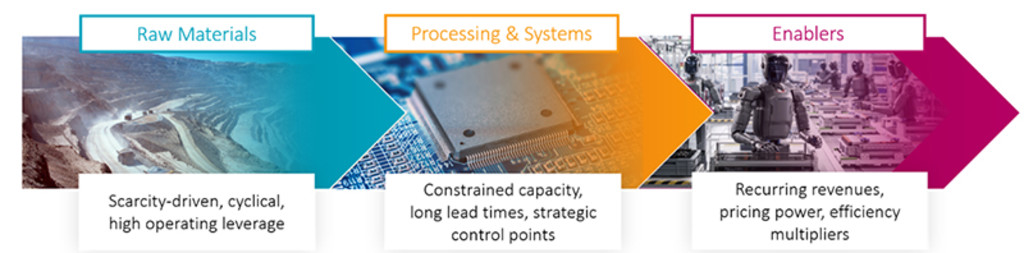
Robeco’s Smart Materials strategy is not based solely on rising demand for scarce resources or higher commodity prices; it also rests on how industries respond to scarcity. As resource constraints, bottlenecks and chokepoints emerge, capital shifts toward new supply, recycling, alternative materials and yield-enhancing technologies.
The strategy invests in a broad opportunity set, combining exposure to upstream companies supplying raw, refined, recovered and recycled materials with companies further downstream which provide specialized manufacturing equipment, software, automation systems and industrial technologies. By investing across these adjustment mechanisms, the Smart Materials strategy seeks to capture value and growth wherever it develops along the materials and manufacturing supply chain.
Figure 5 - The Smart Materials strategy invests in scarcity and innovation
Source: Robeco
Footnotes
1 Aviva Metals, ‘Data Center Copper: Meeting AI-Era Demand’, accessed September 2026.; World Economic Forum, ‘Metals at scale for AI at scale: Securing the data centre materials backbone’, December 2025.
2 S&P Global Energy & Market Intelligence, ‘Copper in the age of AI: Challenges of Electrification, January 2026.; S&P Global Press Release, ‘Substantial shortfall in Copper supply widens…’, January 2026.
3 S&P Global Energy & Market Intelligence, Copper discoveries: Expansion over addition as new discoveries lag.’ September 2026.
4 IEA, Global Critical Minerals Outlook 2026; Bloomberg, ‘Aluminum Hits $3,000 for First Time Since 2022 on Supply Concern’, January 2026.
5 Construction Dive, ‘Data centers are eating up steel…’, September 2026
6 IEA, Global Critical Minerals Outlook 2026
7 The impact of China’s new critical mineral export controls. Wood Mackenzie, October 2025.; ‘With new export controls, supply concentration risks become reality.’ IEA Commentary October 2025.
8 IEA, Global Critical Minerals Outlook, 2026.
9 US Dept. of Energy, Energy Department announces realignment of critical minerals and energy innovation programs.’ January 2026.
10 Bloomberg, ‘Carmakers May Wean Off Dependence on Palladium With Breakthrough’, March 2020.;
Asia Commodity Exchange, ‘Platinum vs. Palladium: The Battle of Precious Metals. January 2025.
11 Mining.com, ’Solar thrifting not enough to curb demand.’ June 2026
重要事項
当資料は情報提供を目的として、ロベコ・ジャパン株式会社(以下「当社」)が独自に作成、または当社のグループ会社(Robeco Institutional Asset Management B.V.およびその関連会社を含む)から提供された資料を当社が編集・翻訳したものです。資料中の個別の金融商品の売買の勧誘や推奨等を目的とするものではありません。記載された情報は十分信頼できるものであると考えておりますが、その正確性、完全性を保証するものではありません。意見や見通しはあくまで作成日における弊社の判断に基づくものであり、今後予告なしに変更されることがあります。運用状況、市場動向、意見等は、過去の一時点あるいは過去の一定期間についてのものであり、過去の実績は将来の運用成果を保証または示唆するものではありません。また、記載された投資方針・戦略等は全ての投資家の皆様に適合するとは限りません。当資料は法律、税務、会計面での助言の提供を意図するものではありません。 ご契約に際しては、必要に応じ専門家にご相談の上、最終的なご判断はお客様ご自身でなさるようお願い致します。 運用を行う資産の評価額は、組入有価証券等の価格、金融市場の相場や金利等の変動、及び組入有価証券の発行体の財務状況による信用力等の影響を受けて変動します。また、外貨建資産に投資する場合は為替変動の影響も受けます。運用によって生じた損益は、全て投資家の皆様に帰属します。したがって投資元本や一定の運用成果が保証されているものではなく、投資元本を上回る損失を被ることがあります。弊社が行う金融商品取引業に係る手数料または報酬は、締結される契約の種類や契約資産額により異なるため、当資料において記載せず別途ご提示させて頂く場合があります。具体的な手数料または報酬の金額・計算方法につきましては弊社担当者へお問合せください。 当資料及び記載されている情報、商品に関する権利は弊社に帰属します。したがって、弊社の書面による同意なくしてその全部もしくは一部を複製またはその他の方法で配布することはご遠慮ください。 商号等: ロベコ・ジャパン株式会社 金融商品取引業者 関東財務局長(金商)第2780号 加入協会: 一般社団法人 資産運用業協会