


Strategist

• インサイト
Could French bond stress change the ECB's course?
France’s fiscal and political risks are putting pressure on its government bonds We examine how wider French bond spreads could affect the ECB’s interest rate outlook and what this means for sovereign bond investors.
執筆者




Strategist

Strategist
まとめ
- Spillovers from French bond stress could delay ECB hikes
- Fed, ECB and BoJ look set to hike in December
- Fed and ECB could hike again in Q1 before peaking
Spreads have risen again recently, as the market has been giving greater attention to difficult budget negotiations and opinion polls for next spring’s presidential election. Social unrest has added to the pressure. These developments suggest that fiscal consolidation will be difficult over both shorter and longer horizons.
Debt dynamics have become even more important with rising interest expenses. If current fiscal policies persist, French debt could easily rise to 137% of GDP by 2030, a level similar to Italy’s. Interest payments alone could then reach 5% of GDP, making deficit reduction even more difficult. Rising debt levels and a lack of policies to curb fiscal deficits would put continued pressure on the credit rating and potential demand for French OATs.
When does a French problem become a European one?
The market scare in French bonds has also affected spreads for lower-rated euro-area government bonds, such as Italian BTPs and Greek government bonds. Euro government-related and corporate bonds have also experienced pressure on their spreads.
A rapid further widening in countries such as Italy and Greece would signal broader stress. Spreads on shorter-maturity bonds will be monitored closely, as will pressure on European banks’ share prices and credit spreads.
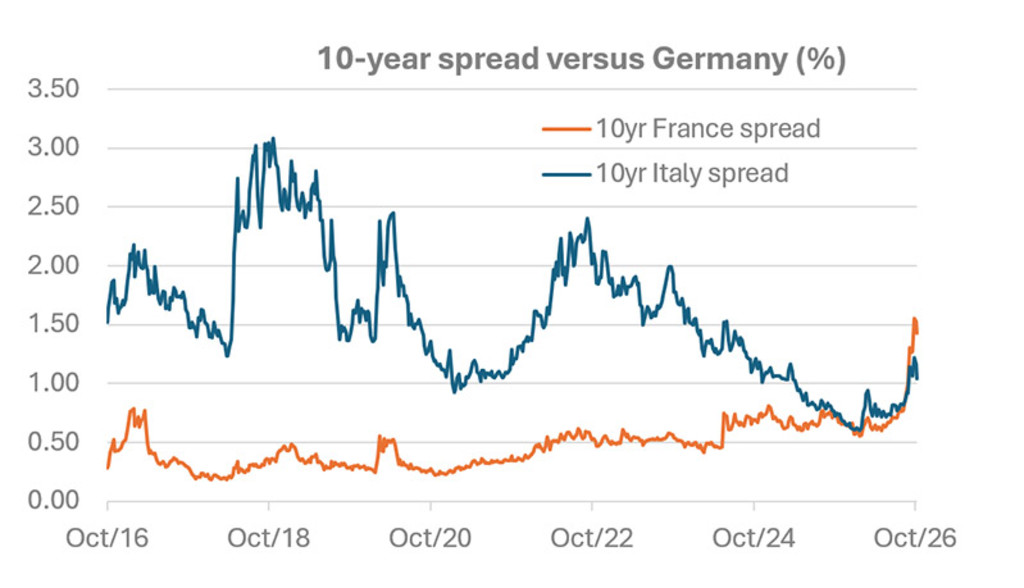
Source: Bloomberg,1 November 2026.
Could bond-market pressure change the ECB’s next moves?
Elevated energy prices underpin our expectation of ECB hikes in December and March. However, further material widening in French spreads, accompanied by spillovers, could cause hikes to be skipped.
There is probably no magic level. The speed of spread widening and its breadth outside France will play important roles. Material widening in shorter-maturity bonds can be an early sign that stress may be intensifying. Postponing further hikes could then help calm market concerns to some extent.
クレジットの最新動向は?
クレジット運用の最新情報を先取りするニュースレター(英文)に登録しましょう。
What other measures could the ECB take?
If tensions in the OAT market continue to spread to other sovereign debt markets, pressure on the ECB may increase to the point where intervention becomes unavoidable. The ECB could initially intervene verbally by reminding markets of its Transmission Protection Instrument (TPI). The instrument allows the ECB to buy bonds from eligible euro-area countries if unwarranted, disorderly market moves threaten the transmission of monetary policy across the euro area.
In our view, there should ultimately be enough flexibility in the TPI rules to allow bond purchases, including OATs. However, there is a high hurdle to activating the tool, as it could give policymakers the wrong incentives – the problem of moral hazard.
Are investors being paid enough to take French risk?
Uncertainty around the French fiscal outlook is likely to remain elevated in the coming months. While there may be room for temporary relief rallies after significant widening, the outlook going into the election will probably remain difficult for French OATs. Pressure on France’s credit rating is also likely to continue.
We will continue to trade French OATs actively.2 For now, the outlook remains challenging, but we remain open to buying French debt, depending on spread levels and political developments.
What is the team monitoring across euro-area sovereign bonds?
Some issuers have seen significant spread widening even though their credit profiles remain strong (the EU) or have improved significantly (Greece and Portugal). For France, quick approval of the 2027 budget or stronger support in opinion polls for centrist candidates with fiscal consolidation plans would be positive signals.
Footnotes
1 The following are trademarks and service marks of Bloomberg Finance L.P., a Delaware limited partnership, or its subsidiaries: BLOOMBERG, BLOOMBERG ANYWHERE, BLOOMBERG MARKETS, BLOOMBERG NEWS, BLOOMBERG PROFESSIONAL, BLOOMBERG TERMINAL and BLOOMBERG.COM: Absence of any trademark or service mark from this list does not waive Bloomberg's intellectual property rights in that name, mark or logo.
2 Specific issuers or securities are for illustrative and factual market review purposes only and do not constitute an investment recommendation or financial advice.
重要事項
当資料は情報提供を目的として、ロベコ・ジャパン株式会社(以下「当社」)が独自に作成、または当社のグループ会社(Robeco Institutional Asset Management B.V.およびその関連会社を含む)から提供された資料を当社が編集・翻訳したものです。資料中の個別の金融商品の売買の勧誘や推奨等を目的とするものではありません。記載された情報は十分信頼できるものであると考えておりますが、その正確性、完全性を保証するものではありません。意見や見通しはあくまで作成日における弊社の判断に基づくものであり、今後予告なしに変更されることがあります。運用状況、市場動向、意見等は、過去の一時点あるいは過去の一定期間についてのものであり、過去の実績は将来の運用成果を保証または示唆するものではありません。また、記載された投資方針・戦略等は全ての投資家の皆様に適合するとは限りません。当資料は法律、税務、会計面での助言の提供を意図するものではありません。 ご契約に際しては、必要に応じ専門家にご相談の上、最終的なご判断はお客様ご自身でなさるようお願い致します。 運用を行う資産の評価額は、組入有価証券等の価格、金融市場の相場や金利等の変動、及び組入有価証券の発行体の財務状況による信用力等の影響を受けて変動します。また、外貨建資産に投資する場合は為替変動の影響も受けます。運用によって生じた損益は、全て投資家の皆様に帰属します。したがって投資元本や一定の運用成果が保証されているものではなく、投資元本を上回る損失を被ることがあります。弊社が行う金融商品取引業に係る手数料または報酬は、締結される契約の種類や契約資産額により異なるため、当資料において記載せず別途ご提示させて頂く場合があります。具体的な手数料または報酬の金額・計算方法につきましては弊社担当者へお問合せください。 当資料及び記載されている情報、商品に関する権利は弊社に帰属します。したがって、弊社の書面による同意なくしてその全部もしくは一部を複製またはその他の方法で配布することはご遠慮ください。 商号等: ロベコ・ジャパン株式会社 金融商品取引業者 関東財務局長(金商)第2780号 加入協会: 一般社団法人 資産運用業協会


