

Head of Multi Asset & Equity Solutions, Co-Head Investment Solutions


• 月次アウトルック
Why equities can still thrive as bond yields rise
Rising government bond yields have led some investors to question whether they should still be taking risks in equities – but corporate earnings are still a superpower for stocks, says multi-asset investor Colin Graham.
執筆者

まとめ
- US AAA-rated benchmark Treasuries now offer a yield above 5%
- Equities can still march on due to strong underlying corporate earnings
- Comparisons with 2022 do not apply so long as inflation remains contained
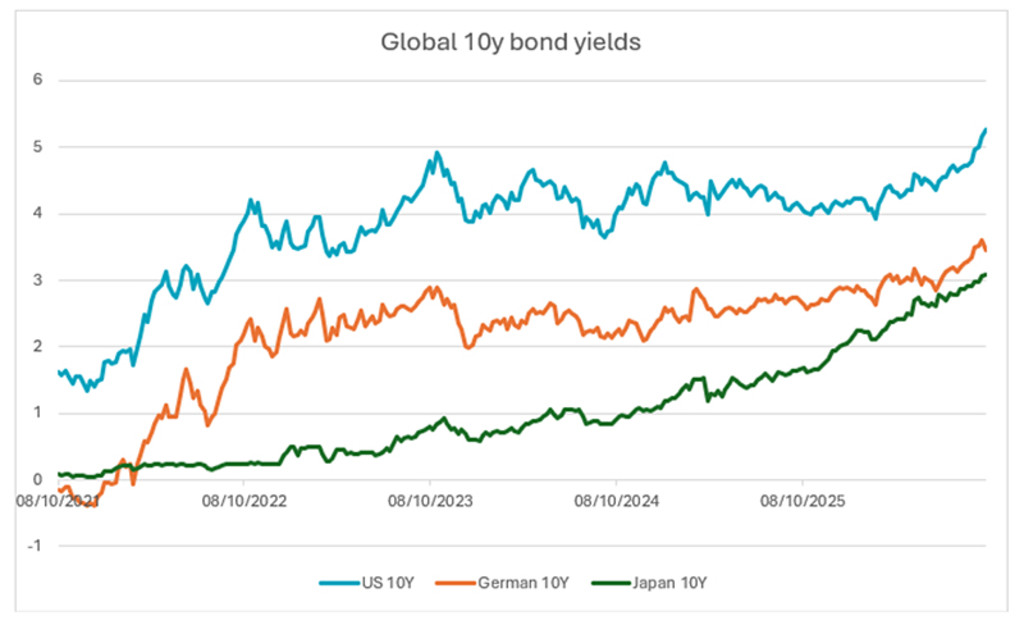
Yields in major sovereign markets such as the US and France have risen as high as 5.26%,1their most generous returns since bonds were spooked by rampant inflation following the post-Covid spending boom in 2022, and Russia’s invasion of Ukraine.
With yields that high from AAA-rated government debt, it begs the question of why investors should risk losing capital in stock markets which are seen as being at highs, fueled by an AI boom that may be unsustainable. Not so, says Graham, Head of Multi-Asset at Robeco.
“For years, investors enjoyed an easy tune – bonds offered paltry returns, leaving stocks as the only game in town, in the famous TINA mindset: ‘There Is No Alternative’. But lately, a new, seductive melody has echoed from the bond market.”
Why risk your hard-earned money in the stock market when you can get a guaranteed 5% risk-free?
“With 10-year Treasury yields hovering around a striking 5.26%, safe government bonds are whispering to investors: ‘Why risk your hard-earned money in the stock market when you can get a guaranteed 5% risk-free?’”
“This is the classic ‘Siren call’ of higher bond yields. In Greek mythology, sailors lashed themselves to masts to resist the fatal call of the Sirens, creatures with the head of a woman and the body of a bird who use enchanting music to lure seafarers to a watery grave. Today, investors are left wondering: Can our stock portfolios sail safely past this temptation, or are we heading for the rocks?”
Figure 1: How bond yields have risen in the US, Germany and Japan
Past performance is no guarantee of future results. The value of your investments may fluctuate.
Source: Robeco, Bloomberg, October 2026.
It’s different from 2022
The reality is different though, thanks to strong corporate earnings that lie behind the continuing stock market rally, and no repeat of the inflation expectations that derailed the bond market in 2022, Graham says.
“A 5% yield certainly isn't a Siren call death sentence for the stock market,” he says. “When bond yields spike, Wall Street’s traditional playbook says that stocks must crash. Higher yields mean higher borrowing costs and a higher discount rate on future profits, which mathematically shrinks stock valuations.”
“However, advanced modeling such as discounted cash flow analysis reveals a fascinating plot twist: a 100-basis-point (one full percentage point) rise in borrowing costs does surprisingly little direct damage to most major stock markets, though it can have a dramatic effect on small-cap indices. It took 200 bps of rate rises to create the environment of the 1987 crash when stocks dropped by 25%.”
“The real danger isn't just the math of debt; it's competition for capital. If safe AAA-rated bonds pay 5% to 6%, investors demand a higher equity risk premium to justify holding volatile stocks. If that required return creeps up even a little bit, it can compress stock price multiples – unless corporate earnings grow fast enough to foot the bill. Most investors will agree that 100 bps rise in bond yields does little to close the gap with earnings growth.”
Inflation is structurally different
Graham says it is also important to distinguish between what happened the last time yields spiked in 2022, and the market’s dynamics today.
“If the 2022 inflation shock still gives you nightmares, take a deep breath,” he says. “We emphasize that today’s inflation is structurally very different from 2022.”
“Firstly, the demand shock is gone: the wild, post-Covid spending spree and massive fiscal stimulus that fueled 2022's inflation scare have faded. Today’s inflation is primarily driven by supply pressures, such as the Middle East conflict, not runaway consumer demand.”
This can be seen in recent figures for both wage and price inflation. The Atlanta Fed Wage Growth Tracker has fallen to 4.1% in August 2026 compared with 6.7% four years earlier, while the core Consumer Price Index (excluding more volatile food and energy) was 2.4% – its lowest level since the pandemic. Headline inflation is higher at 3.4% due to higher energy costs.
The superpower saving equities
Meanwhile the superpower that enables stocks to stay afloat, and remain attractive despite the lure of higher yields, is simple – corporate earnings are putting up “epic numbers”, Graham says.
“Historically, a massive surge in bond yields came alongside sluggish corporate performance,” he says. “Today, however, US trailing earnings are growing at a robust 28% year-on-year. In short, the sheer horsepower of corporate earnings is overwhelming the gravity of higher discount rates.”
Robeco’s recent Expected Returns five-year outlook predicts that developed and emerging market equities will continue to deliver the highest returns in the coming years.2 Developed market stocks are seen returning 7.0% a year in annualized terms in euros, significantly outpacing the 3.25% that domestic government bonds are predicted to deliver, despite the recent spike.
The Sirens’ sea may be choppier
Graham says it means equities can keep marching higher, so long as inflation expectations don’t shoot up, which means wage pressures need to remain well-contained, and earnings growth needs to outpace the rising cost of capital.
“In all, the sea may be a bit choppier with 5% bond yields on the map, and there is room in a high-growth risk profile to increase bond allocation. However, with strong corporate earnings driving the ship, for now equities still have a clear path forward.”
Footnotes
1 Past performance is no guarantee of future results. The value of your investments may fluctuate.
2 Expected performance is no guarantee of future results. The value of your investments may fluctuate. The scenarios presented are an estimate of future performance based on evidence from the past on how the value of this investment varies, and/or current market conditions and are not an exact indicator. What you will get will vary depending on how the market performs and how long you keep the investment/product.
最新のインサイトを受け取る
投資に関する最新情報や専門家の分析を盛り込んだニュースレター(英文)を定期的にお届けします。
重要事項
当資料は情報提供を目的として、ロベコ・ジャパン株式会社(以下「当社」)が独自に作成、または当社のグループ会社(Robeco Institutional Asset Management B.V.およびその関連会社を含む)から提供された資料を当社が編集・翻訳したものです。資料中の個別の金融商品の売買の勧誘や推奨等を目的とするものではありません。記載された情報は十分信頼できるものであると考えておりますが、その正確性、完全性を保証するものではありません。意見や見通しはあくまで作成日における弊社の判断に基づくものであり、今後予告なしに変更されることがあります。運用状況、市場動向、意見等は、過去の一時点あるいは過去の一定期間についてのものであり、過去の実績は将来の運用成果を保証または示唆するものではありません。また、記載された投資方針・戦略等は全ての投資家の皆様に適合するとは限りません。当資料は法律、税務、会計面での助言の提供を意図するものではありません。 ご契約に際しては、必要に応じ専門家にご相談の上、最終的なご判断はお客様ご自身でなさるようお願い致します。 運用を行う資産の評価額は、組入有価証券等の価格、金融市場の相場や金利等の変動、及び組入有価証券の発行体の財務状況による信用力等の影響を受けて変動します。また、外貨建資産に投資する場合は為替変動の影響も受けます。運用によって生じた損益は、全て投資家の皆様に帰属します。したがって投資元本や一定の運用成果が保証されているものではなく、投資元本を上回る損失を被ることがあります。弊社が行う金融商品取引業に係る手数料または報酬は、締結される契約の種類や契約資産額により異なるため、当資料において記載せず別途ご提示させて頂く場合があります。具体的な手数料または報酬の金額・計算方法につきましては弊社担当者へお問合せください。 当資料及び記載されている情報、商品に関する権利は弊社に帰属します。したがって、弊社の書面による同意なくしてその全部もしくは一部を複製またはその他の方法で配布することはご遠慮ください。 商号等: ロベコ・ジャパン株式会社 金融商品取引業者 関東財務局長(金商)第2780号 加入協会: 一般社団法人 資産運用業協会