

Portfolio Manager


• 月次アウトルック
Why markets are watching rising defense spending
Higher defense spending will be closely watched by markets for its impacts on government budgets and across asset classes, says multi-asset investor Aliki Rouffiac.
執筆者

まとめ
- Wars in Ukraine and Iran put focus on the high cost of security independence
- Rising budget deficits will have repercussions for sovereign bonds and rates
- Equity markets in sectors such as cybersecurity and rare earths can benefit
As the cost of security independence in the West starts to run into the trillions, investors will be wary of their repercussions for budget deficits and future interest rate policy, putting a focus on future sovereign bond values, says Rouffiac, Portfolio Manager with Robeco’s Investor Solutions multi-asset team.
Many stock markets sectors can though continue to benefit, such as cybersecurity and rare earths, following a strong rise in the stocks of defense-related manufacturing companies in the past year, she says.
“After a year of tariff wars, geopolitical risks have risen again, as the start of the US-Iran war in February accelerated the focus back toward defense,” she says. “The great reset that is taking place has meant that countries are already adapting to numerous evolving trends.”
“Security independence remains high on the agenda, and more resilient supply chains are needed to navigate an uncertain economic landscape. Deglobalization and reshoring are reshaping the capacity potential of the manufacturing sector, which is absorbing this higher spending.”
“Against this evolving backdrop, military spending by European allies and Canada (based on the NATO defense spending tracker) has outpaced previous expectations, increasing by 20% in 2025. Defense spending pressure is now one of the top ten fiscal risks identified for advanced economies, seen as a problem in 24% of countries.”
Figure 1: Top fiscal risks identified in advanced economies (percentage of countries)
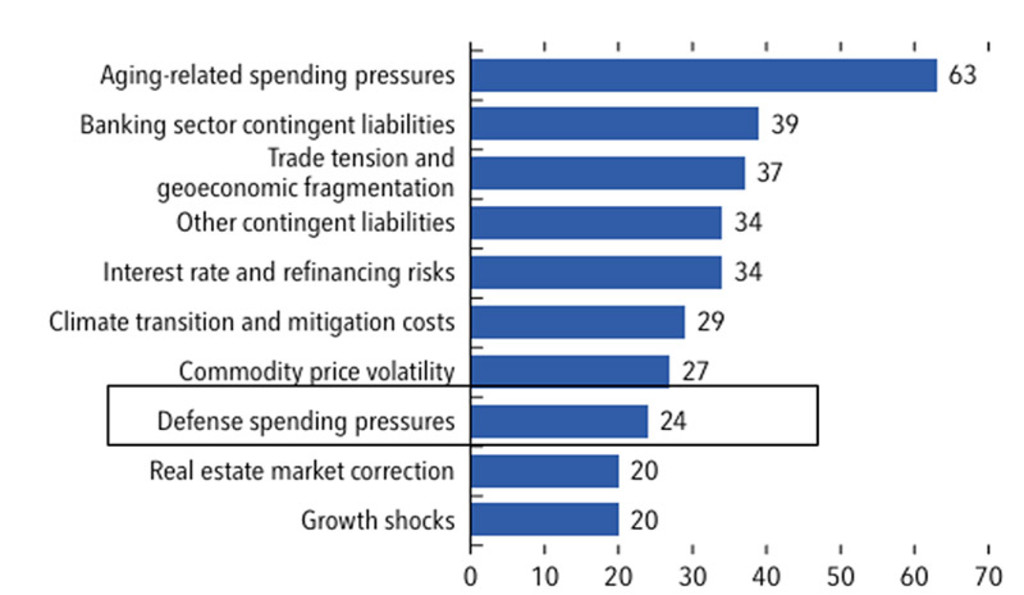
Source: IMF Fiscal Monitor April 2026. IMF staff calculations are based on data from 32 IMF staff reports on advanced economies published in 2025 using the Fiscal Monitor AI Analyst, a custom large-language-model pipeline.
Much of the likely impact is country-specific, given that nations in eastern Europe closer to the border with Russia are spending far more than their counterparts further west, relative to GDP. Countries with a relatively strong domestic defense industry like France and the UK also tend to spend more.
“Notably, the fiscal expansion needed to accommodate higher spending is unlikely to be transitory in Europe, where defense expenditures tend to be rigid,” Rouffiac says. “For now, the activation of national escape clauses has provided some leeway to European countries to circumvent fiscal rules constraints, but the potential remains for structural increases in debt levels if the spending is not offset by other policies.”
In the US, estimates for the cost of the war in Iran so far have been in the region of USD 30 billion and counting, while its latest proposed defense budget for 2027 is USD 1.5 trillion, which is higher than the GDP of most European economies.
Figure 2: The costs of the war in Iran are rising at a time when deficits are already high
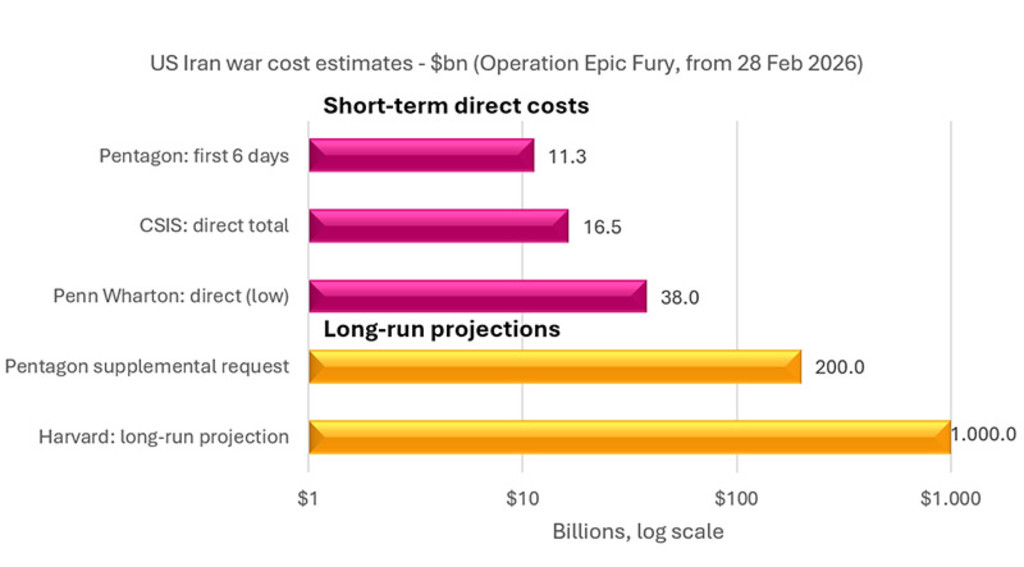
Source: Pentagon, CSIS, Penn Wharton, Harvard, May 2026.
Implications for rates
“This level of spending constitutes an uplift from the previous years’ projections and increases the uncertainty around the future levels of deficit, which is likely not factored into current interest rates,” Rouffiac warns.
“Higher spending will have implications for inflation and rates expectations, where investors are likely to differentiate between countries that run higher fiscal deficits and those that don’t. In the same vein, the recent oil shock has added a headwind, though this may be seen as short-lived and transitory under a peace deal scenario.”
“In the meantime, the risk of higher-for-longer rates has supported higher premiums in government bonds, particularly for countries that are energy importers. This has brought to the fore an additional burden to government budgets, at a time when fiscal expansion is needed to support higher defense spending goals.”
最新のインサイトを受け取る
投資に関する最新情報や専門家の分析を盛り込んだニュースレター(英文)を定期的にお届けします。
Boost for manufacturing
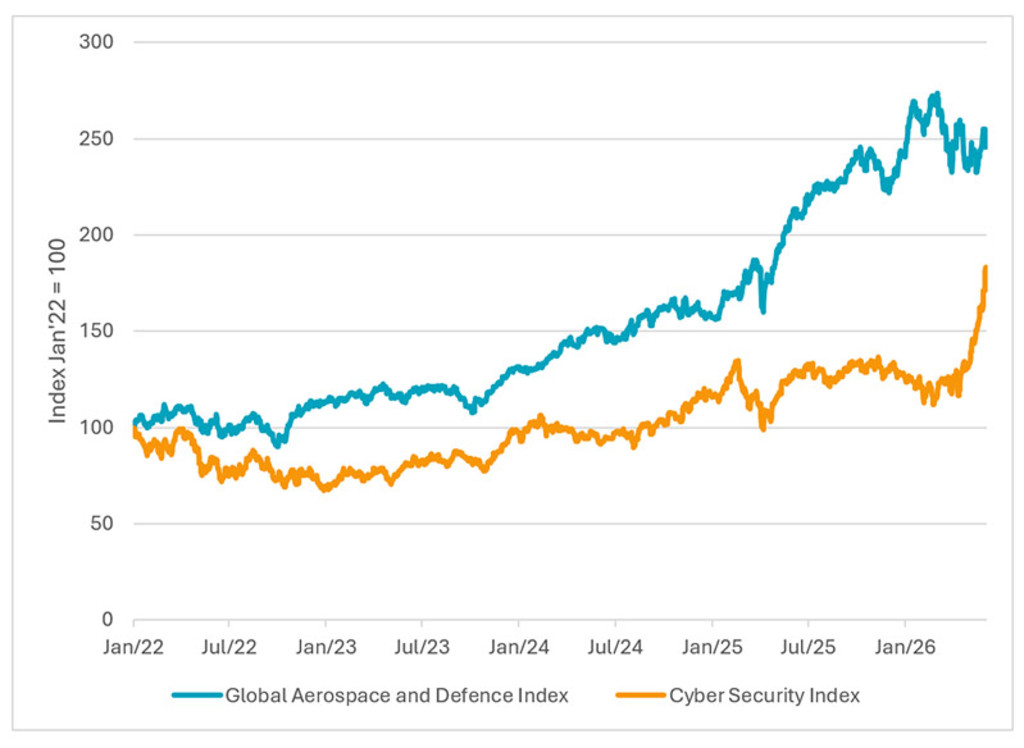
One of the beneficiaries of higher spending has been manufacturing, which has the potential to support future growth in the labour market across Europe and has led to a rally in aerospace and defense stocks since the start of 2025. Future growth areas can be seen in cybersecurity, critical minerals and rare earths, and energy self-sufficiency, Rouffiac says.
“More efficient and faster procurement processes – particularly in Europe – and innovations are needed to support higher demand and the modernization of the defense ecosystem,” she says.
“As such, tech innovation and private capital will be crucial in areas like artificial intelligence, quantum technologies and next-generation communication networks, that NATO has identified as having the greatest potential in transforming the future of warfare, in which cybersecurity takes a center stage.”
“Markets are already factoring in this trend, with the global cybersecurity stock index up 36% since the beginning of the year. On the other hand, global aerospace and defense equity returns have been muted after a very strong 2025, which saw them delivering performance in excess of 50%. Still, earnings growth projections continue to be supportive, despite higher valuations.”
Figure 3: Cybersecurity stocks have reaped the benefits
Past performance is no guarantee of future results. The value of your investments may fluctuate.
Source: Robeco, Bloomberg. Data as at June 2026.
Another beneficiary has been rare earth metals, due to their use in advanced defense systems, which has boosted their prices.
“But as we wrote on our previous theme, ‘Energy self-sufficiency in the age of shocks’, greater reliance on critical mineral sourcing and infrastructure expands the concept of security, and requires supply chain diversification to support future growth and investment opportunities,” Rouffiac concludes.
重要事項
当資料は情報提供を目的として、ロベコ・ジャパン株式会社(以下「当社」)が独自に作成、または当社のグループ会社(Robeco Institutional Asset Management B.V.およびその関連会社を含む)から提供された資料を当社が編集・翻訳したものです。資料中の個別の金融商品の売買の勧誘や推奨等を目的とするものではありません。記載された情報は十分信頼できるものであると考えておりますが、その正確性、完全性を保証するものではありません。意見や見通しはあくまで作成日における弊社の判断に基づくものであり、今後予告なしに変更されることがあります。運用状況、市場動向、意見等は、過去の一時点あるいは過去の一定期間についてのものであり、過去の実績は将来の運用成果を保証または示唆するものではありません。また、記載された投資方針・戦略等は全ての投資家の皆様に適合するとは限りません。当資料は法律、税務、会計面での助言の提供を意図するものではありません。 ご契約に際しては、必要に応じ専門家にご相談の上、最終的なご判断はお客様ご自身でなさるようお願い致します。 運用を行う資産の評価額は、組入有価証券等の価格、金融市場の相場や金利等の変動、及び組入有価証券の発行体の財務状況による信用力等の影響を受けて変動します。また、外貨建資産に投資する場合は為替変動の影響も受けます。運用によって生じた損益は、全て投資家の皆様に帰属します。したがって投資元本や一定の運用成果が保証されているものではなく、投資元本を上回る損失を被ることがあります。弊社が行う金融商品取引業に係る手数料または報酬は、締結される契約の種類や契約資産額により異なるため、当資料において記載せず別途ご提示させて頂く場合があります。具体的な手数料または報酬の金額・計算方法につきましては弊社担当者へお問合せください。 当資料及び記載されている情報、商品に関する権利は弊社に帰属します。したがって、弊社の書面による同意なくしてその全部もしくは一部を複製またはその他の方法で配布することはご遠慮ください。 商号等: ロベコ・ジャパン株式会社 金融商品取引業者 関東財務局長(金商)第2780号 加入協会: 一般社団法人 資産運用業協会