
Head of SI Thought Leadership and Climate & Biodiversity Strategist
• インサイト
Energy security and AI are accelerating the renewable energy transition
Investment in renewable energy is likely to get a boost from both heightened energy security concerns and the rise of artificial intelligence (AI), the Robeco Global Climate Investing Survey shows.
執筆者



まとめ
- Three-quarters of investors think the Middle East conflict will accelerate the transition
- Over half think AI will support renewable energy and sustainable infrastructure
- Most expect the transition to continue despite backlash against net zero
Enthusiasm for climate mitigation solutions such as solar power, grids and storage remains strong, even as governments are backtracking on net-zero commitments and reducing subsidy support. Investors continue to see investing in such solutions as a cornerstone for advancing their climate strategy, underpinned by energy security and AI as additional drivers, according to the sixth annual survey of 300 investors from across Europe, Asia-Pacific (APAC) and North America.
For the first time, the survey asked how the conflict in the Middle East and the disruption to energy supplies caused by the closure of the crucial Strait of Hormuz could impact the transition to renewable energy sources.
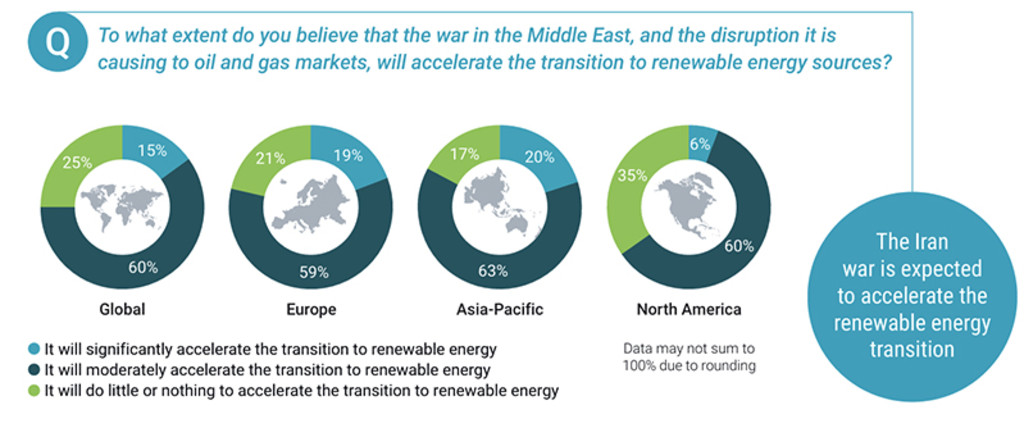
Globally, 75% thought the conflict will moderately or significantly accelerate the transition, rising to 78% in Europe and 83% in APAC, but falling to 66% in North America. Most respondents are in the ‘moderately accelerate’ bucket, while a quarter globally expected little or no acceleration.
The regional difference may partly reflect exposure to Gulf oil and gas supplies. Europe and APAC are more dependent on these imports, whereas the US is the world’s largest producer of crude oil and natural gas.1 Canada ranks fourth for oil production and fifth for natural gas. 2
Figure 1: How will the Middle East conflict accelerate the transition?
Source: Robeco Global Climate Investing Survey 2026
“The survey highlights that investors increasingly view renewable energy not only as a climate solution but also as an energy security solution,” says Lucian Peppelenbos, Climate and Biodiversity Strategist at Robeco. “Recent geopolitical tensions have reinforced the strategic value of domestic renewable power and reduced dependence on imported fossil fuels.”
“The implications extend beyond short-term energy price volatility. If governments and companies place greater value on energy resilience, investment may increasingly be directed toward domestic renewable generation, storage, electricity networks and electrification technologies.”
“The opportunity set therefore goes beyond renewable developers to the equipment, infrastructure and services needed to build a more secure power system.”
Benefits of AI
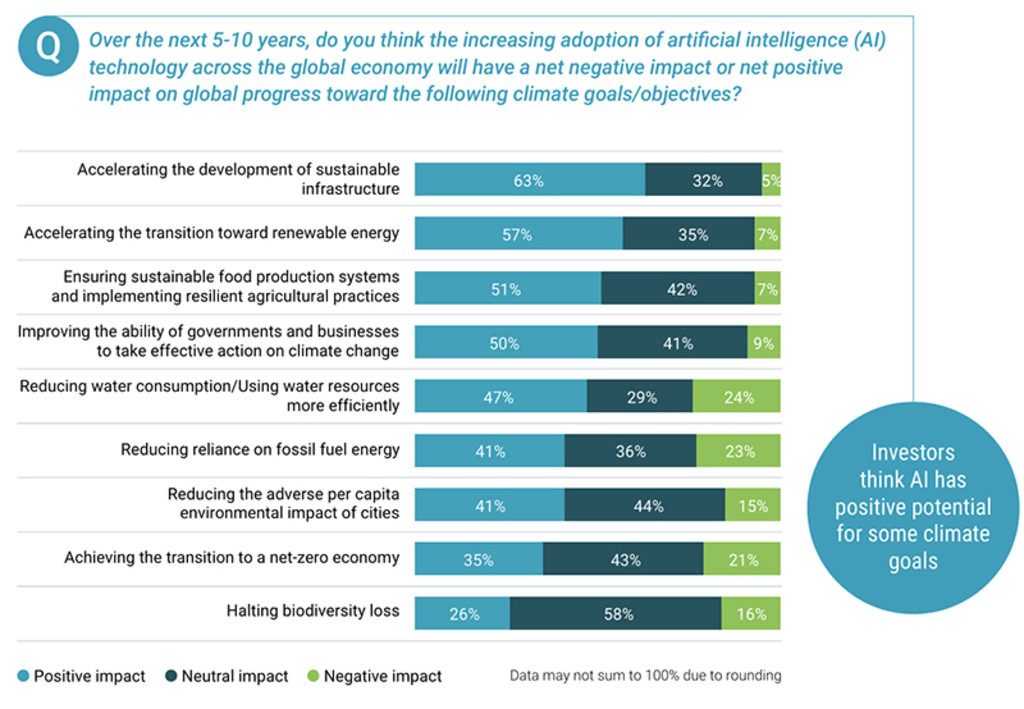
A second new question examined whether investors were more positive about the benefits of AI than its drawbacks. Globally, 57% said it would have a positive impact on accelerating the transition toward renewable energy, while a higher proportion of 63% thought it would accelerate the development of sustainable infrastructure.
AI can work out the maximum efficiencies of wind turbines and solar panels, optimize the building of other renewable sources such as hydroelectric and tidal power, and predict variations in peak power demand and supply. Applying AI-based management could unlock up to 175 gigawatts (GW) of additional transmission capacity without building a single new physical line, according to the International Energy Agency. 3
Figure 2: How will AI impact climate goals?
Source: Robeco Global Climate Investing Survey 2026
Investors nevertheless recognize the environmental cost of expanding data centre capacity. Data centres are heavy users of electricity for power and water for cooling, now accounting for 1.5% of global electricity demand and 0.5% of CO2 emissions, according to CarbonBrief. 4
Only 47% of respondents expected AI to reduce water consumption or improve water use, while 24% expected a negative effect. Views were also mixed on reducing reliance on fossil fuels (41% positive, 23% negative) and achieving net zero (35% positive, 21% negative).
“AI is affecting the transition in two directions,” Peppelenbos says. “On the one hand, it increases demand for electricity and infrastructure, while on the other, it can improve the efficiency of renewable energy systems and electricity networks. While recognizing the emission increase in the short term, it seems that investors see both effects ultimately supporting the long-term transition.”
最新のインサイトを受け取る
投資に関する最新情報や専門家の分析を盛り込んだニュースレター(英文)を定期的にお届けします。
Continuing with net zero
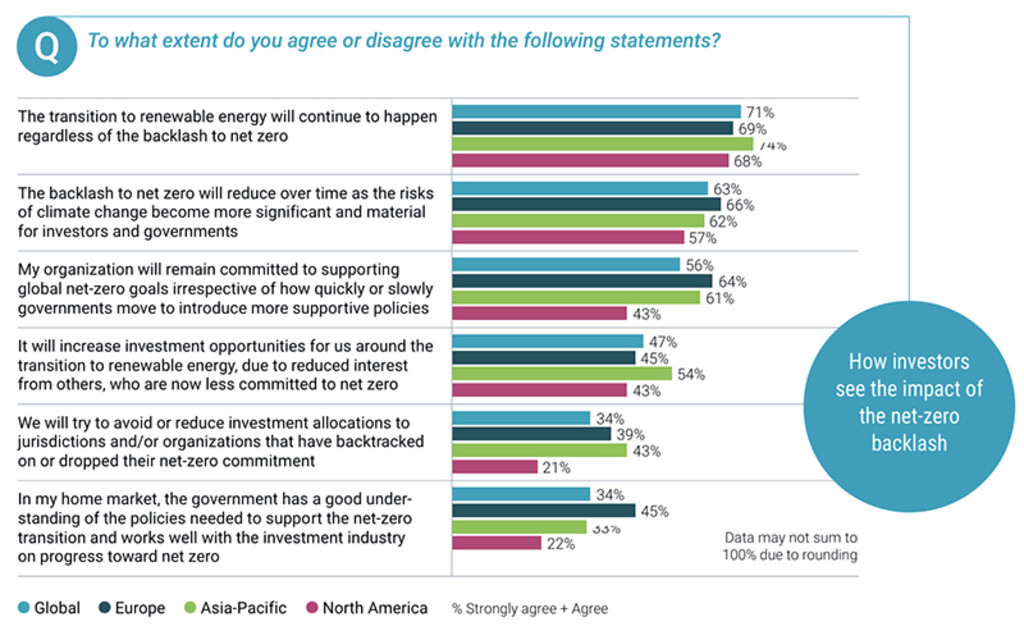
The survey also asked whether political and populist backlash against net-zero emissions could slow the transition. A majority of investors remained confident that renewable energy adoption would continue regardless of that backlash.
Globally, 71% thought that the transition will continue, rising to 74% in APAC, but dropping slightly to 69% in Europe and 68% in North America. In addition, 63% globally believed opposition to net zero would reduce over time as climate risks became more significant and material for investors and governments. This view was shared by 66% in Europe, 62% in APAC and 57% in North America.
Figure 3: Views on the transition to renewables
Source: Robeco Global Climate Investing Survey 2026
“What stands out from this year’s survey is the resilience of investor conviction,” Peppelenbos says. “Despite political debates around net zero, most institutional investors continue to see climate change as a critical factor shaping the long-term economic transition and associated investment risks and opportunities.”
Footnotes
1 https://www.eia.gov/todayinenergy/detail.php?id=67844
2 https://www.capp.ca/en/oil-natural-gas-you/oil-natural-gas-canada/
3 https://www.renewableinstitute.org/how-ai-is-making-renewable-energy-smarter/
4 https://www.carbonbrief.org/ai-five-charts-that-put-data-centre-energy-use-and-emissions-into-context

Global Climate Investing Survey 2026
Investors commit to net zero goals amid energy security and climate risks
重要事項
当資料は情報提供を目的として、ロベコ・ジャパン株式会社(以下「当社」)が独自に作成、または当社のグループ会社(Robeco Institutional Asset Management B.V.およびその関連会社を含む)から提供された資料を当社が編集・翻訳したものです。資料中の個別の金融商品の売買の勧誘や推奨等を目的とするものではありません。記載された情報は十分信頼できるものであると考えておりますが、その正確性、完全性を保証するものではありません。意見や見通しはあくまで作成日における弊社の判断に基づくものであり、今後予告なしに変更されることがあります。運用状況、市場動向、意見等は、過去の一時点あるいは過去の一定期間についてのものであり、過去の実績は将来の運用成果を保証または示唆するものではありません。また、記載された投資方針・戦略等は全ての投資家の皆様に適合するとは限りません。当資料は法律、税務、会計面での助言の提供を意図するものではありません。 ご契約に際しては、必要に応じ専門家にご相談の上、最終的なご判断はお客様ご自身でなさるようお願い致します。 運用を行う資産の評価額は、組入有価証券等の価格、金融市場の相場や金利等の変動、及び組入有価証券の発行体の財務状況による信用力等の影響を受けて変動します。また、外貨建資産に投資する場合は為替変動の影響も受けます。運用によって生じた損益は、全て投資家の皆様に帰属します。したがって投資元本や一定の運用成果が保証されているものではなく、投資元本を上回る損失を被ることがあります。弊社が行う金融商品取引業に係る手数料または報酬は、締結される契約の種類や契約資産額により異なるため、当資料において記載せず別途ご提示させて頂く場合があります。具体的な手数料または報酬の金額・計算方法につきましては弊社担当者へお問合せください。 当資料及び記載されている情報、商品に関する権利は弊社に帰属します。したがって、弊社の書面による同意なくしてその全部もしくは一部を複製またはその他の方法で配布することはご遠慮ください。 商号等: ロベコ・ジャパン株式会社 金融商品取引業者 関東財務局長(金商)第2780号 加入協会: 一般社団法人 資産運用業協会