

Global Head of Thematic Investing

• 市場觀點
How strategic autonomy is reshaping thematic investing
The drive to secure energy, critical minerals and strategic technologies is reshaping industrial policy and capital allocation. In 2027, this should continue to support investment in renewables, electrification, reshoring, recycling and cybersecurity as governments and companies seek to reduce external dependencies and protect critical physical and digital infrastructure.
作者


概要
- Countries vulnerabilities exposed by geopolitical tensions and trade barriers
- Governments are prioritizing investments to secure and protect supply chains
- Resource-scarcity and security themes should benefit from structural shifts
Dependence on imported fossil fuels constrains economic growth, competitiveness and national security. Reliance on Russian gas prompted European governments to spend EUR 758 billion (equivalent to 4.4% of GDP) to shield households and industry from soaring energy prices.1 Meanwhile, disruption in the Strait of Hormuz has exposed Asian economies’ dependence on Middle Eastern oil and gas.2 With three-quarters of the world’s population living in countries that are net importers of fossil fuels, energy dependence is a global challenge.3
Electrification – replacing fossil fuels with electrons – offers a versatile, long-term solution. By shifting transport, heating and industry to domestically produced electricity, countries can strengthen energy security, lower costs and reduce emissions.
Figure 1: The global cost of fossil-fuel dependence
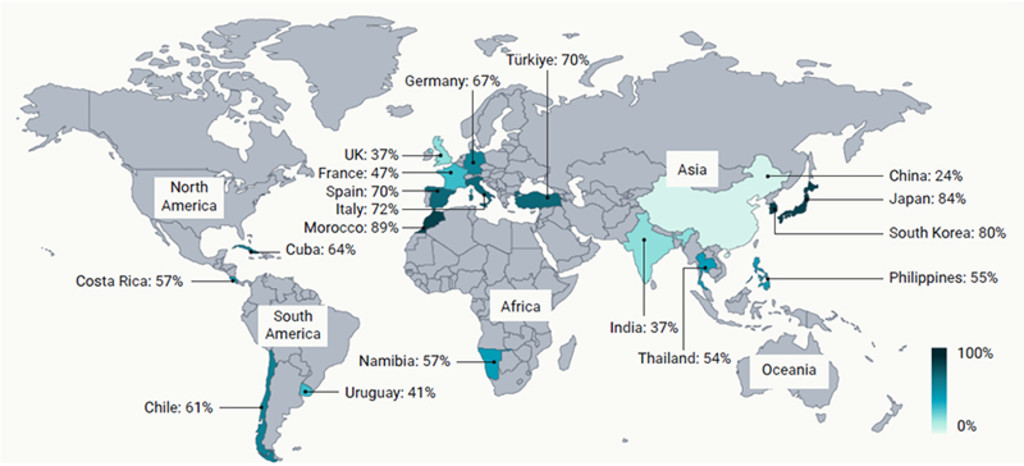
Source: Robeco, Ember, 2026 (https://ember-energy.org/latest-insights/the-energy-security-fall-out-from-fossil-fuel-fragility-to-electric-independence/). Fossil fuel net imports as a share of primary energy demand in 2023 (%). 50 countries import more than half of their primary energy demand as fossil fuels.
Policy action reflects this opportunity. Under its 2026 Electrification Action Plan, the EU aims to reduce oil and gas imports, raise electricity’s share of final energy consumption from 23% to 46% and cut EUR 260 billion in annual energy costs by 2040.4 Similarly, Japan, another import-strapped Asian economy, launched the Green Transformation Plan (GX2040), which links clean power, energy security and economic growth.5,6
Both underscore how energy-importing economies increasingly view domestic electricity systems as a strategic asset. These and other global initiatives7 point to a long-duration investment cycle8in the Smart Energy value chain – from electrified end-use technologies and power electronics to renewables, transmission grids, distribution networks, and energy storage.
Mobility: Powering transport resilience
Higher fuel prices are helping to accelerate transport electrification. In the EU, plug-in hybrids and battery-electric vehicles accounted for nearly 32% of new car registrations in the first eight months of 2026, exceeding the combined share of petrol and diesel cars.9 Surging energy prices have also helped accelerate adoption in markets globally, with many countries recording their highest-ever share of battery-electric vehicle sales in 2026.
Figure 2: Energy shocks are turbo-charging EV adoption in global markets
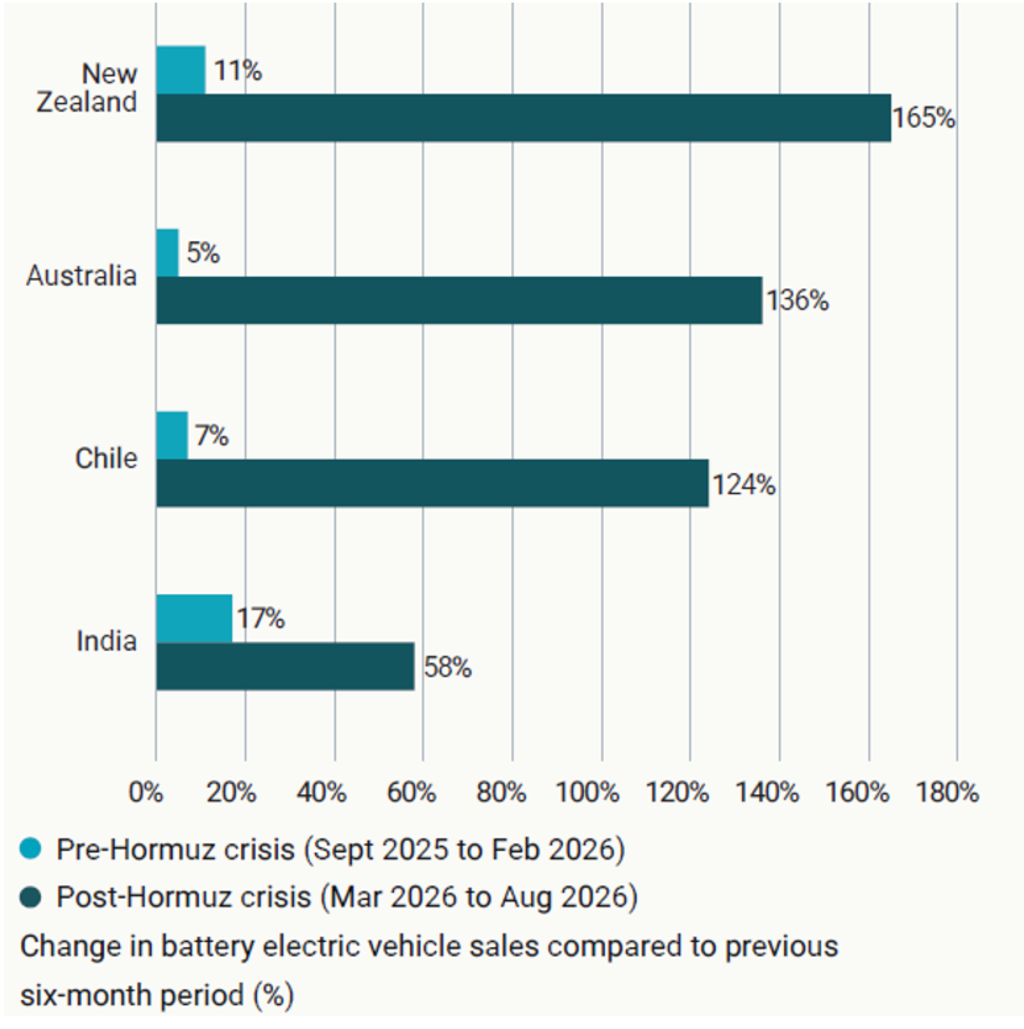
Source: Robeco, Ember, 2026, https://ember-energy.org/latest-insights/electric-energy-security-how-evs-are-reducing-oil-import-vulnerabilities/. Monthly EV sales data.
Beyond electrification, autonomous driving is emerging as one of the most tangible applications of AI in mobility. As AI moves from research into real-world applications, demand for the chips, sensors, software and automation technologies that enable autonomous systems is expected to grow rapidly. Companies across the Smart Mobility ecosystem supply these critical building blocks, positioning them to benefit both from autonomous vehicle adoption and from wider applications of physical AI.10
Resource scarcity is driving innovation and investment
A country’s growth and prosperity also depend on access to materials and the domestic manufacturing capacity to turn energy and other inputs into productive output. US supply chains demonstrate the economic stakes of materials dependence. Mineral-reliant industries contributed USD 4.09 trillion to the US economy in 2025.11 Yet China remained a major source for 14 of the 33 critical minerals on which the US was most import-dependent, leaving strategic-growth industries such as semiconductors, defense, robotics and electrification exposed to geopolitical disruption.12
Over the coming year, export controls, elevated prices and concentrated mineral processing, particularly in China, are pushing countries to secure supplies any which way they can, including financing projects, stockpiling reserves and pursuing international partnerships to support mining and processing capacity.13 New mines take decades to develop, so scarcity and price volatility should continue to incentivize substitution, resource-efficient production and technologies that reduce material intensity. Over time, these measures can reduce import dependence and strengthen the resilience of domestic producers.14
Figure 3: China dominates production of minerals needed for strategic industries
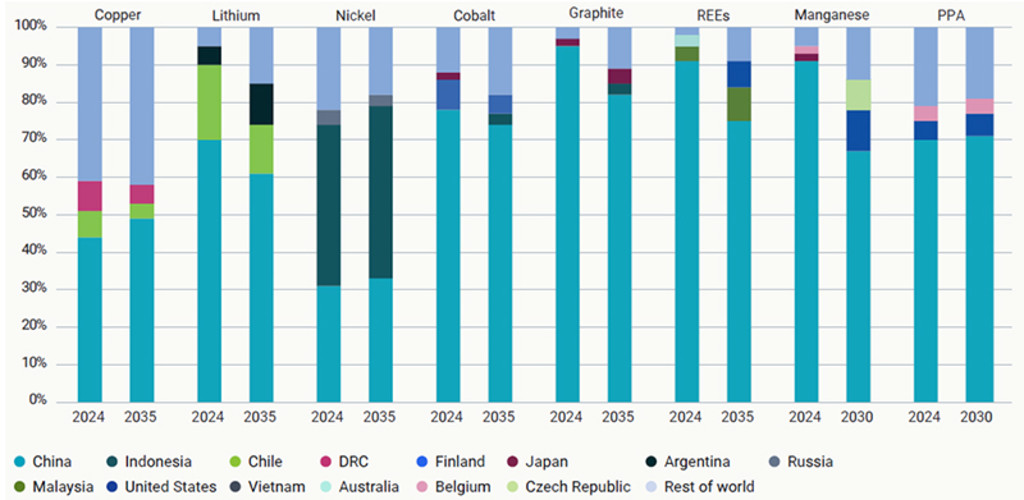
Source: IEA, Critical Minerals Outlook 2025. Chart updated 13 May 2025. Notes: Manganese=battery-grade manganese sulphate, PPA=battery-grade purified phosphoric acid. The figures for graphite are based on battery-grade including spherical graphite and synthetic graphite. REE=rare earth elements. The figures for rare earths are for magnet rare earth elements only. The figure depicts the value of the top three producing countries in a given year.
Moreover, secondary supplies of materials from recovery and recycling are expected to double their contribution to key mineral supplies, from 10% to around 20% by 2040, easing pressure on primary sources as demand intensifies from AI, data centers, energy infrastructure and national defense.15 Together, these trends create opportunities for companies across our Smart Materials and Circular Economy strategies,16 spanning the value chain from raw inputs and extraction equipment to advanced materials, manufacturing, recycling and recovery technologies.
Cybersecurity: There can be no autonomy without security
Increased reliance on digital systems from banking to supply chain management illustrates the critical role of cybersecurity in strategic autonomy. Over the last five years, the volume of cyberattacks has surged more than threefold according to Check Point Research. Over the past year, the number of disclosed high- or critical-severity common vulnerability exposures (CVE) rose nearly ninefold (see Figure 4). Alarmingly, cyberattacks have increasingly targeted critical infrastructure and services including airlines, banks, government agencies, hospitals, and retailers.
Figure 4: High- and critical-severity vulnerability disclosures rose sharply in 2026
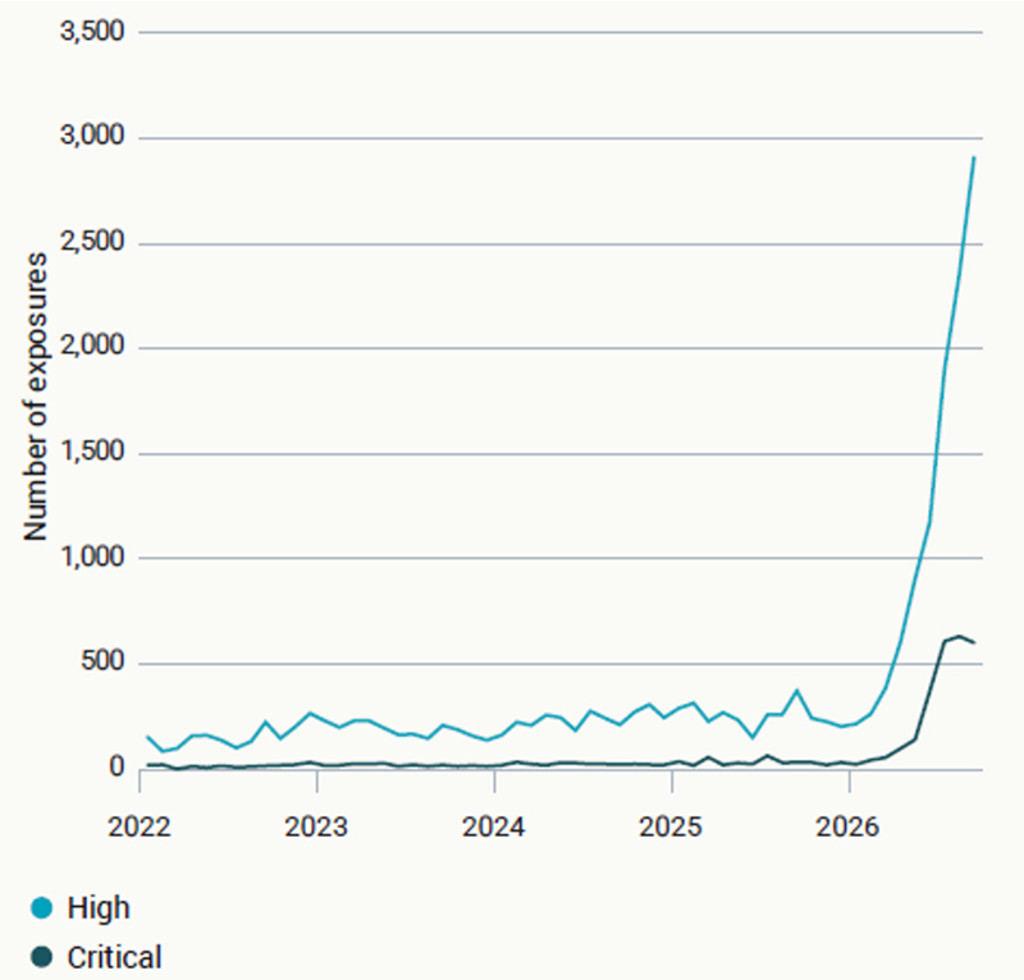
Source: Epoch AI based on CVE.org data, October 2026. Monthly high- and critical-severity vulnerabilities published by 21 major technology organizations, January 2022 to October 2026. CVEs are standardized records of publicly disclosed software and hardware vulnerabilities; they do not necessarily indicate that a vulnerability has been exploited or resulted in a breach. Severity is based on the Common Vulnerability Scoring System, with scores of 7.0-8.9 classified as high and 9.0-10.0 as critical.
To address growing cyber risks, AI is increasingly used to improve threat detection and automate responses. However, AI is a double-edged sword in cybersecurity: both defenders and attackers can leverage it. A 2025 US House Committee on Homeland Security report found that one in six data breaches involved AI-driven attacks. As a result, a faster-moving, more complex threat environment is expected to provide structural tailwinds for cybersecurity and cloud computing services, both key pillars of Robeco’s Digital Innovations strategy.17
Conclusion
Looking across sectors and geographies, Robeco’s thematic equity strategies identify the companies developing the energy, raw materials, and manufacturing solutions needed to build more resilient economies, as well as the cybersecurity capabilities to secure them.18 While the macroeconomic backdrop may influence the pace of investment in 2027, we believe it is unlikely to reverse the powerful structural forces driving countries and companies toward strategic autonomy.
This article was originally published as a special feature in our 2027 Investment Outlook.
Footnotes
1https://eprinc.org/eu-plus-norway-and-the-u-k-national-fiscal-policy-responses-to-the-energy-crisis-september-2021-to-january-2023/
2https://www.iea.org/about/oil-security-and-emergency-response/strait-of-hormuz
3https://ember-energy.org/latest-insights/the-energy-security-fall-out-from-fossil-fuel-fragility-to-electric-independence/
4https://energy.ec.europa.eu/topics/eus-energy-system/electrification_en
5https://opengov.jp/en/economy/energy/self-sufficiency/
6https://www.meti.go.jp/policy/energy_environment/global_warming/transition/pathways_to_green_transformation_eng.pdf
7https://energy.ec.europa.eu/topics/eus-energy-system/electrification/electrify-now_en
8Investment in Smart Energy strategies involves risk of capital loss, heightened volatility due to technological disruption, regulatory uncertainty, and sector concentration risk. Past performance or anticipated growth trends are not a reliable indicator of future results.
9https://www.acea.auto/pc-registrations/new-car-registrations-5-3-in-august-2026-year-to-date-battery-electric-21-7-market-share/
10Investment in Smart Mobility strategies involves risk of capital loss, heightened volatility due to technological disruption, regulatory uncertainty, and sector concentration risk. Past performance or anticipated growth trends are not a reliable indicator of future results.
11https://www.usgs.gov/news/national-news-release/value-us-mineral-production-rose-last-year-driven-precious-metals-prices
12https://usgs.maps.arcgis.com/apps/dashboards/399d237a295e4eec9394e0e880ec8e4e#
13https://www.spglobal.com/energy/en/news-research/latest-news/metals/010926-us-eu-to-further-intensify-critical-mineral-investments-as-china-tightens-hold
14 https://www.iea.org/reports/global-critical-minerals-outlook-2026 and https://www.spglobal.com/energy/en/news-research/latest-news/metals/010926-us-eu-to-further-intensify-critical-mineral-investments-as-china-tightens-hold and https://www.jpmorganchase.com/content/dam/jpmorganchase/documents/center-for-geopolitics/jpmc-cfg-minerals-ada-remediated.pdf
15https://www.iea.org/reports/recycling-of-critical-minerals/executive-summary
16Key strategy risks: Investing in Smart Materials and Circular Economy strategies involves specific risks, including sector concentration, exposure to commodity price volatility, supply chain disruptions, and regulatory shifts. Capital is at risk, and investors may not recover the full amount invested.
17Risk consideration: Technology-focused strategies such as Digital Innovations may experience higher volatility and carry risks related to rapid technological shifts, rapid obsolescence, cybersecurity breaches, and valuation fluctuations. Capital is at risk.
18Important risk notice: Thematic equity investing carries risks, including market risk, sector concentration risk, and the risk of capital loss. The value of investments and any income from them can fall as well as rise, and investors may not get back the amount originally invested.

The forces beneath the surface
2027 Investment outlook
重要資料
本網站僅供《證券及期貨條例》(香港法例第571章)及其附屬法例所界定之專業投資者瀏覽及使用。 投資涉及風險。過往表現並不代表未來表現。本網站所載資料僅供參考之用,並不構成任何投資建議,亦非作出買賣任何證券或採納任何投資策略之要約或招攬。投資者不應僅憑本網站提供之資料作出投資決定,在作出任何投資決定前,應徵詢獨立意見(包括有關稅務影響之意見)。投資者應確保完全理解投資產品的相關風險,亦應考量自身投資目標及風險承受水平。投資乃閣下之個人決定。除非銷售投資產品的中介人已向閣下告知該投資產品適合閣下,並已解釋其符合閣下投資目標之原因,否則閣下不應投資。請參閱相關發售文件或其他法律文件,以獲取包括風險因素在內的進一步詳情。 本網站由荷寶投資管理香港有限公司發布,該公司受香港證券及期貨事務監察委員會(「證監會」)規管(中央編號:APU851)。本網站未經證監會審閱。 無法保證任何投資產品可實現其投資目標。概不就任何投資產品之表現或投資回報作任何聲明或承諾。投資的價值或會波動。本網站所載過往表現、推算或預測,均不應視作未來表現之保證或指標,且概不提供任何明示或暗示之保證。本網站內容建基於相信為可靠之來源,惟因應資料傳遞技術特性及須採用多項數據來源(包括第三方內容),故概不保證其準確性。所述觀點僅乃截至上述日期,或會隨市況變化而改變,可予更改而毋須另行通知。該等意見可能有別於其他荷寶投資專業人士之意見。因使用本材料或當中所載任何評論、意見或估算而引致之直接、間接或相應損失,荷寶概不承擔法律責任。荷寶並無責任更新本網站或任何網站內容。未經荷寶事先書面許可,不得複製、分發或刊發本網站任何材料。 除非另有說明,資料來源:荷寶。