
Head of SI Thought Leadership and Climate & Biodiversity Strategist
• 市場觀點
Energy security and AI are accelerating the renewable energy transition
Investment in renewable energy is likely to get a boost from both heightened energy security concerns and the rise of artificial intelligence (AI), the Robeco Global Climate Investing Survey shows.
作者



概要
- Three-quarters of investors think the Middle East conflict will accelerate the transition
- Over half think AI will support renewable energy and sustainable infrastructure
- Most expect the transition to continue despite backlash against net zero
Enthusiasm for climate mitigation solutions such as solar power, grids and storage remains strong, even as governments are backtracking on net-zero commitments and reducing subsidy support. Investors continue to see investing in such solutions as a cornerstone for advancing their climate strategy, underpinned by energy security and AI as additional drivers, according to the sixth annual survey of 300 investors from across Europe, Asia-Pacific (APAC) and North America.
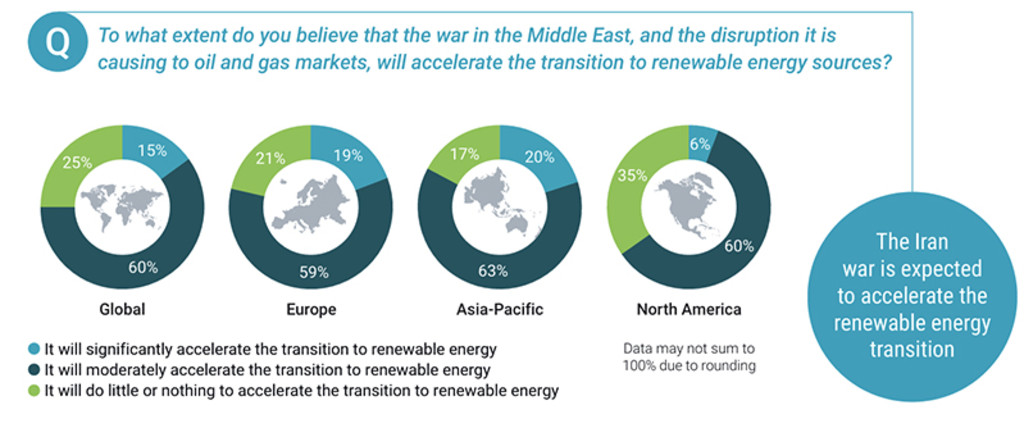
For the first time, the survey asked how the conflict in the Middle East and the disruption to energy supplies caused by the closure of the crucial Strait of Hormuz could impact the transition to renewable energy sources.
Globally, 75% thought the conflict will moderately or significantly accelerate the transition, rising to 78% in Europe and 83% in APAC, but falling to 66% in North America. Most respondents are in the ‘moderately accelerate’ bucket, while a quarter globally expected little or no acceleration.
The regional difference may partly reflect exposure to Gulf oil and gas supplies. Europe and APAC are more dependent on these imports, whereas the US is the world’s largest producer of crude oil and natural gas.1 Canada ranks fourth for oil production and fifth for natural gas. 2
Figure 1: How will the Middle East conflict accelerate the transition?
Source: Robeco Global Climate Investing Survey 2026
“The survey highlights that investors increasingly view renewable energy not only as a climate solution but also as an energy security solution,” says Lucian Peppelenbos, Climate and Biodiversity Strategist at Robeco. “Recent geopolitical tensions have reinforced the strategic value of domestic renewable power and reduced dependence on imported fossil fuels.”
“The implications extend beyond short-term energy price volatility. If governments and companies place greater value on energy resilience, investment may increasingly be directed toward domestic renewable generation, storage, electricity networks and electrification technologies.”
“The opportunity set therefore goes beyond renewable developers to the equipment, infrastructure and services needed to build a more secure power system.”
Benefits of AI
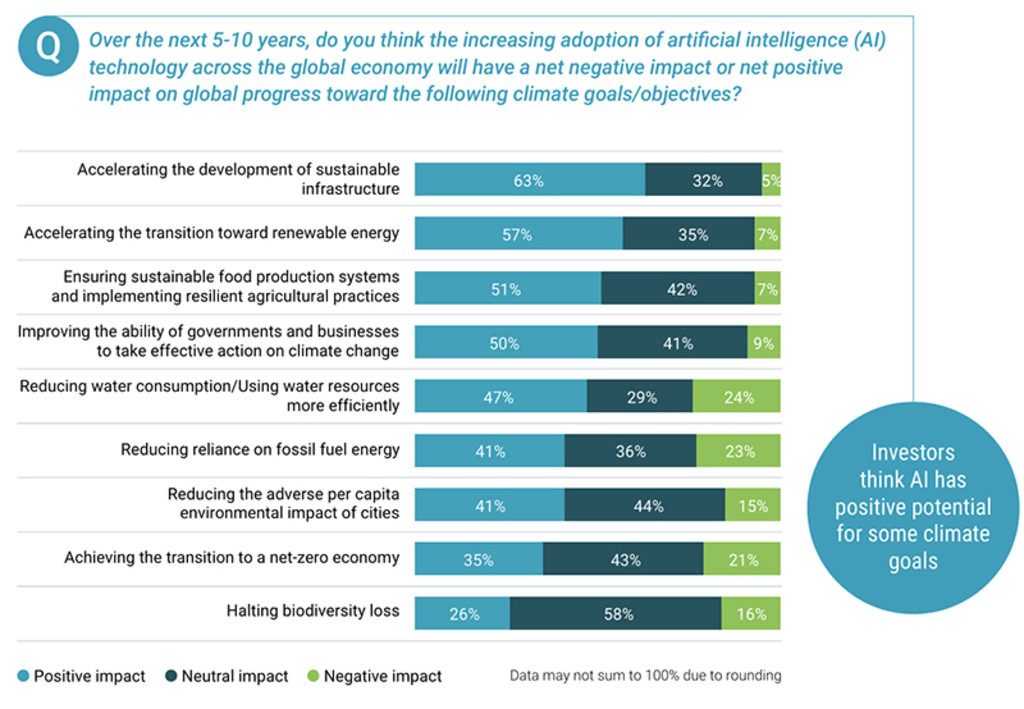
A second new question examined whether investors were more positive about the benefits of AI than its drawbacks. Globally, 57% said it would have a positive impact on accelerating the transition toward renewable energy, while a higher proportion of 63% thought it would accelerate the development of sustainable infrastructure.
AI can work out the maximum efficiencies of wind turbines and solar panels, optimize the building of other renewable sources such as hydroelectric and tidal power, and predict variations in peak power demand and supply. Applying AI-based management could unlock up to 175 gigawatts (GW) of additional transmission capacity without building a single new physical line, according to the International Energy Agency. 3
Figure 2: How will AI impact climate goals?
Source: Robeco Global Climate Investing Survey 2026
Investors nevertheless recognize the environmental cost of expanding data centre capacity. Data centres are heavy users of electricity for power and water for cooling, now accounting for 1.5% of global electricity demand and 0.5% of CO2 emissions, according to CarbonBrief. 4
Only 47% of respondents expected AI to reduce water consumption or improve water use, while 24% expected a negative effect. Views were also mixed on reducing reliance on fossil fuels (41% positive, 23% negative) and achieving net zero (35% positive, 21% negative).
“AI is affecting the transition in two directions,” Peppelenbos says. “On the one hand, it increases demand for electricity and infrastructure, while on the other, it can improve the efficiency of renewable energy systems and electricity networks. While recognizing the emission increase in the short term, it seems that investors see both effects ultimately supporting the long-term transition.”
獲取最新市場觀點
訂閱我們的電子報,時刻把握投資資訊和專家分析。
Continuing with net zero
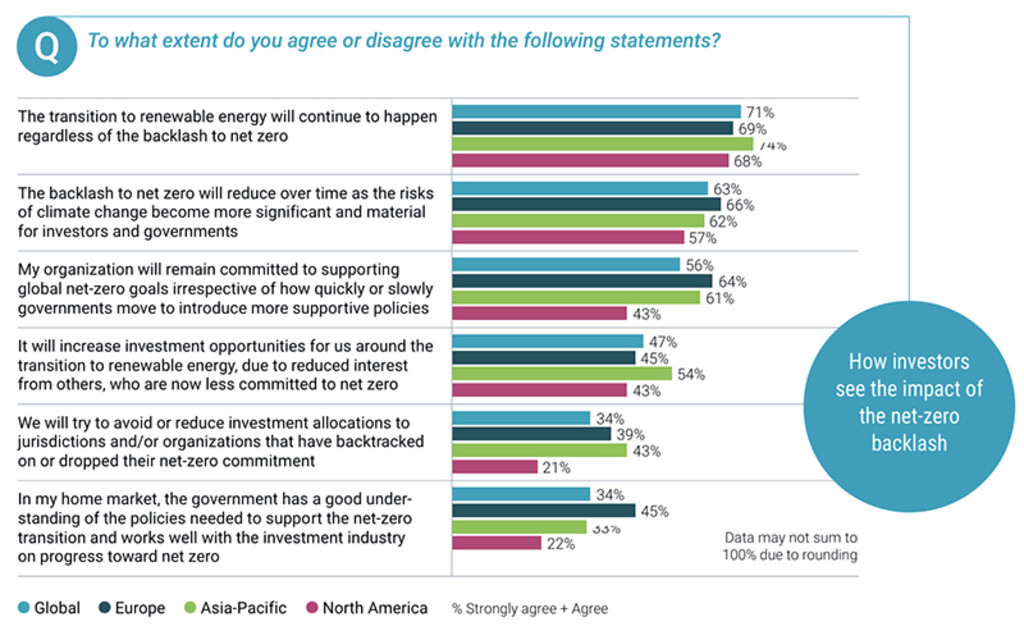
The survey also asked whether political and populist backlash against net-zero emissions could slow the transition. A majority of investors remained confident that renewable energy adoption would continue regardless of that backlash.
Globally, 71% thought that the transition will continue, rising to 74% in APAC, but dropping slightly to 69% in Europe and 68% in North America. In addition, 63% globally believed opposition to net zero would reduce over time as climate risks became more significant and material for investors and governments. This view was shared by 66% in Europe, 62% in APAC and 57% in North America.
Figure 3: Views on the transition to renewables
Source: Robeco Global Climate Investing Survey 2026
“What stands out from this year’s survey is the resilience of investor conviction,” Peppelenbos says. “Despite political debates around net zero, most institutional investors continue to see climate change as a critical factor shaping the long-term economic transition and associated investment risks and opportunities.”
Footnotes
1 https://www.eia.gov/todayinenergy/detail.php?id=67844
2 https://www.capp.ca/en/oil-natural-gas-you/oil-natural-gas-canada/
3 https://www.renewableinstitute.org/how-ai-is-making-renewable-energy-smarter/
4 https://www.carbonbrief.org/ai-five-charts-that-put-data-centre-energy-use-and-emissions-into-context

Global Climate Investing Survey 2026
Investors commit to net zero goals amid energy security and climate risks
重要資料
本網站僅供《證券及期貨條例》(香港法例第571章)及其附屬法例所界定之專業投資者瀏覽及使用。 投資涉及風險。過往表現並不代表未來表現。本網站所載資料僅供參考之用,並不構成任何投資建議,亦非作出買賣任何證券或採納任何投資策略之要約或招攬。投資者不應僅憑本網站提供之資料作出投資決定,在作出任何投資決定前,應徵詢獨立意見(包括有關稅務影響之意見)。投資者應確保完全理解投資產品的相關風險,亦應考量自身投資目標及風險承受水平。投資乃閣下之個人決定。除非銷售投資產品的中介人已向閣下告知該投資產品適合閣下,並已解釋其符合閣下投資目標之原因,否則閣下不應投資。請參閱相關發售文件或其他法律文件,以獲取包括風險因素在內的進一步詳情。 本網站由荷寶投資管理香港有限公司發布,該公司受香港證券及期貨事務監察委員會(「證監會」)規管(中央編號:APU851)。本網站未經證監會審閱。 無法保證任何投資產品可實現其投資目標。概不就任何投資產品之表現或投資回報作任何聲明或承諾。投資的價值或會波動。本網站所載過往表現、推算或預測,均不應視作未來表現之保證或指標,且概不提供任何明示或暗示之保證。本網站內容建基於相信為可靠之來源,惟因應資料傳遞技術特性及須採用多項數據來源(包括第三方內容),故概不保證其準確性。所述觀點僅乃截至上述日期,或會隨市況變化而改變,可予更改而毋須另行通知。該等意見可能有別於其他荷寶投資專業人士之意見。因使用本材料或當中所載任何評論、意見或估算而引致之直接、間接或相應損失,荷寶概不承擔法律責任。荷寶並無責任更新本網站或任何網站內容。未經荷寶事先書面許可,不得複製、分發或刊發本網站任何材料。 除非另有說明,資料來源:荷寶。