

Portfolio Manager


• 月度展望
Why markets are watching rising defense spending
Higher defense spending will be closely watched by markets for its impacts on government budgets and across asset classes, says multi-asset investor Aliki Rouffiac.
作者

概要
- Wars in Ukraine and Iran put focus on the high cost of security independence
- Rising budget deficits will have repercussions for sovereign bonds and rates
- Equity markets in sectors such as cybersecurity and rare earths can benefit
As the cost of security independence in the West starts to run into the trillions, investors will be wary of their repercussions for budget deficits and future interest rate policy, putting a focus on future sovereign bond values, says Rouffiac, Portfolio Manager with Robeco’s Investor Solutions multi-asset team.
Many stock markets sectors can though continue to benefit, such as cybersecurity and rare earths, following a strong rise in the stocks of defense-related manufacturing companies in the past year, she says.
“After a year of tariff wars, geopolitical risks have risen again, as the start of the US-Iran war in February accelerated the focus back toward defense,” she says. “The great reset that is taking place has meant that countries are already adapting to numerous evolving trends.”
“Security independence remains high on the agenda, and more resilient supply chains are needed to navigate an uncertain economic landscape. Deglobalization and reshoring are reshaping the capacity potential of the manufacturing sector, which is absorbing this higher spending.”
“Against this evolving backdrop, military spending by European allies and Canada (based on the NATO defense spending tracker) has outpaced previous expectations, increasing by 20% in 2025. Defense spending pressure is now one of the top ten fiscal risks identified for advanced economies, seen as a problem in 24% of countries.”
Figure 1: Top fiscal risks identified in advanced economies (percentage of countries)
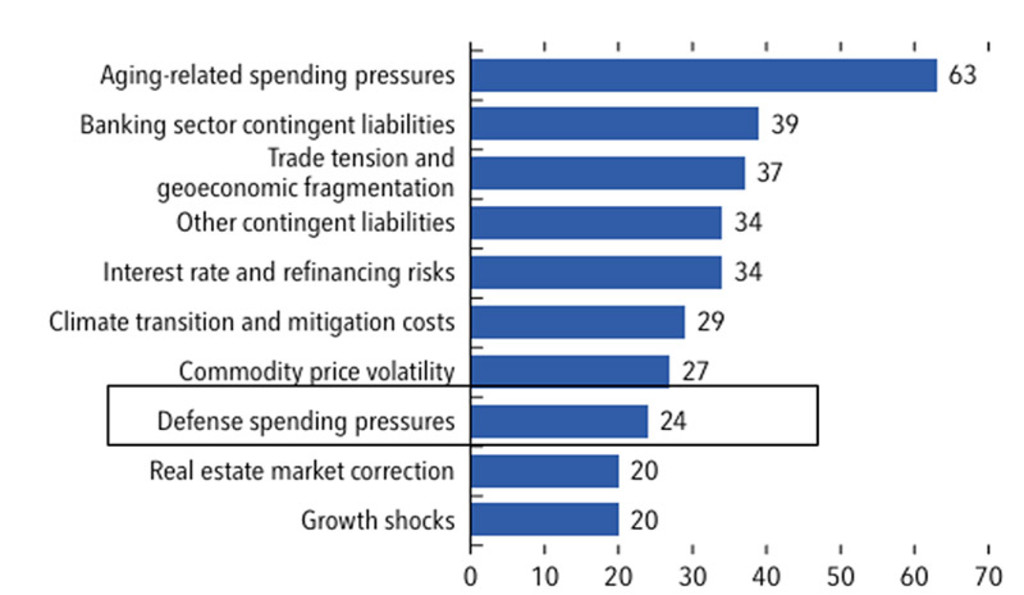
Source: IMF Fiscal Monitor April 2026. IMF staff calculations are based on data from 32 IMF staff reports on advanced economies published in 2025 using the Fiscal Monitor AI Analyst, a custom large-language-model pipeline.
Much of the likely impact is country-specific, given that nations in eastern Europe closer to the border with Russia are spending far more than their counterparts further west, relative to GDP. Countries with a relatively strong domestic defense industry like France and the UK also tend to spend more.
“Notably, the fiscal expansion needed to accommodate higher spending is unlikely to be transitory in Europe, where defense expenditures tend to be rigid,” Rouffiac says. “For now, the activation of national escape clauses has provided some leeway to European countries to circumvent fiscal rules constraints, but the potential remains for structural increases in debt levels if the spending is not offset by other policies.”
In the US, estimates for the cost of the war in Iran so far have been in the region of USD 30 billion and counting, while its latest proposed defense budget for 2027 is USD 1.5 trillion, which is higher than the GDP of most European economies.
Figure 2: The costs of the war in Iran are rising at a time when deficits are already high
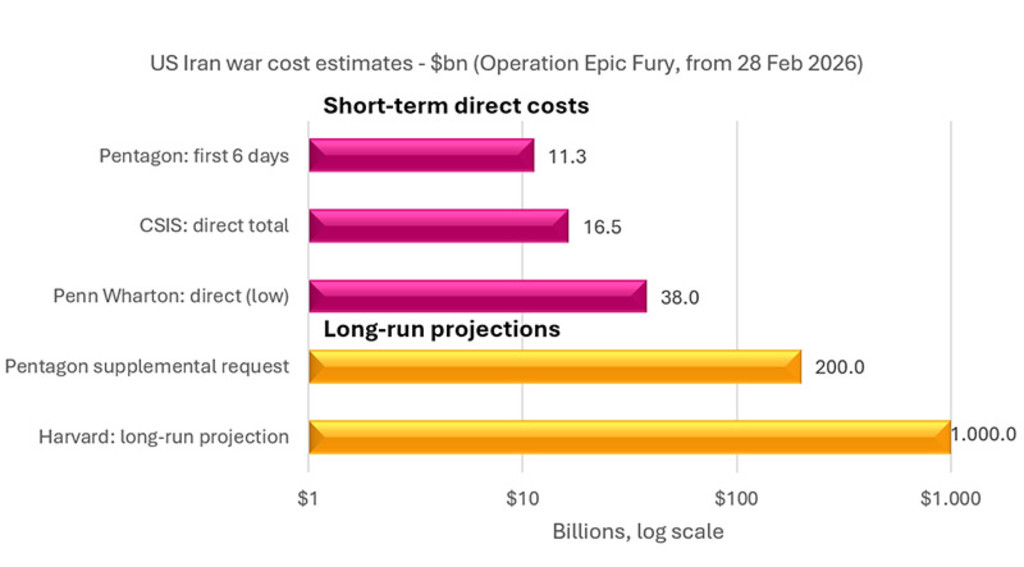
Source: Pentagon, CSIS, Penn Wharton, Harvard, May 2026.
Implications for rates
“This level of spending constitutes an uplift from the previous years’ projections and increases the uncertainty around the future levels of deficit, which is likely not factored into current interest rates,” Rouffiac warns.
“Higher spending will have implications for inflation and rates expectations, where investors are likely to differentiate between countries that run higher fiscal deficits and those that don’t. In the same vein, the recent oil shock has added a headwind, though this may be seen as short-lived and transitory under a peace deal scenario.”
“In the meantime, the risk of higher-for-longer rates has supported higher premiums in government bonds, particularly for countries that are energy importers. This has brought to the fore an additional burden to government budgets, at a time when fiscal expansion is needed to support higher defense spending goals.”
獲取最新市場觀點
訂閱我們的電子報,時刻把握投資資訊和專家分析。
Boost for manufacturing
One of the beneficiaries of higher spending has been manufacturing, which has the potential to support future growth in the labour market across Europe and has led to a rally in aerospace and defense stocks since the start of 2025. Future growth areas can be seen in cybersecurity, critical minerals and rare earths, and energy self-sufficiency, Rouffiac says.
“More efficient and faster procurement processes – particularly in Europe – and innovations are needed to support higher demand and the modernization of the defense ecosystem,” she says.
“As such, tech innovation and private capital will be crucial in areas like artificial intelligence, quantum technologies and next-generation communication networks, that NATO has identified as having the greatest potential in transforming the future of warfare, in which cybersecurity takes a center stage.”
“Markets are already factoring in this trend, with the global cybersecurity stock index up 36% since the beginning of the year. On the other hand, global aerospace and defense equity returns have been muted after a very strong 2025, which saw them delivering performance in excess of 50%. Still, earnings growth projections continue to be supportive, despite higher valuations.”
Figure 3: Cybersecurity stocks have reaped the benefits
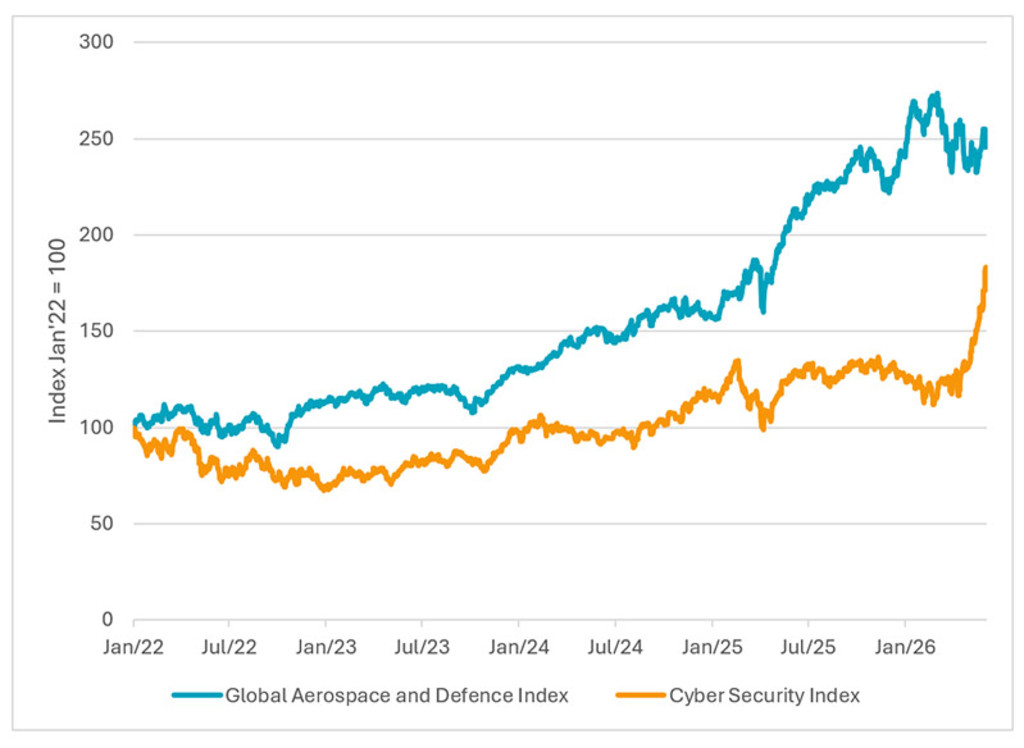
Past performance is no guarantee of future results. The value of your investments may fluctuate.
Source: Robeco, Bloomberg. Data as at June 2026.
Another beneficiary has been rare earth metals, due to their use in advanced defense systems, which has boosted their prices.
“But as we wrote on our previous theme, ‘Energy self-sufficiency in the age of shocks’, greater reliance on critical mineral sourcing and infrastructure expands the concept of security, and requires supply chain diversification to support future growth and investment opportunities,” Rouffiac concludes.
重要資料
本網站僅供《證券及期貨條例》(香港法例第571章)及其附屬法例所界定之專業投資者瀏覽及使用。 投資涉及風險。過往表現並不代表未來表現。本網站所載資料僅供參考之用,並不構成任何投資建議,亦非作出買賣任何證券或採納任何投資策略之要約或招攬。投資者不應僅憑本網站提供之資料作出投資決定,在作出任何投資決定前,應徵詢獨立意見(包括有關稅務影響之意見)。投資者應確保完全理解投資產品的相關風險,亦應考量自身投資目標及風險承受水平。投資乃閣下之個人決定。除非銷售投資產品的中介人已向閣下告知該投資產品適合閣下,並已解釋其符合閣下投資目標之原因,否則閣下不應投資。請參閱相關發售文件或其他法律文件,以獲取包括風險因素在內的進一步詳情。 本網站由荷寶投資管理香港有限公司發布,該公司受香港證券及期貨事務監察委員會(「證監會」)規管(中央編號:APU851)。本網站未經證監會審閱。 無法保證任何投資產品可實現其投資目標。概不就任何投資產品之表現或投資回報作任何聲明或承諾。投資的價值或會波動。本網站所載過往表現、推算或預測,均不應視作未來表現之保證或指標,且概不提供任何明示或暗示之保證。本網站內容建基於相信為可靠之來源,惟因應資料傳遞技術特性及須採用多項數據來源(包括第三方內容),故概不保證其準確性。所述觀點僅乃截至上述日期,或會隨市況變化而改變,可予更改而毋須另行通知。該等意見可能有別於其他荷寶投資專業人士之意見。因使用本材料或當中所載任何評論、意見或估算而引致之直接、間接或相應損失,荷寶概不承擔法律責任。荷寶並無責任更新本網站或任何網站內容。未經荷寶事先書面許可,不得複製、分發或刊發本網站任何材料。 除非另有說明,資料來源:荷寶。