


Strategist

• 市場觀點
Could French bond stress change the ECB's course?
France’s fiscal and political risks are putting pressure on its government bonds We examine how wider French bond spreads could affect the ECB’s interest rate outlook and what this means for sovereign bond investors.
作者




Strategist

Strategist
概要
- Spillovers from French bond stress could delay ECB hikes
- Fed, ECB and BoJ look set to hike in December
- Fed and ECB could hike again in Q1 before peaking
Spreads have risen again recently, as the market has been giving greater attention to difficult budget negotiations and opinion polls for next spring’s presidential election. Social unrest has added to the pressure. These developments suggest that fiscal consolidation will be difficult over both shorter and longer horizons.
Debt dynamics have become even more important with rising interest expenses. If current fiscal policies persist, French debt could easily rise to 137% of GDP by 2030, a level similar to Italy’s. Interest payments alone could then reach 5% of GDP, making deficit reduction even more difficult. Rising debt levels and a lack of policies to curb fiscal deficits would put continued pressure on the credit rating and potential demand for French OATs.
When does a French problem become a European one?
The market scare in French bonds has also affected spreads for lower-rated euro-area government bonds, such as Italian BTPs and Greek government bonds. Euro government-related and corporate bonds have also experienced pressure on their spreads.
A rapid further widening in countries such as Italy and Greece would signal broader stress. Spreads on shorter-maturity bonds will be monitored closely, as will pressure on European banks’ share prices and credit spreads.
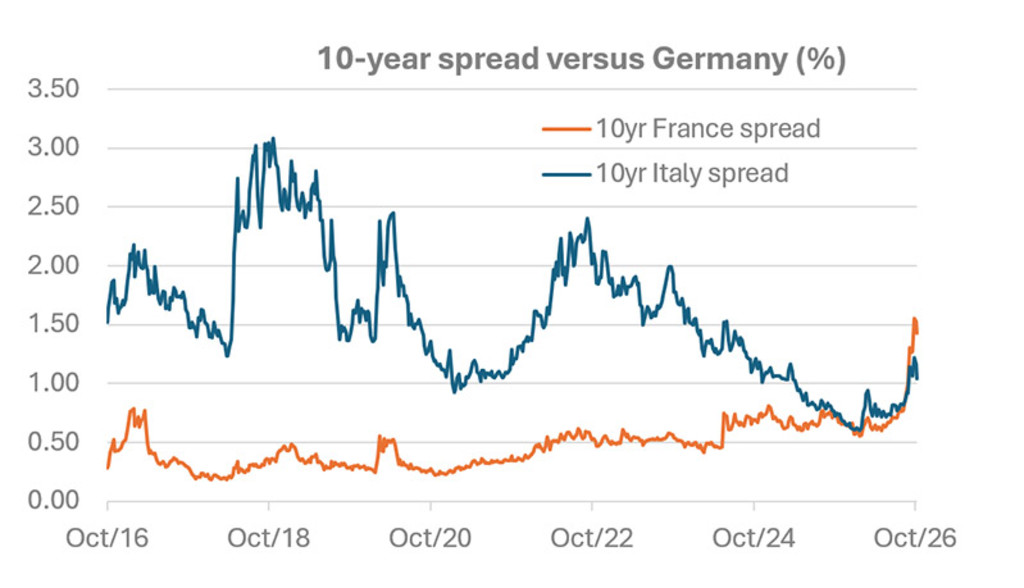
Source: Bloomberg,1 November 2026.
Could bond-market pressure change the ECB’s next moves?
Elevated energy prices underpin our expectation of ECB hikes in December and March. However, further material widening in French spreads, accompanied by spillovers, could cause hikes to be skipped.
There is probably no magic level. The speed of spread widening and its breadth outside France will play important roles. Material widening in shorter-maturity bonds can be an early sign that stress may be intensifying. Postponing further hikes could then help calm market concerns to some extent.
信貸投資的新動態
訂閱我們的電子報,緊跟最新的信貸投資趨勢。
What other measures could the ECB take?
If tensions in the OAT market continue to spread to other sovereign debt markets, pressure on the ECB may increase to the point where intervention becomes unavoidable. The ECB could initially intervene verbally by reminding markets of its Transmission Protection Instrument (TPI). The instrument allows the ECB to buy bonds from eligible euro-area countries if unwarranted, disorderly market moves threaten the transmission of monetary policy across the euro area.
In our view, there should ultimately be enough flexibility in the TPI rules to allow bond purchases, including OATs. However, there is a high hurdle to activating the tool, as it could give policymakers the wrong incentives – the problem of moral hazard.
Are investors being paid enough to take French risk?
Uncertainty around the French fiscal outlook is likely to remain elevated in the coming months. While there may be room for temporary relief rallies after significant widening, the outlook going into the election will probably remain difficult for French OATs. Pressure on France’s credit rating is also likely to continue.
We will continue to trade French OATs actively.2 For now, the outlook remains challenging, but we remain open to buying French debt, depending on spread levels and political developments.
What is the team monitoring across euro-area sovereign bonds?
Some issuers have seen significant spread widening even though their credit profiles remain strong (the EU) or have improved significantly (Greece and Portugal). For France, quick approval of the 2027 budget or stronger support in opinion polls for centrist candidates with fiscal consolidation plans would be positive signals.
Footnotes
1 The following are trademarks and service marks of Bloomberg Finance L.P., a Delaware limited partnership, or its subsidiaries: BLOOMBERG, BLOOMBERG ANYWHERE, BLOOMBERG MARKETS, BLOOMBERG NEWS, BLOOMBERG PROFESSIONAL, BLOOMBERG TERMINAL and BLOOMBERG.COM: Absence of any trademark or service mark from this list does not waive Bloomberg's intellectual property rights in that name, mark or logo.
2 Specific issuers or securities are for illustrative and factual market review purposes only and do not constitute an investment recommendation or financial advice.
重要資料
本網站僅供《證券及期貨條例》(香港法例第571章)及其附屬法例所界定之專業投資者瀏覽及使用。 投資涉及風險。過往表現並不代表未來表現。本網站所載資料僅供參考之用,並不構成任何投資建議,亦非作出買賣任何證券或採納任何投資策略之要約或招攬。投資者不應僅憑本網站提供之資料作出投資決定,在作出任何投資決定前,應徵詢獨立意見(包括有關稅務影響之意見)。投資者應確保完全理解投資產品的相關風險,亦應考量自身投資目標及風險承受水平。投資乃閣下之個人決定。除非銷售投資產品的中介人已向閣下告知該投資產品適合閣下,並已解釋其符合閣下投資目標之原因,否則閣下不應投資。請參閱相關發售文件或其他法律文件,以獲取包括風險因素在內的進一步詳情。 本網站由荷寶投資管理香港有限公司發布,該公司受香港證券及期貨事務監察委員會(「證監會」)規管(中央編號:APU851)。本網站未經證監會審閱。 無法保證任何投資產品可實現其投資目標。概不就任何投資產品之表現或投資回報作任何聲明或承諾。投資的價值或會波動。本網站所載過往表現、推算或預測,均不應視作未來表現之保證或指標,且概不提供任何明示或暗示之保證。本網站內容建基於相信為可靠之來源,惟因應資料傳遞技術特性及須採用多項數據來源(包括第三方內容),故概不保證其準確性。所述觀點僅乃截至上述日期,或會隨市況變化而改變,可予更改而毋須另行通知。該等意見可能有別於其他荷寶投資專業人士之意見。因使用本材料或當中所載任何評論、意見或估算而引致之直接、間接或相應損失,荷寶概不承擔法律責任。荷寶並無責任更新本網站或任何網站內容。未經荷寶事先書面許可,不得複製、分發或刊發本網站任何材料。 除非另有說明,資料來源:荷寶。