

PhD, Head of Robeco Indices


• 市場觀點
A liquid alternative to private equity investments
Private equity has become one of the fastest-growing asset classes, but it remains costly and illiquid. Can investors capture its return potential through listed markets instead? In new research, Joop Huij and Georgi Kyosev suggest that replicating private equity exposures in public equities offers a compelling liquid alternative.
作者




PhD, Portfolio Manager Robeco Indices
概要
- Private equity has historically delivered strong returns, but comes with challenges.
- Factor exposures explain much of private equity’s performance
- Robeco’s liquid alternative delivers private equity-like returns with greater flexibility
Over the past decade, private equity assets under management have surged from USD 2 trillion in 2014 to more than USD 9 trillion by mid-2024. Pension funds and endowments have raised allocations significantly, inspired by models such as Yale’s, where exposure to venture capital, buyouts, and private real estate often reaches 29%.
The two dominant strategies are leveraged buyouts and venture capital. Buyouts focus on smaller firms at attractive valuations, often highly leveraged and with profitability challenges. Venture capital backs young, high-growth firms with substantial R&D spending, typically at higher valuations.
Private equity investors generally enjoy closer alignment with management than public shareholders, Huij and Kyosev explain, reducing agency costs such as excessive pay or empire building. This alignment, combined with the ability to restructure companies and implement operational improvements, explains much of private equity’s appeal.
Returns and challenges
Private equity has delivered annualized returns of around 15% since 1991, a premium of roughly 6% compared to global public markets. Buyout strategies saw peaks of 8% in the late 1990s and mid-2000s, while venture capital delivered annual premiums as high as 25% before the dotcom crash. Beyond returns, diversification benefits stem from leverage, strategic barriers to entry, and active ownership.
However, as Huij and Kyosev point out, investors must contend with several challenges:
Dry powder: Committed but undeployed capital still incurs fees.
High costs: Management fees of around 2% and performance carry of 20% are common.
Liquidity constraints: Exits through IPOs or private sales are uncertain and time-consuming.
Sustainability data gaps: Limited reporting makes it difficult to track portfolio-level impact.
獲取最新市場觀點
訂閱我們的電子報,時刻把握投資資訊和專家分析。
Can public markets replicate private equity?
Extensive research suggests that private equity returns largely reflect exposure to public equity factors. Buyout funds typically show high market beta and a tilt toward value, while venture capital exhibits high market exposure and a strong growth tilt.
Even after adjusting for factor exposures, residual alpha remains – about 3% annually for buyouts and 8% for venture capital. Nonetheless, Huij and Kyosev argue that replication strategies targeting these exposures in public equities can approximate private equity-like returns, with the added benefits of liquidity, lower costs, and transparency.
Figure 1: Exposures of private equity
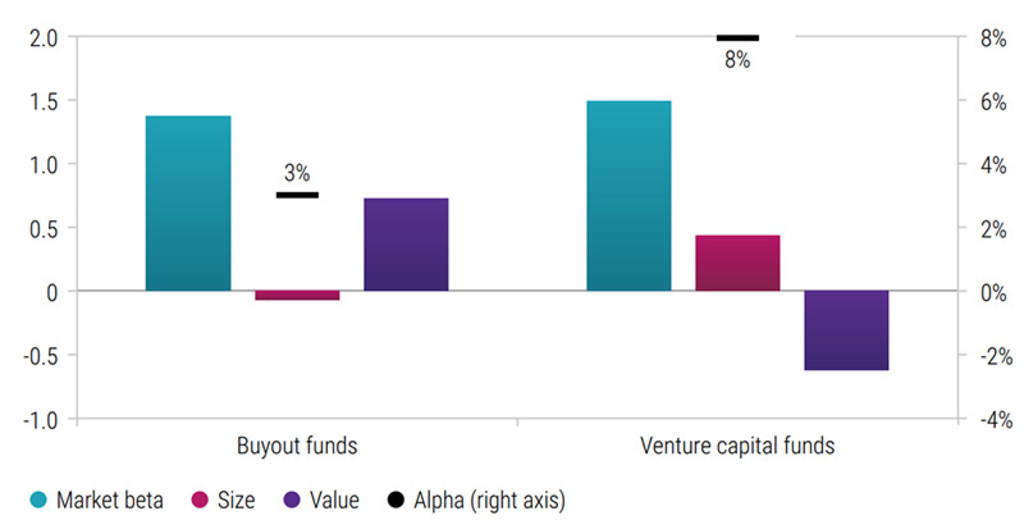
Past performance is no guarantee for future returns. The value of your investment may fluctuate. Source: Robeco (June 2025 and Ang et al (2014).
Robeco’s liquid alternative
Building on its systematic investing expertise and active ownership capabilities, Robeco has developed a liquid strategy to replicate private equity characteristics in public equities. The process involves first defining the universe, starting with over 10,000 companies, screened for liquidity. Then factor tilts are applied. Buyout proxies emphasize leverage and share buybacks, while venture capital proxies focus on earnings growth and R&D.
Portfolio construction follows, during which weights are optimized to mirror private equity exposures. Sustainability is integrated by applying proprietary SDG scores and engagement insights to improve governance and climate alignment.
As Huij and Kyosev demonstrate, this systematic approach has delivered simulated performance broadly in line with the MSCI Burgiss private equity benchmark. While reported private equity returns appear smoother due to infrequent NAV updates, research shows that ‘unsmoothed’ results exhibit volatilities closer to those of Robeco’s replicating strategy.
Figure 2: Cumulative returns in portfolio simulations
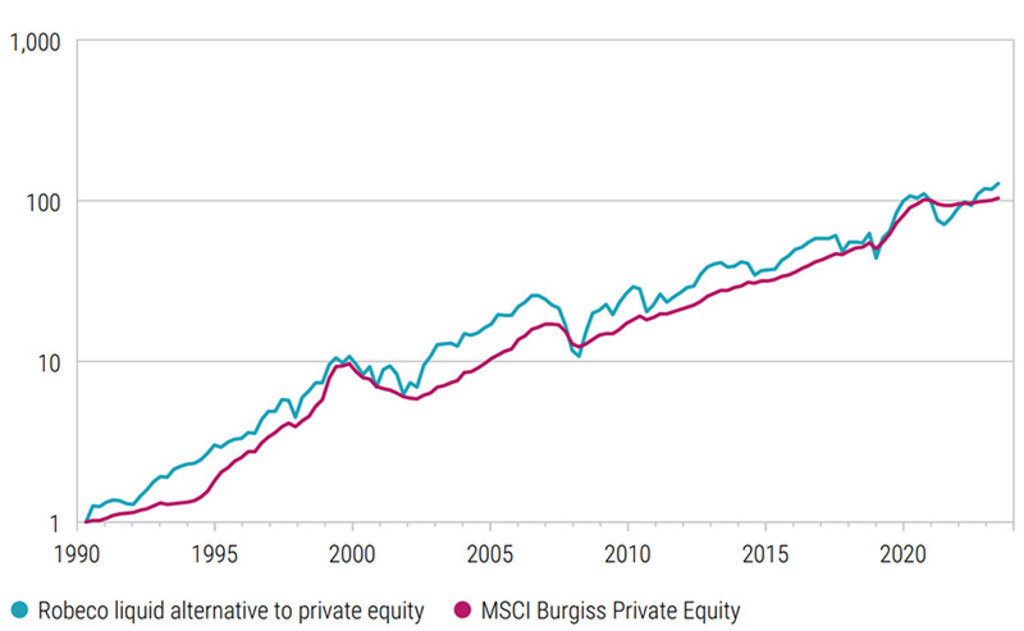
Simulated past performance is no guarantee of future results. For illustrative purposes only. Source: Robeco, based on portfolio simulation, cumulative return in USD, gross dividends reinvested, Developed markets, Q1 1991-Q3 2024, logarithmic scale. MSCI Burgiss returns are based on MSCI Global Private Equity Closed-End Fund Index (Unfrozen; USD). The performance shown is based on a simulated and hypothetical (back-tested) data and may suffer from the benefit of hindsight. Although Robeco is prudent in its assumptions for simulations, no representation is made that the index will achieve results similar to those shown and actual performance results may deviate significantly.
Sustainability and engagement benefits
Public markets provide a broad investment pool and rich sustainability data, enabling portfolios to be tilted toward positive SDG alignment while underweighting negatively scored companies. This aligns particularly well with venture-style exposure to innovative firms.
Robeco’s strategy also emphasizes active ownership. Engagement with portfolio companies addresses sustainability, governance, and human capital – reflecting the close involvement typical in private equity but applied within listed markets.
Conclusion
Private equity offers attractive return potential but is costly, illiquid, and often lacking in sustainability transparency. Replication in public equities enables investors to capture much of the premium while improving liquidity, lowering fees, and integrating sustainability.
Robeco’s innovative research aims to capture the full alpha by combining academic knowledge, portfolio construction expertise, and proprietary voting and engagement data. The goal is to deliver private equity-like returns but with the benefits of public equity – high liquidity, lower costs, and sustainability integration.
This article is an excerpt of a special topic in our five-year outlook.

Expected Returns 2026 - 2030
重要資料
本網站僅供《證券及期貨條例》(香港法例第571章)及其附屬法例所界定之專業投資者瀏覽及使用。 投資涉及風險。過往表現並不代表未來表現。本網站所載資料僅供參考之用,並不構成任何投資建議,亦非作出買賣任何證券或採納任何投資策略之要約或招攬。投資者不應僅憑本網站提供之資料作出投資決定,在作出任何投資決定前,應徵詢獨立意見(包括有關稅務影響之意見)。投資者應確保完全理解投資產品的相關風險,亦應考量自身投資目標及風險承受水平。投資乃閣下之個人決定。除非銷售投資產品的中介人已向閣下告知該投資產品適合閣下,並已解釋其符合閣下投資目標之原因,否則閣下不應投資。請參閱相關發售文件或其他法律文件,以獲取包括風險因素在內的進一步詳情。 本網站由荷寶投資管理香港有限公司發布,該公司受香港證券及期貨事務監察委員會(「證監會」)規管(中央編號:APU851)。本網站未經證監會審閱。 無法保證任何投資產品可實現其投資目標。概不就任何投資產品之表現或投資回報作任何聲明或承諾。投資的價值或會波動。本網站所載過往表現、推算或預測,均不應視作未來表現之保證或指標,且概不提供任何明示或暗示之保證。本網站內容建基於相信為可靠之來源,惟因應資料傳遞技術特性及須採用多項數據來源(包括第三方內容),故概不保證其準確性。所述觀點僅乃截至上述日期,或會隨市況變化而改變,可予更改而毋須另行通知。該等意見可能有別於其他荷寶投資專業人士之意見。因使用本材料或當中所載任何評論、意見或估算而引致之直接、間接或相應損失,荷寶概不承擔法律責任。荷寶並無責任更新本網站或任何網站內容。未經荷寶事先書面許可,不得複製、分發或刊發本網站任何材料。 除非另有說明,資料來源:荷寶。