

Head of Sustainability Integration


• インサイト
SFDR – what asset managers need to know
The EU’s Sustainable Finance Disclosure Regulations (SFDR) are a set of disclosure rules designed to enhance the transparency and maintain the credibility of sustainable investing. We unpack what it means for asset managers in theory and how it’s evolving in practice.
執筆者

まとめ
- SFDR is part of the EU’s ambitions to build a sustainable economy
- Deeper scrutiny of Articles 6, 8, and 9 reveals surprises
- Progress in practice is incremental and currently on pause
Regulation is a dirty word in many corners of business and politics, but sustainability regulations are desperately needed to accelerate the transition to cleaner, greener and more equitable economies. The EU has wasted no time in drafting legislative frameworks to steer its companies, industries, and trading partners toward sustainable profits and growth.
The EU Sustainable Finance Action Plan is just one part of the grand plan. Its overarching goal is to channel capital to sustainable investments and development across the 27-nation bloc. It does so through several underlying initiatives including the Sustainable Finance Disclosure Regulations (SFDR).
The SFDR is designed to ensure that capital intended for sustainable investments flows into bona fide sustainable products. To accomplish this, the SFDR requires asset managers to thoughtfully consider sustainability risks in their investment products, substantiate any sustainability claims based on objective criteria, and disclose those results publicly.
In addition to protecting investors from ‘greenwashing’, more data and disclosure should also arm them with more information to compare the merits and trade-offs of competing investment products.
Common misconceptions
By now, the SFDR’s most famous feature is its classification system. Asset managers are required to classify all investment products as Article 6, 8, or 9.
Article 6 products have no sustainability goal but must disclose why that’s the case.
Article 8 products must demonstrate they promote environmental or social characteristics.
Article 9 products must pursue a clear sustainable investment objective.
Investment managers may be tempted to use these new classifications as a marketing label to increase their attractiveness. However, labels imply that products have been assessed using a strict set of standardized metrics and that’s not the case with SFDR. Though it requires reporting across common subject areas, there is still a wide range of variability between the sustainability features. At its core, the SFDR is a transparency measure that lets investors peer inside a product so they can understand what features make it sustainable.
The SFDR is a transparency measure that lets investors peer inside a product so they can understand what features make it sustainable
Another common error is assuming that Article 6 products are exempt from sustainability disclosures. SFDR requires all financial market participants to assess and disclose whether they integrate sustainability policies into their products, the likely impact of sustainability risk on returns, as well as if they consider the negative impacts their products may have on a special set of EU-defined indicators known as Principal Adverse Impacts (PAIs).1
Comparing Articles 8 and 9
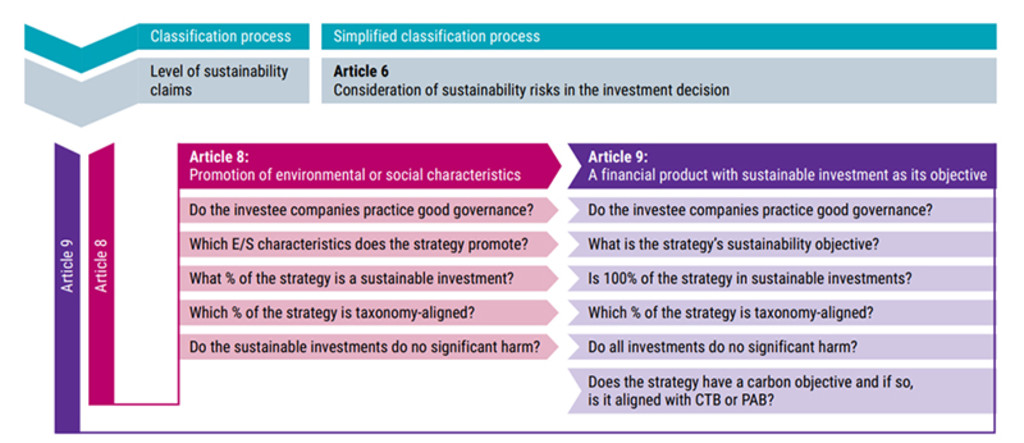
Relative to Article 6, Articles 8 and 9 require more measurement and reporting across a broad range of sustainability metrics. Article 8 products must demonstrate they promote sustainability while Article 9 products must demonstrate they directly contribute to them. In addition, both classes must show they adhere to good governance and report to what extent they are using the ‘sustainable activities’ definitions of the EU Taxonomy.
Beyond these requirements, Article 9 portfolios are mandated to report on any negative effects their underlying securities may have on 18 (of 64) PAIs that include areas such as carbon emissions, waste disposal, human rights, and gender diversity. In contrast, Article 8 products need only to explain whether they consider PAIs in their investments.
Another distinction is that Article 9 must be fully invested in companies that are deemed sustainable, while Article 8 products need only state the share of sustainable investments they intend to make.
Figure 1 – How Robeco determines a product’s SFDR classification
Source: Robeco, April 2023
More clarity is critical
What constitutes a ‘sustainable investment’ however is not strictly defined. A wind farm investment may be sustainable for a clean energy strategy, but its poor worker-safety record may make it unacceptable for a portfolio focused on high performance on socially oriented factors. That lack of clarity is causing kinks and slowing SFDR’s progress.
Amendments have been proposed which include stricter technical standards and more rigor on PAI
assessments (i.e., not just whether but how PAIs are applied to investments). However, it may take years before these are vetted, approved, and implemented (if approved at all).
The EU Taxonomy’s classification system could provide a speedier solution, given both Article 8 and 9 classes require managers to already report how much their products align with the Taxonomy2. But that can’t be measured until investee companies themselves classify and report their sustainable activities. The CSRD, a separate sustainable finance directed aimed at corporate sustainability disclosure, requires larger companies (more than 500 employees) to report the Taxonomy alignment of their operations beginning already this year.
But given the costs involved, smaller companies still have years to comply. Moreover, the social part of the EU Taxonomy that defines which activities contribute positively to social impact, is still in development. Given these gaps in reporting, using the Taxonomy as an accelerated solution by year’s end is unlikely.
Where we are and where we’re going
For the time being, uncertainty over how rules will evolve has caused many managers to put a pause on further SFDR action plans. Despite the pause, rules are creating lots of dialogue and engagement. Moreover, progress at such scale and with so much impact is better done in increments.
Over time, we believe external pressure from stakeholders combined with technological advances in data capture and processing should push companies and the investment industry toward more integration and disclosure of sustainability risks and impact.
Read more on how sustainability is impacting finance and investments in our SI Big Book 2.0.
Footnotes
1PAIs are a specific set of impact indicators defined by the EU as “negative, material, or likely to be material effects on sustainability factors that are caused, compounded by, or directly linked to investment decisions and advice performed by the legal entity.”
2EU Taxonomy alignment is measured by % share of total portfolio holdings whose underlying business operations count as ‘sustainable activities’ based on EU Taxonomy technical criteria.
重要事項
当資料は情報提供を目的として、ロベコ・ジャパン株式会社(以下「当社」)が独自に作成、または当社のグループ会社(Robeco Institutional Asset Management B.V.およびその関連会社を含む)から提供された資料を当社が編集・翻訳したものです。資料中の個別の金融商品の売買の勧誘や推奨等を目的とするものではありません。記載された情報は十分信頼できるものであると考えておりますが、その正確性、完全性を保証するものではありません。意見や見通しはあくまで作成日における弊社の判断に基づくものであり、今後予告なしに変更されることがあります。運用状況、市場動向、意見等は、過去の一時点あるいは過去の一定期間についてのものであり、過去の実績は将来の運用成果を保証または示唆するものではありません。また、記載された投資方針・戦略等は全ての投資家の皆様に適合するとは限りません。当資料は法律、税務、会計面での助言の提供を意図するものではありません。 ご契約に際しては、必要に応じ専門家にご相談の上、最終的なご判断はお客様ご自身でなさるようお願い致します。 運用を行う資産の評価額は、組入有価証券等の価格、金融市場の相場や金利等の変動、及び組入有価証券の発行体の財務状況による信用力等の影響を受けて変動します。また、外貨建資産に投資する場合は為替変動の影響も受けます。運用によって生じた損益は、全て投資家の皆様に帰属します。したがって投資元本や一定の運用成果が保証されているものではなく、投資元本を上回る損失を被ることがあります。弊社が行う金融商品取引業に係る手数料または報酬は、締結される契約の種類や契約資産額により異なるため、当資料において記載せず別途ご提示させて頂く場合があります。具体的な手数料または報酬の金額・計算方法につきましては弊社担当者へお問合せください。 当資料及び記載されている情報、商品に関する権利は弊社に帰属します。したがって、弊社の書面による同意なくしてその全部もしくは一部を複製またはその他の方法で配布することはご遠慮ください。 商号等: ロベコ・ジャパン株式会社 金融商品取引業者 関東財務局長(金商)第2780号 加入協会: 一般社団法人 資産運用業協会