

Head of Solutions Research


• 市場觀點
Seizing quant and fundamental alpha in developed equity markets
Building on the success of our previous exploration into combining fundamental and quantitative strategies in emerging markets, we now shift our focus to developed markets. Our latest research investigates how these distinct investment styles can be leveraged, both individually and in tandem, to navigate the challenges posed by high valuations and market concentration, aiming to uncover new avenues for alpha generation.
作者


Researcher

Head of Quant Equity Research



Researcher
熱門關鍵詞
概要
- To keep enjoying high equity returns, investors need to rely increasingly on active alpha
- Quant and fundamental investing styles presents two distinct routes to target alpha
- Diversifying across genuine quant and fundamental strategies can offer significant benefits
Equity investors face a dilemma in developed markets. While equity markets have mostly been going up following the global financial crisis in 2009, their high valuations and concentration indicate lower future expected returns and increased risks. To illustrate, the forward price-to-earnings ratio of the MSCI World traded at 18.09, hence at the higher end of the historical range. This high valuation resonates with Robeco’s 5-year Expected Returns forecast of 6.5% (EUR, nominal), which is not even half of the 13.6% annual realized developed market return over the previous five years.
To compensate for this potential future return gap, investors have to rely more on alpha from active management. However, active management comes in various forms and degrees of activeness. To this end, we investigate the performance of quantitative and fundamental equity investment styles. Which of the two is better suited to outperform in developed markets? Are there differences in factor exposures and risk-taking? And what happens when the two approaches are combined?1
Distinct and complementary
From first principles, it is natural to expect quant and fundamental investment styles to be complementary in nature. On the one hand, the fundamental approach typically thrives on very deep knowledge about a select set of companies. On the other hand, quant investing uses data-driven insights to rank the whole stock universe, based on company characteristics corresponding to rewarded factors. Given this distinct nature of building investment signals, portfolio construction calls for very different approaches as well: a high-conviction fundamental portfolio consisting of few stocks versus a broadly diversified quant portfolio to harvest the targeted factor premiums.
In our study spanning from November 2004 to March 2025, we show that both quant and fundamental managers listed in the eVestment database have outperformed the market. While fundamental strategies show a higher average outperformance, their managers also typically take higher active risks relative to their benchmark, in other words, have a higher tracking error (TE). Considering these two dimensions jointly, we document relatively higher information ratios (IRs) for quant strategies (0.29 vs. 0.22).
From an investment style perspective, quant strategies typically exhibit exposure to salient style factors, such as value, momentum, and quality, while fundamental strategies do not. This characterization highlights the difference between the two approaches and suggests that portfolio diversification can be strategically enhanced by combining quantitative and fundamental styles. Indeed, over the period spanning from January 2008 to March 2025, a risk parity combination of quant and fundamental strategies increases the IR to 0.34 on average, which is around 50% higher than the average of the two subgroups (0.23).2
Robeco style stars
When combining the different fundamental strategies with the Robeco Global Developed Enhanced Indexing strategy or the various quantitative strategies with the Robeco Global Stars Equities strategy, we find average IRs of 0.61 and 0.54, respectively.
Figure 1 – Information ratio for risk parity combinations of quant and fundamental strategies
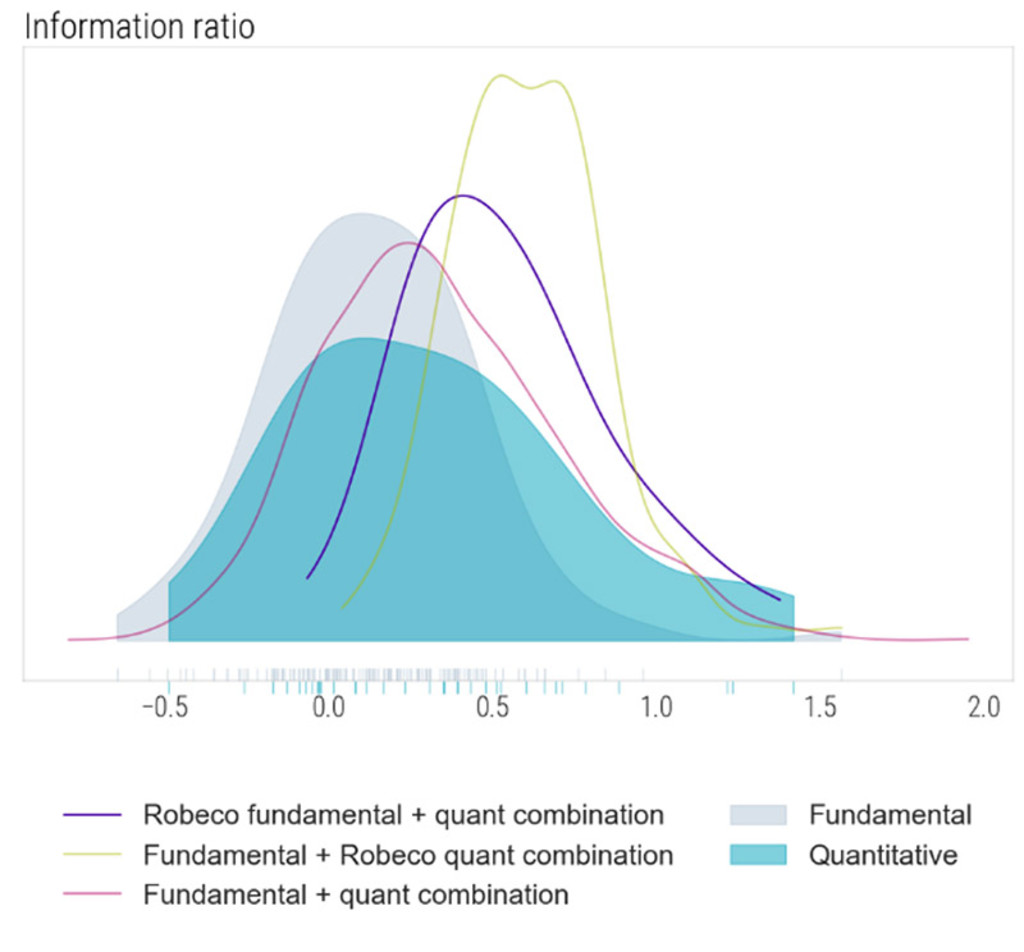
Past performance is no guarantee of future results. The value of your investments may fluctuate. Source: Robeco, eVestment. The figure shows density plots for the annualized information ratio of risk parity combinations of quant and fundamental strategies. The densities for the quantitative strategies are shown in blue, for fundamental ones in grey, and for the risk parity combinations in pink (using all strategies), green (combining only Robeco Global Developed Enhanced Indexing with all fundamental strategies) and purple (combining only Robeco Global Stars Equities with all quant strategies). We include strategies that were active from January 2008 to March 2025. This results in 135 fundamental strategies, 36 quant ones, and 135*36 = 4860 combinations.
Given their good track record a combination of these two strategies yields an IR of 0.88. Apparently, the opportunity set of strategy style diversification is considerable, especially if one relies on contenders that genuinely live up to their targeted investment style, be it quant or fundamental. Moreover, at Robeco, we can also create tailor-made solutions that combine our quantitative and fundamental strategies into a single strategy, providing customized solutions to meet each client’s specific investment goals.
Footnotes
1This study complements our January 2024 emerging markets study, ‘Embracing fundamental and quant investing in emerging markets’.
2We start this analysis only in 2008 to have both a fundamental and quantitative Robeco strategy included
下載刊物
探索量化價值
訂閱我們的電子報,獲取尖端的量化策略和見解。
重要資料
本網站僅供《證券及期貨條例》(香港法例第571章)及其附屬法例所界定之專業投資者瀏覽及使用。 投資涉及風險。過往表現並不代表未來表現。本網站所載資料僅供參考之用,並不構成任何投資建議,亦非作出買賣任何證券或採納任何投資策略之要約或招攬。投資者不應僅憑本網站提供之資料作出投資決定,在作出任何投資決定前,應徵詢獨立意見(包括有關稅務影響之意見)。投資者應確保完全理解投資產品的相關風險,亦應考量自身投資目標及風險承受水平。投資乃閣下之個人決定。除非銷售投資產品的中介人已向閣下告知該投資產品適合閣下,並已解釋其符合閣下投資目標之原因,否則閣下不應投資。請參閱相關發售文件或其他法律文件,以獲取包括風險因素在內的進一步詳情。 本網站由荷寶投資管理香港有限公司發布,該公司受香港證券及期貨事務監察委員會(「證監會」)規管(中央編號:APU851)。本網站未經證監會審閱。 無法保證任何投資產品可實現其投資目標。概不就任何投資產品之表現或投資回報作任何聲明或承諾。投資的價值或會波動。本網站所載過往表現、推算或預測,均不應視作未來表現之保證或指標,且概不提供任何明示或暗示之保證。本網站內容建基於相信為可靠之來源,惟因應資料傳遞技術特性及須採用多項數據來源(包括第三方內容),故概不保證其準確性。所述觀點僅乃截至上述日期,或會隨市況變化而改變,可予更改而毋須另行通知。該等意見可能有別於其他荷寶投資專業人士之意見。因使用本材料或當中所載任何評論、意見或估算而引致之直接、間接或相應損失,荷寶概不承擔法律責任。荷寶並無責任更新本網站或任何網站內容。未經荷寶事先書面許可,不得複製、分發或刊發本網站任何材料。 除非另有說明,資料來源:荷寶。