


Head of Quant Equity Research


• 研究
Embracing fundamental and quant investing in emerging markets
New research explores the dynamic interplay of fundamental and quant investing styles in emerging markets, revealing potential for enhanced portfolio performance.




概要
- A new era in emerging markets is likely dawning, ripe with investment opportunities
- New Robeco research shows both fundamental and quant strategies can generate alpha in emerging markets
- Merging these strategies skillfully can enhance portfolio stability through style diversification
Emerging markets are well placed to lead the next global equity upcycle, both from a macroeconomic and valuation perspective. This positive outlook is also reflected in our five-year expected return forecast of 8.25% for emerging markets, a 1.5% premium over developed markets.
Furthermore, we see growing interest in this asset class from clients. A new white paper by our quant researchers Vera Roersma, Harald Lohre, and Matthias Hanauer delves into whether a fundamental or quant approach is better suited to capitalize on these opportunities. More specifically, they examine fundamental and quantitative emerging market equity strategies’ risk and return profiles, as well as their style exposures. Alternatively, investors who refrain from choosing and instead adopt both strategies may benefit from the best of both worlds.
Our research reveals distinct investment styles and risk profiles between fundamental and quant strategies. Despite achieving similar average outperformance of around 2%, fundamental managers typically take higher active risks, resulting in relatively higher information ratios (IRs) for quant strategies (0.47 vs. 0.32). This suggests that quantitative strategies tend to deliver more stable performance with lower relative risk. However, higher active risks (or tracking errors, TEs) are most often a prerequisite for high outperformance. Interestingly, the high TEs of the top-performing strategies often derive from below-average absolute volatility, highlighting the effectiveness of low volatility strategies in emerging markets.
Figure 1 – Distribution of information ratios for fundamental and quantitative strategies and 50/50 combinations
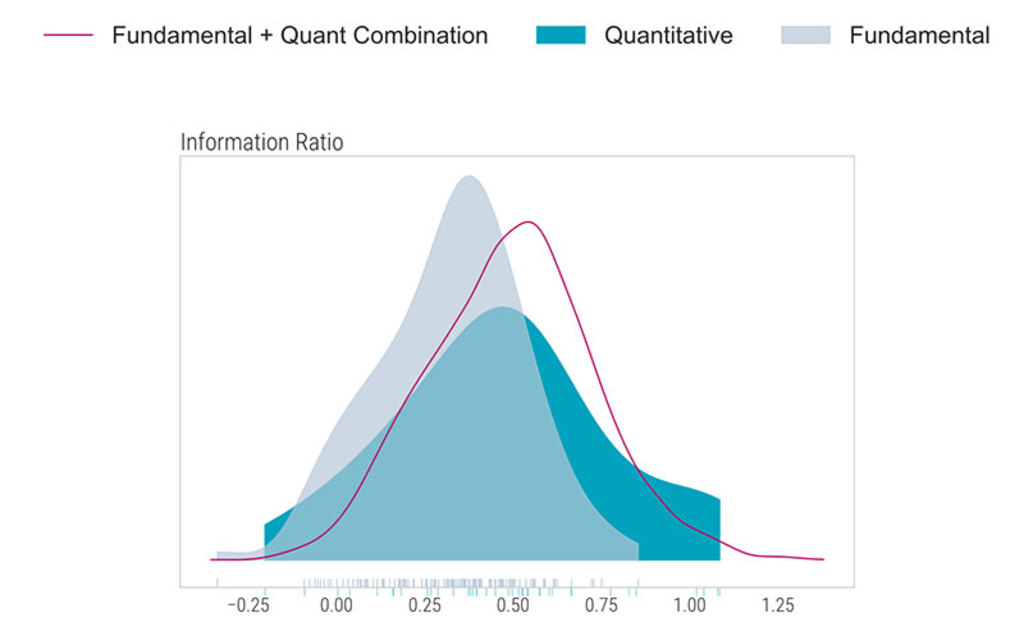
Source: Robeco, eVestment. The figure shows density plots for the annualized information ratio. The densities for the quantitative strategies are shown in blue, for fundamental ones in grey, and for the 50 fundamental/50 quant combinations in pink. We include strategies that were active from April 2011 to September 2023. This results in 123 fundamental strategies, 39 quant ones, and 39*123 = 4,797 50/50 combinations.
新興市場的新機會
訂閱我們的電子報,深入了解新興市場投資機會。
Investment style analysis shows that quantitative strategies usually have exposure to the four style factors considered in the study, in contrast to most fundamental strategies that exhibit a growth-like exposure as reflected in their anti-value tilt. This distinction offers a strategic opportunity for portfolio diversification. Indeed, merging quant and fundamental styles in a 50/50 split raises the average IR to 0.49, indicating a 25% improvement over the individual subgroup averages, as illustrated in Figure 1.
More thoughtful combinations of quant and fundamental approaches can bolster portfolio performance and risk management even more, and the study thus presents a benchmark-relative core investment, a sustainable core investment, and a conservative completion portfolio.
Conclusion
Our comprehensive study highlights the potential effectiveness of both quantitative and fundamental strategies in emerging market equities. While their returns are similar, their risk-taking approaches differ, with quantitative funds typically exhibiting lower active risks. Thoughtfully combining these styles not only enhances the IR but also creates a more balanced risk profile, demonstrating the strategic advantage of a diversified approach in emerging markets investment.
下載刊物

Why you should increase allocation to EM in 2024
On-demand webinar
重要資料
本網站僅供《證券及期貨條例》(香港法例第571章)及其附屬法例所界定之專業投資者瀏覽及使用。 投資涉及風險。過往表現並不代表未來表現。本網站所載資料僅供參考之用,並不構成任何投資建議,亦非作出買賣任何證券或採納任何投資策略之要約或招攬。投資者不應僅憑本網站提供之資料作出投資決定,在作出任何投資決定前,應徵詢獨立意見(包括有關稅務影響之意見)。投資者應確保完全理解投資產品的相關風險,亦應考量自身投資目標及風險承受水平。投資乃閣下之個人決定。除非銷售投資產品的中介人已向閣下告知該投資產品適合閣下,並已解釋其符合閣下投資目標之原因,否則閣下不應投資。請參閱相關發售文件或其他法律文件,以獲取包括風險因素在內的進一步詳情。 本網站由荷寶投資管理香港有限公司發布,該公司受香港證券及期貨事務監察委員會(「證監會」)規管(中央編號:APU851)。本網站未經證監會審閱。 無法保證任何投資產品可實現其投資目標。概不就任何投資產品之表現或投資回報作任何聲明或承諾。投資的價值或會波動。本網站所載過往表現、推算或預測,均不應視作未來表現之保證或指標,且概不提供任何明示或暗示之保證。本網站內容建基於相信為可靠之來源,惟因應資料傳遞技術特性及須採用多項數據來源(包括第三方內容),故概不保證其準確性。所述觀點僅乃截至上述日期,或會隨市況變化而改變,可予更改而毋須另行通知。該等意見可能有別於其他荷寶投資專業人士之意見。因使用本材料或當中所載任何評論、意見或估算而引致之直接、間接或相應損失,荷寶概不承擔法律責任。荷寶並無責任更新本網站或任何網站內容。未經荷寶事先書面許可,不得複製、分發或刊發本網站任何材料。 除非另有說明,資料來源:荷寶。