


Client Portfolio Manager

• 市場觀點
How dynamic high yield responds when spreads widen
High yield offers attractive income, but how can investors stay invested if tight spreads widen? Dynamic high yield uses market signals to adjust risk as conditions change.
作者

Ward Poirters

Portfolio Manager
概要
- Dynamic high yield has shown resilience in past periods of spread widening
- Its systematic process adjusts exposure as signals strengthen or weaken
- Its portfolio structure allows it to reposition quickly
Investors are facing no shortage of reasons for concern. Geopolitical tensions, energy-price risks and uncertainty over central bank policy continue to cloud the outlook. Although spreads have widened in recent weeks, they remain close to historically tight levels.
This suggests that investors are still demanding relatively little extra compensation for taking credit risk. For investors who want to keep earning income from high yield, this creates a challenge: staying invested while managing the risk of a market reversal.
A high yield bond usually pays more interest than a government bond because there is more risk that the company borrowing the money will struggle to repay it. The spread is that extra yield. If a government bond yields 3% and a high yield bond yields 6%, the spread is three percentage points.
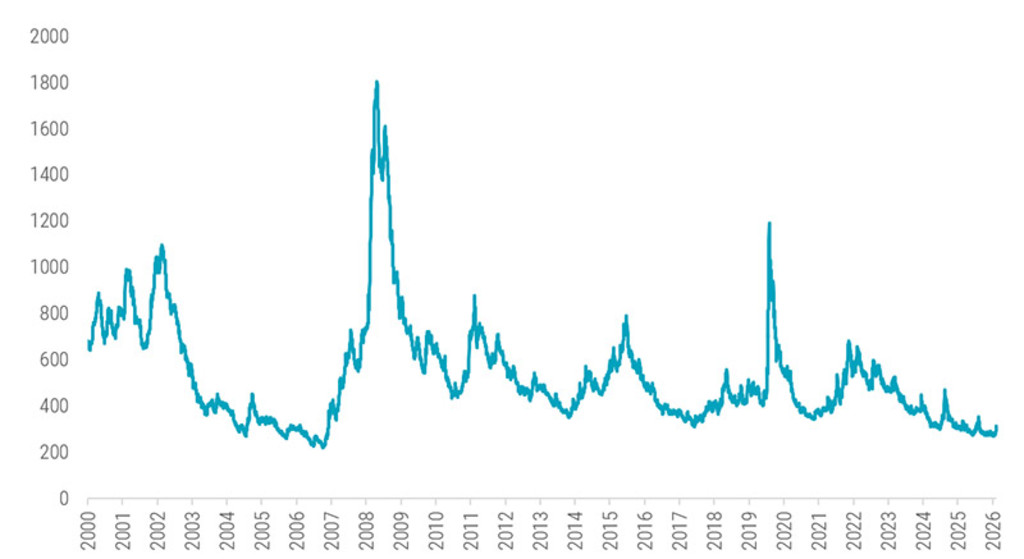
Today, spreads are tight, meaning investors receive relatively little extra yield for taking additional company risk. If confidence in companies weakens, investors may demand more compensation. Spreads then widen, and the prices of existing high yield bonds generally fall. Figure 1 puts today’s position in context: spreads rose sharply during past periods of concern, but are now near the low end of the range shown.
Figure 1 - How the spread on high yield bonds has changed over time
Past performance is no guarantee of future results. The value of your investments may fluctuate.
Source: Bloomberg Global High Yield Index, until the end of September 2026.
Why stay invested in high yield?
Despite tight credit spreads, high yield continues to offer attractive income, with yields around levels not seen for more than two decades. Those yields provide a stronger starting point for returns. The income earned can also help offset some decline in bond prices. Fundamentals across the asset class remain relatively strong. The high yield market has become higher-quality over time, with BB-rated bonds now representing a record share of both the US and European markets.1
When conditions become less supportive, the strategy can reduce exposure; when they improve, it can increase exposure again
High yield can also add diversification to a broader bond portfolio because it behaves differently from more interest-rate-sensitive bonds. Attractive income, relatively solid fundamentals and diversification therefore continue to make a case for staying invested. But tight spreads mean investors also need to be prepared if market conditions worsen. This is where a more flexible approach can help.
信貸投資的新動態
訂閱我們的電子報,緊跟最新的信貸投資趨勢。
How does dynamic high yield operate in difficult markets?
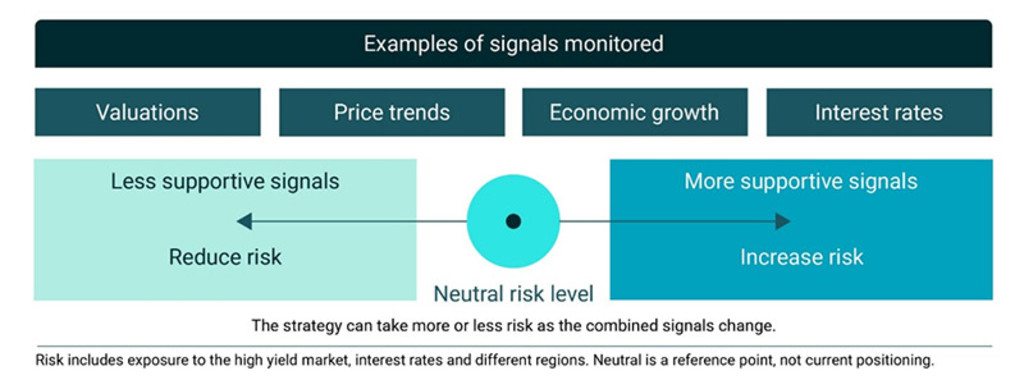
Traditional high yield strategies generally stay invested so they can earn income and benefit when the market rises. But that also leaves them exposed when high yield bonds fall in value. Dynamic high yield has a different approach: it can adjust how much high yield risk it takes. It does this by monitoring signals such as the extra yield bonds offer, price trends, economic growth and interest rates.
These signals are combined systematically to determine the strategy's level of high yield exposure. When conditions become less supportive, the strategy can reduce exposure to help limit downside risk. But the flexibility also works in the other direction: when conditions are more favorable, it can increase exposure above its neutral level to capture more of the income and return potential available from high yield.
Figure 2 - Market signals guide high yield risk exposure – the aim is not to predict every market turning point perfectly, but to adapt as conditions change
Source: Robeco, October 2026.
Why consider dynamic high yield today?
Today's combination of attractive yields and tight spreads makes flexibility particularly relevant. Dynamic high yield seeks to capture that income while adjusting risk as conditions change. This allows investors to remain in the asset class without having to decide for themselves when to exit or re-enter the market.
Footnote
1Source: KKR, August 2026. BB-rated bonds account for approximately 57% of the US high yield market and 68% of the European high yield market, both record levels.
重要資料
本網站僅供《證券及期貨條例》(香港法例第571章)及其附屬法例所界定之專業投資者瀏覽及使用。 投資涉及風險。過往表現並不代表未來表現。本網站所載資料僅供參考之用,並不構成任何投資建議,亦非作出買賣任何證券或採納任何投資策略之要約或招攬。投資者不應僅憑本網站提供之資料作出投資決定,在作出任何投資決定前,應徵詢獨立意見(包括有關稅務影響之意見)。投資者應確保完全理解投資產品的相關風險,亦應考量自身投資目標及風險承受水平。投資乃閣下之個人決定。除非銷售投資產品的中介人已向閣下告知該投資產品適合閣下,並已解釋其符合閣下投資目標之原因,否則閣下不應投資。請參閱相關發售文件或其他法律文件,以獲取包括風險因素在內的進一步詳情。 本網站由荷寶投資管理香港有限公司發布,該公司受香港證券及期貨事務監察委員會(「證監會」)規管(中央編號:APU851)。本網站未經證監會審閱。 無法保證任何投資產品可實現其投資目標。概不就任何投資產品之表現或投資回報作任何聲明或承諾。投資的價值或會波動。本網站所載過往表現、推算或預測,均不應視作未來表現之保證或指標,且概不提供任何明示或暗示之保證。本網站內容建基於相信為可靠之來源,惟因應資料傳遞技術特性及須採用多項數據來源(包括第三方內容),故概不保證其準確性。所述觀點僅乃截至上述日期,或會隨市況變化而改變,可予更改而毋須另行通知。該等意見可能有別於其他荷寶投資專業人士之意見。因使用本材料或當中所載任何評論、意見或估算而引致之直接、間接或相應損失,荷寶概不承擔法律責任。荷寶並無責任更新本網站或任何網站內容。未經荷寶事先書面許可,不得複製、分發或刊發本網站任何材料。 除非另有說明,資料來源:荷寶。