

Portfolio Manager


• 市場觀點
The neobank era has arrived
Neobanks, which are challenging traditional banks with their digital-only banking services, have been growing fast and grabbing market share from conventional rivals worldwide. Now profitability is the focus and we believe the neobank era has truly arrived.
作者




Portfolio Manager

Portfolio Manager

FinTech/New World Financials Analyst
概要
- Common elements but unique business models
- Diversified revenue streams underpin positive outlook
- Focus shifts to profitable growth as opposed to profit at any cost
Neobanks saw rapid customer growth with the pandemic’s shift to digital banking. However, higher interest rates since 2022 have affected availability of funding for fintech in general and raised concerns over business models of neobanks and their ability to monetize a growing customer base. According to BCG, only 23 out of 453 global digital challenger banks in 2023 were operationally profitable.
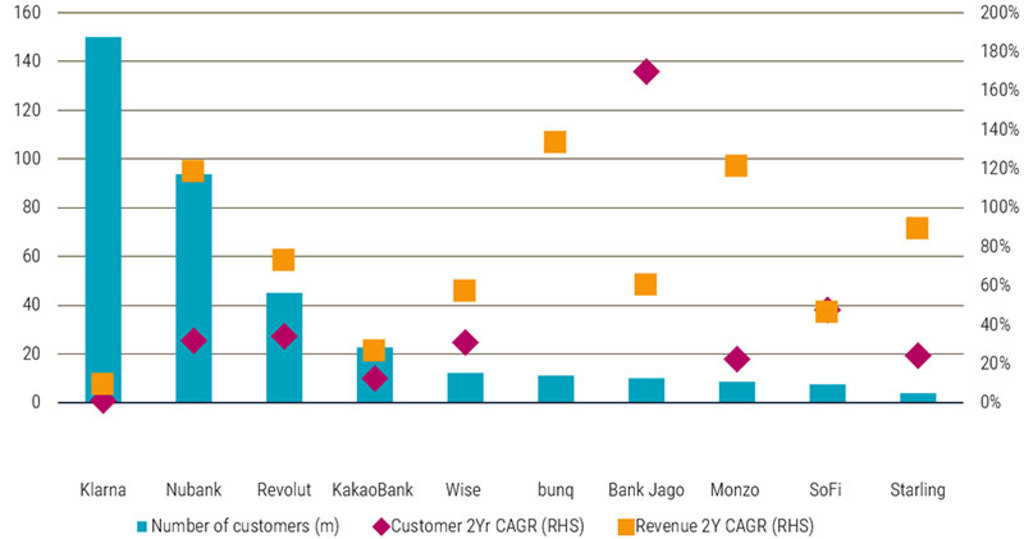
Figure 1: Neobanks are growing revenue fast
Source: Robeco, company data, end December 2023
The challenging backdrop has prompted neobanks to shift from ‘growth at all cost’ to profitable growth and sustainable operations. Customer acquisition has decelerated somewhat from pandemic highs, but revenues continue to rise impressively. According to BCG, challenger banks were star performers posting revenue CAGR of 78% in 2021-2023 compared to 14% average for global fintech, and 21% excluding crypto- and China-exposed fintechs.
In 2023 a number of leading neobanks demonstrated record profitability
In 2023 a number of leading neobanks (Revolut and Starling) demonstrated record profitability and several players reported full year of profits for the first time (Monzo and bunq). The positive trend continued into 2024 with Dave, MoneyLion, Chime and SoFi turning to profitability in recent quarters in the US.
Figure 2: Profitability improving (in USD millions)

Source: Robeco, company data, end December 2023
Regional focus
Neobanks have taken unique paths to scale and profitability depending on the starting point including geography, market characteristics, customer focus and product strategy. The operating and regulatory environment differs across countries. In the US neobanks tend to be niche, focus on payments and operate in partnerships with banks. Chime, for example, is partnering with two US banks and its revenue stems primarily from interchange fees.
In the EU neobanks face tough competition with a high number of neobanks per capita, low interchange fees (capped at 0.2% for debit and 0.3% for credit) and increased regulatory scrutiny. In Brazil, on the other hand, the central bank and regulators created infrastructure (instant payment system Pix) enabling fintech solutions to scale with a number of success stories including Nubank (a neobank), Creditas (a lending platform), Dock (a fintech infrastructure provider), and Ebanx (a payments provider).
Markets with a significant underbanked population offer attractive growth prospects. Nubank is a good example of a neobank that benefited from a narrow geographic focus, operating only in Brazil for its first six years, where they have now gathered more than 95 million clients (making up 55% of the adult population) before expanding elsewhere. Other examples include KakaoBank with 24 million customers in Korea, and Monzo surpassing 10 million customers in the UK.
There are some notable exceptions like Wise and Revolut that pursued rapid international expansion. Revolut boasts a global footprint across 38 countries with 45 million customers as of June 2024.
Diversified revenue streams
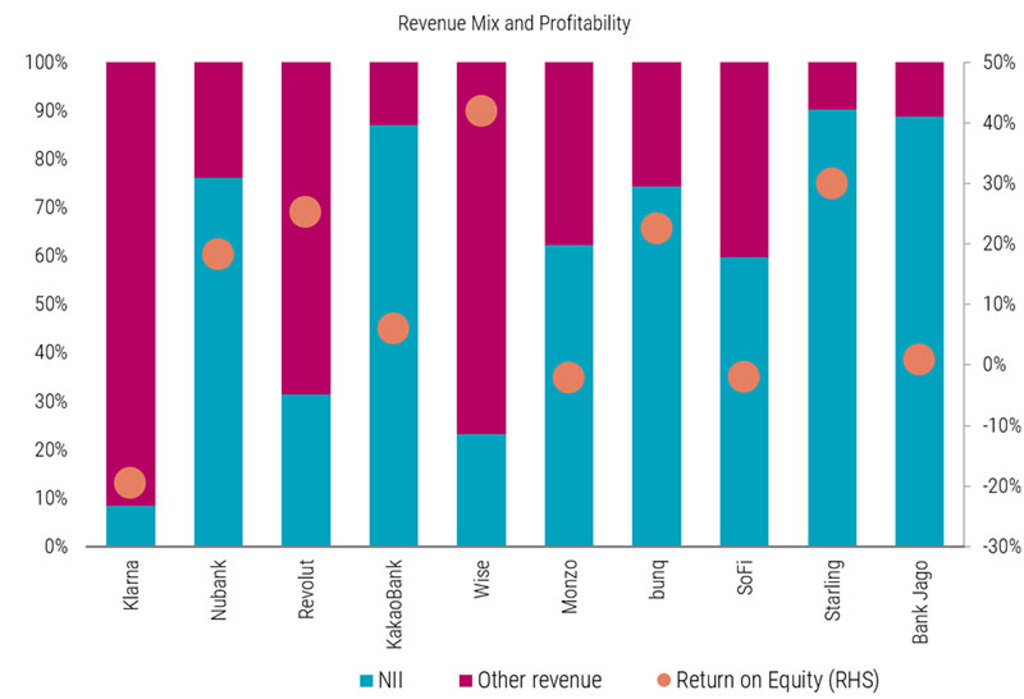
Establishing robust credit operations is a crucial factor. Nubank and Starling have established lending businesses and others are in the process of rolling out credit to their clients. Neobanks tend to focus more on unsecured credit, though there are some players offering mortgages (Starling in the UK, KakaoBank in Korea, Inter in Brazil). Revolut delivered strong profitability last year despite low reliance on credit (loan-to-deposit ratio at just 3.5%). This was due to higher interest on liquidity and strong revenue diversification, with no single product stream or region accounting for more than 30% of the top line.
Figure 3: Neobanks are very focused on diversified revenue streams, not just net interest income
Source: Robeco, company data, end December 2023
Continuous innovation
Lacking legacy tech and digital focus allow neobanks to rapidly launch and re-work new products and solutions. Revolut, which had only two products in 2015 (its flagship multi-currency travel card and a mobile app) now offers a full suite of services including investments, trading (including crypto) and credit. Revolut also has a dynamic approach to managing its products and cancels products/features based on customer feedback. Similarly Nubank expanded its offer from credit cards to personal loans, investments, cryptocurrency trading, auto and life insurance, among other product lines.
Focus on primary relationships
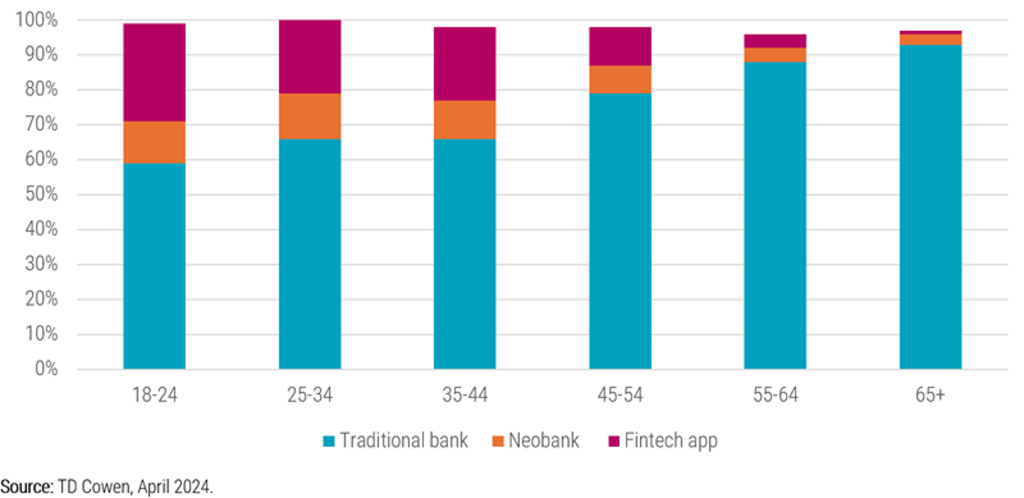
Neobanks attracted customers with the promise of a better user experience, but they are in the early stage of capturing primary banking relationships. According to data from EY, between 72% and 81% of consumers in the UK, France, and Germany say their primary financial relationship is with a traditional bank. Similarly, in the US consumers still predominantly use traditional banks for primary banking relationships, with 59% of the 18-24 age cohort and 93% of those over 65 (see Figure 4). Nubank stands out among peers, enjoying a primary banking relationship with 60% of its monthly active customers.
Figure 4: What type of company do US consumers use for their primary banking relationship?

釋放主題的投資潛能
25年多來,荷寶一直是主題策略建構的先驅者。
Efficient customer acquisition
Successful neobanks tend to focus on customer-centric metrics like customer lifetime value and customer acquisition costs (CAC). Nubank managed to acquire approximately 80%-90% of customers through word-of-mouth or direct unpaid referrals, without the need for significant marketing expenses. As a result, CAC at Nubank remained broadly unchanged at <USD 1 in 2021-2023. Revolut saw 70% of new retail customers joining organically in 2023, however word-of-mouth growth was complemented by further investment into marketing and sales. As a result, the blended CAC doubled from ~GBP 10 per user in 2021 to ~GBP 20 in 2023, compared to GBP 9 for Wise (vs GBP 7 in 2021) with 66% of customer growth coming via word-of-mouth.
Conclusion
There is a large untapped market for neobanks with 1.5 billion unbanked and 2.8 billion underbanked adults across the world. While few neobanks are achieving profitability yet, successful business models with diversified revenue streams and a focus on innovation are well placed to deliver attractive returns. We invest in select neobanks in our Fintech strategy and are monitoring the private neobanks which could list in the future such as Chime, Klarna, and Revolut. We invested in Nubank at the time of the IPO after contact with management for more than a year. The investment has generated an annualized return of over 100%1 since Nubank turned profitable at the start of 2023, demonstrating the growing importance of this fintech segment.
Footnote
1 Robeco, 30 August 2024.
重要資料
本網站僅供《證券及期貨條例》(香港法例第571章)及其附屬法例所界定之專業投資者瀏覽及使用。 投資涉及風險。過往表現並不代表未來表現。本網站所載資料僅供參考之用,並不構成任何投資建議,亦非作出買賣任何證券或採納任何投資策略之要約或招攬。投資者不應僅憑本網站提供之資料作出投資決定,在作出任何投資決定前,應徵詢獨立意見(包括有關稅務影響之意見)。投資者應確保完全理解投資產品的相關風險,亦應考量自身投資目標及風險承受水平。投資乃閣下之個人決定。除非銷售投資產品的中介人已向閣下告知該投資產品適合閣下,並已解釋其符合閣下投資目標之原因,否則閣下不應投資。請參閱相關發售文件或其他法律文件,以獲取包括風險因素在內的進一步詳情。 本網站由荷寶投資管理香港有限公司發布,該公司受香港證券及期貨事務監察委員會(「證監會」)規管(中央編號:APU851)。本網站未經證監會審閱。 無法保證任何投資產品可實現其投資目標。概不就任何投資產品之表現或投資回報作任何聲明或承諾。投資的價值或會波動。本網站所載過往表現、推算或預測,均不應視作未來表現之保證或指標,且概不提供任何明示或暗示之保證。本網站內容建基於相信為可靠之來源,惟因應資料傳遞技術特性及須採用多項數據來源(包括第三方內容),故概不保證其準確性。所述觀點僅乃截至上述日期,或會隨市況變化而改變,可予更改而毋須另行通知。該等意見可能有別於其他荷寶投資專業人士之意見。因使用本材料或當中所載任何評論、意見或估算而引致之直接、間接或相應損失,荷寶概不承擔法律責任。荷寶並無責任更新本網站或任何網站內容。未經荷寶事先書面許可,不得複製、分發或刊發本網站任何材料。 除非另有說明,資料來源:荷寶。