

Portfolio Manager

• 市場觀點
Affordability is steering consumer spending trends
Inflation is easing, but consumer sentiment and purchasing behavior suggest that households remain vigilantly focused on value and affordability. Spending patterns are diverging, with affluent households driving consumption growth, while lower-income cohorts cut back. The battle for consumer hearts (and wallets) is heating up with retailers competing on not just lowest price but on their ability to deliver the greatest value.
作者

概要
- Affordability is top of mind for consumers and the companies serving them
- Consumers feel gloomy, but spending is resilient
- Scaled-value retailers, off-price and second-hand are benefiting
Boardroom vocabulary now mirrors kitchen-table conversations. Companies across consumer staples and consumer discretionary segments are discussing ‘affordability’ with striking frequency; mentions among executives have tripled over the past five years through Q1 2026 (see Figure 1). Households are watching every dollar, and companies have noticed.
The squeeze in numbers
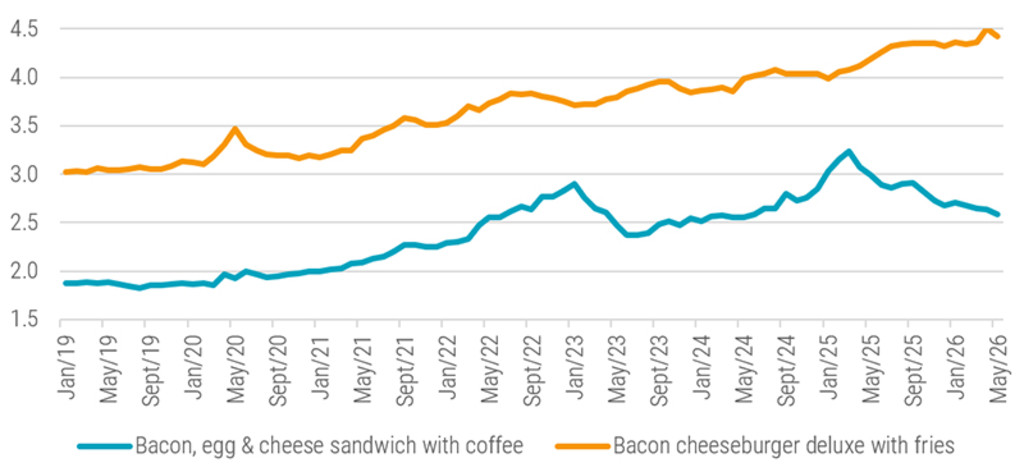
Everyday items are now causing ‘sticker shock’ for many consumers – the unpleasant surprise of an unexpectedly high price. Bloomberg’s price index for an American bacon, egg, and cheese sandwich with coffee has climbed 38% (from USD 1.87 in 2020 to 2.58 in 2026). The cheeseburger-deluxe-with-fries combo rose 42% (from USD 3.12 to 4.43 (see Figure 1). These real-world ‘bites’ explain why so many consumers still feel poorer even as US inflation has cooled from a peak of 9.1% in 2022 to 4.2% in May.
Figure 1 – Price index of widely consumed meals in the US
Source: Bloomberg, 2026.
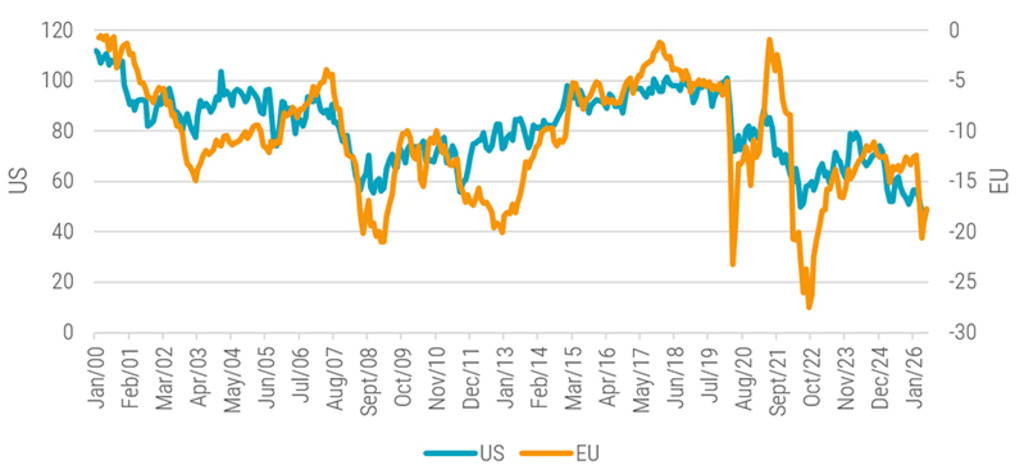
What’s more, households on both sides of the Atlantic feel they are losing ground. The University of Michigan’s Consumer Sentiment Index (US) fell from around 100 in 2020 to a new all-time low of 45 in May; levels typically associated with recessions. European sentiment slipped from -12 in February to -18 in June, its sharpest two-month deterioration in many years (see Figure 2).
Figure 2 – Consumer sentiment index
Source: University of Michigan, Eurostat, 2026.
Watch what they do, not what they say
Fortunately for retailers, the gloom and doom consumers feel has been offset by resilient employment and incomes. US unemployment remains low at 4.3% (as of May 2026), and jobless rates in other major economies are also within a healthy 2.5-6% range. Meanwhile, retail sales continue to grow, suggesting only a weak link between sentiment and actual spending. US payment volume growth confirms this, rising about 9.0% through April, up from 7.5% in Q1. Globally, volumes grew 9.0% in Q1 up from 8.0% in Q4, reinforcing the adage: ‘watch what consumers do, not what they say’ (see Figure 3).
Figure 3 – Retail spending is on the upswing in most major economies

Source: US BLS, Eurostat, Japan Ministry of Internal Affairs, China National Bureau of Statistics, Central Statistics Office India, 2026.
A K-shaped paradox
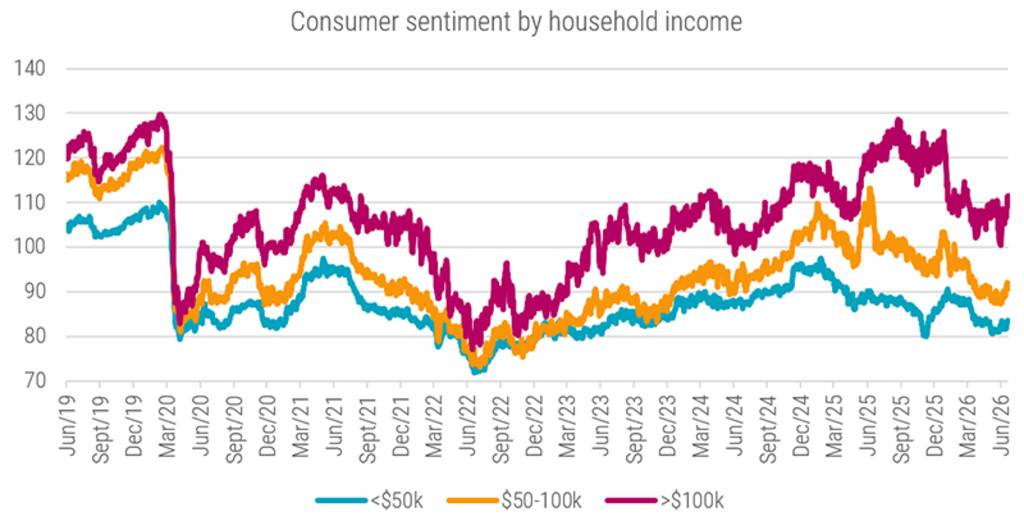
Earnings are growing stronger for lower-income earners relative to higher-income cohorts, but they are still spending less, resulting in a ‘K-shaped’ economy. As a result, companies must speak to two audiences: the wealthier shopper still willing to pay for performance, and the squeezed shopper who needs everyday prices to fall. US labor data show that since early 2019 through present, real wages (after inflation) have actually grown more for low earners than for higher ones. Moreover, all income cohorts outpaced inflation. At the same time, the spending data reveals a starkly two-track economy. Higher-income US households are spending more (5%-10% growth) since the start of 2025, while spending from lower-income households has slowed and in some cases reversed.
Figure 4 – Consumer sentiment is diverging for low- and high-income households
Source: Morning Consult, Bloomberg, May 2026
Similar trends are observed by travel companies which say wealthier consumers are spending freely on travel, dining, and premium experiences. Luxury hotelier Hyatt* said demand from premium customers was exceptionally strong this past quarter, increasing approximately 7% compared to last year. Another perceived luxury item, cruise travel, is also enjoying wind in its sails. The world’s two largest cruise lines Royal Caribbean and Carnival have posted record booking and pricings as bundling accommodation, meals and entertainment into a single fare is perceived as a good value compared to land-based holidays.*
Consumer behavior shifts to value
Consumer behavior is shifting decisively toward value and cost-consciousness. Roughly 75% of US households are trading down to cheaper brands and retailers, while half are delaying discretionary purchases. Consumers are also cutting back on eating and drinking out. But price isn’t the only decision variable – in addition to hunting bargains, consumers are collecting loyalty points from their favorite brands and gravitating toward more perceived value.
Retailers are swiftly adapting and scaled-value retailers are the clearest beneficiaries. Walmart* is leaning into value, so in addition to lower prices, it’s expanding its in-house private label range and offering same-day shipping. Amazon’s everyday essentials and grocery categories are also growing fast and now represents one in three units sold. Like Walmart, Amazon* is increasing value via convenience with its same-day delivery on low-priced items.
Consumer behavior is shifting decisively toward value and cost-consciousness. Roughly 75% of US households are trading down to cheaper brands and retailers
The popularity of private labels is also rising, with US sales hitting a record USD 283 billion in 2025 – almost a quarter of unit volumes. Costco’s* Kirkland Signature generated an estimated USD 80 billion in annual sales last year (larger than most global retailers). By mid-2026, Gen Z is expected to spend a higher share of budgets on in-store brands than any other generation, suggesting the shift is structural rather than cyclical. Consumers are also looking for steeper discounts and flocking to off-price chains such as TJ Maxx, Marshalls, HomeGoods, Ross Stores and Burlington*, all of which report solid growth.
Second-hand has also gone mainstream, as a growing share of value-seeking consumers no longer associate ‘great value’ exclusively with new goods. The online marketplace eBay* has posted double-digit growth as it attracts higher-income shoppers who are economically and sustainably minded. Resale platforms such as Vinted, Depop and Poshmark* have also continued to scale to capture a second-hand apparel market worth USD 350 billion by 2028.
Second-hand has also gone mainstream, as a growing share of value-seeking consumers no longer associate great value exclusively with new goods
Prices and promotions are also on the menu in retail food. McDonald’s* has successfully won back low-income diners with the launch of its McValue menus. These have helped restore momentum across most of its markets. Taco Bell, Wendy's, Chipotle and even fast-casual Panera have followed with their own value menus. While many fast-food chains have improved their value offering, they continue to face headwinds including more people eating at home and adoption of weight loss drugs that reduce calorie intake.
What’s clear is that companies best positioned to capture today and tomorrow’s consumers focus on 1) building trust by delivering consistent value rather than short-term promotional gimmicks; 2) investing in extra product or service features so that ‘low-price’ does not equate with ‘low quality’; and 3) communicating the value proposition early and often.
*The companies referenced are for illustrative purposes only in order to demonstrate the investment strategy on the date stated. The companies are not necessarily held by the strategy nor is future inclusion guaranteed. This is not a buy, sell or hold recommendation, nor should any inference be made on the future development of these companies.
獲取最新市場觀點
訂閱我們的電子報,時刻把握投資資訊和專家分析。
重要資料
本網站僅供《證券及期貨條例》(香港法例第571章)及其附屬法例所界定之專業投資者瀏覽及使用。 投資涉及風險。過往表現並不代表未來表現。本網站所載資料僅供參考之用,並不構成任何投資建議,亦非作出買賣任何證券或採納任何投資策略之要約或招攬。投資者不應僅憑本網站提供之資料作出投資決定,在作出任何投資決定前,應徵詢獨立意見(包括有關稅務影響之意見)。投資者應確保完全理解投資產品的相關風險,亦應考量自身投資目標及風險承受水平。投資乃閣下之個人決定。除非銷售投資產品的中介人已向閣下告知該投資產品適合閣下,並已解釋其符合閣下投資目標之原因,否則閣下不應投資。請參閱相關發售文件或其他法律文件,以獲取包括風險因素在內的進一步詳情。 本網站由荷寶投資管理香港有限公司發布,該公司受香港證券及期貨事務監察委員會(「證監會」)規管(中央編號:APU851)。本網站未經證監會審閱。 無法保證任何投資產品可實現其投資目標。概不就任何投資產品之表現或投資回報作任何聲明或承諾。投資的價值或會波動。本網站所載過往表現、推算或預測,均不應視作未來表現之保證或指標,且概不提供任何明示或暗示之保證。本網站內容建基於相信為可靠之來源,惟因應資料傳遞技術特性及須採用多項數據來源(包括第三方內容),故概不保證其準確性。所述觀點僅乃截至上述日期,或會隨市況變化而改變,可予更改而毋須另行通知。該等意見可能有別於其他荷寶投資專業人士之意見。因使用本材料或當中所載任何評論、意見或估算而引致之直接、間接或相應損失,荷寶概不承擔法律責任。荷寶並無責任更新本網站或任何網站內容。未經荷寶事先書面許可,不得複製、分發或刊發本網站任何材料。 除非另有說明,資料來源:荷寶。