


Portfolio Manager


概要
- Technology adoption is faster in emerging markets
- ‘Leapfrogging’ is enabling rapid financial innovation
- This creates investment opportunities and positive macroeconomic effects
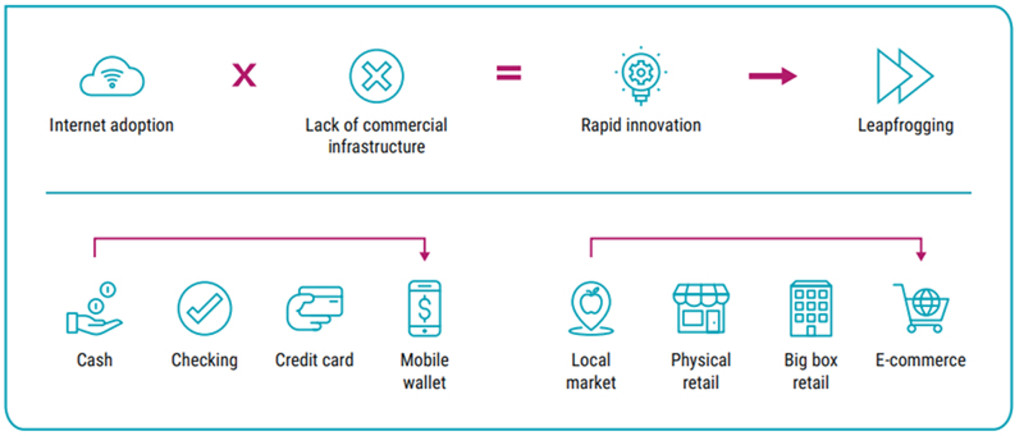
In emerging markets a whole generation of technology is being quickly bypassed through superior and cheaper innovation, which has disrupted multiple industries. The telecommunications (straight to mobile) and energy (solar and wind in remote locations without grid infrastructure) industries are the most well-known examples. In finance it’s having a particularly rapid impact with mobile telecommunications enabling new payment networks, while access to basic banking services has become easier, and costs have fallen. This in turn has positive macroeconomic effects, bringing more of the population into the organized economy, reducing transaction costs, and potentially increasing the tax base, making this a powerful tailwind for emerging markets in general.
Figure 1: The leapfrog effect in finance and retail
Source: Robeco
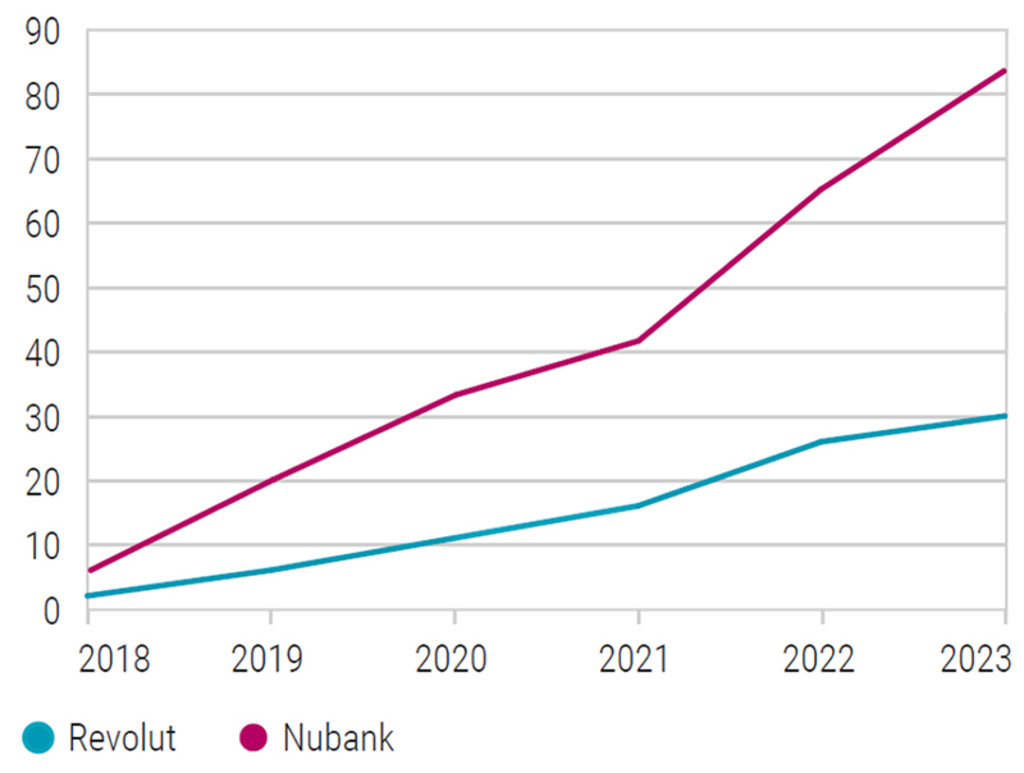
There is evidence that digital leapfrogging is enabling EM fintech to scale faster than DM peers, which typically face stronger competition from traditional finance incumbents. A good illustration is to compare Nubank, now Brazil’s fourth largest bank with over 90 million customers which recorded its first transaction in 2014, with Revolut, a similar online ‘neo-bank’, which entered the UK market in 2015 and now offers banking services across Europe.
Figure 2: Nubank versus Revolut growth trajectory (in millions of customers)
Source: Revolut, Nubank. Data to end of June 2023.
Leapfrogging to growth
There are some important reasons why Nubank has been able to grow faster. In emerging markets, the rise in internet connectivity combined with a lack of pre-existing offline commercial infrastructure is leading to exponential leaps in technology adoption and business model growth. Many new internet users have access to smartphones and mobile internet, but do not have access to traditional offline banking services. These users are either unbanked, or do not have access to physical bank branches that can provide services comparable to those in the US and Europe. As a result, these new users tend to be rapid adopters of mobile money and electronic banking services, never needing to use an ATM or write checks. This is reflected in the data on financial inclusion. Brazil, Nubank’s core market, had much lower financial inclusion than all developed economies. Thereby, a large underbanked community was waiting to be tapped, especially in younger demographics. According to World Bank data from 2014 to 2021, the percentage of adults (defined as older than 15 years old) with a bank account rose from 68% to 84% in Brazil. In contrast, developed economies were all above 95% in the same data set.
Furthermore, the entrepreneurial spirit and innovation ecosystem in emerging markets play a crucial role in driving tech leapfrogging. Local entrepreneurs and startups are often at the forefront of developing and implementing innovative solutions tailored to the specific needs and constraints of their markets. This agility and adaptability enables emerging market economies to quickly adopt and integrate new technologies into their societies.
Not an isolated example
Nubank is not an isolated example of an EM fintech startup moving rapidly to scale. For example, Mercado Libre, which offers payments and ecommerce services across South and Central America, listed back in 2007 and now has over USD 10 billion in annual revenues. In China, Alibaba’s AliPay and Tencent’s WeChat Pay power a structurally different but equally disruptive wallet-based closed-loop model. In Central Asia, Kaspi is attempting to extend its dominant position in payments and online banking in Kazakhstan into neighboring economies. Similar trends are unfolding for other daily activities beyond fintech, such as buying groceries, looking for employment, consuming media, moving to new cities, and access to healthcare. Online adoption is faster, local solutions become smarter, and internet economies are booming.
Where will the next winners be found?
Robeco’s EM team works with the thematic financials team who manage the Robeco Next Digital Billion strategy to discover and analyze the best fintech companies in emerging markets. There are gaps to fill in financial inclusion in other fast growing EM economies with high mobile penetration rates like India (where 78% of adults had a bank account in 2021, according to the World Bank), Indonesia (52%) and the Philippines (51%). Every opportunity is different depending on the market, the regulatory framework and the macroeconomic backdrop, but in our view it’s likely that more regional, or potentially even global, fintech winners will come from EM in the coming years.
獲取最新市場觀點
訂閱我們的電子報,時刻把握投資資訊和專家分析。

Emerging markets’ second growth wave is straight ahead
The best time to invest in emerging markets was 30 years ago. The next best time is today
重要資料
本網站僅供《證券及期貨條例》(香港法例第571章)及其附屬法例所界定之專業投資者瀏覽及使用。 投資涉及風險。過往表現並不代表未來表現。本網站所載資料僅供參考之用,並不構成任何投資建議,亦非作出買賣任何證券或採納任何投資策略之要約或招攬。投資者不應僅憑本網站提供之資料作出投資決定,在作出任何投資決定前,應徵詢獨立意見(包括有關稅務影響之意見)。投資者應確保完全理解投資產品的相關風險,亦應考量自身投資目標及風險承受水平。投資乃閣下之個人決定。除非銷售投資產品的中介人已向閣下告知該投資產品適合閣下,並已解釋其符合閣下投資目標之原因,否則閣下不應投資。請參閱相關發售文件或其他法律文件,以獲取包括風險因素在內的進一步詳情。 本網站由荷寶投資管理香港有限公司發布,該公司受香港證券及期貨事務監察委員會(「證監會」)規管(中央編號:APU851)。本網站未經證監會審閱。 無法保證任何投資產品可實現其投資目標。概不就任何投資產品之表現或投資回報作任何聲明或承諾。投資的價值或會波動。本網站所載過往表現、推算或預測,均不應視作未來表現之保證或指標,且概不提供任何明示或暗示之保證。本網站內容建基於相信為可靠之來源,惟因應資料傳遞技術特性及須採用多項數據來源(包括第三方內容),故概不保證其準確性。所述觀點僅乃截至上述日期,或會隨市況變化而改變,可予更改而毋須另行通知。該等意見可能有別於其他荷寶投資專業人士之意見。因使用本材料或當中所載任何評論、意見或估算而引致之直接、間接或相應損失,荷寶概不承擔法律責任。荷寶並無責任更新本網站或任何網站內容。未經荷寶事先書面許可,不得複製、分發或刊發本網站任何材料。 除非另有說明,資料來源:荷寶。