
Co-Portfolio Manager


• 市場觀點
Data center clouds could rain revenue for water companies
Digitization and AI acceleration are intensifying not only processing speeds but also energy use and heat generation. The increasing energy intensity of traditional air-based cooling systems is driving data center operators to seek liquid-based solutions, creating attractive long-term growth opportunities for the sustainable water strategy.
作者


Analyst
概要
- Digitization and AI are raising data center temperatures and operational risks
- Liquid-based solutions are more resource-efficient compared to air cooling
- Water-related services are critical for data center cooling and performance
AI promises to be revolutionary as companies design applications to harness its power to enhance processes and products. But AI’s intensified computational demand also means more electric power and more heat surging through data centers. To illustrate, an average ChatGPT query needs nearly 10 times as much electricity as a Google search.1 And it’s not just AI: rapid digitalization, electrification, and automation trends are also increasing data center workloads.
After decades of incremental growth, data center power demand is forecasted to increase by 160% in the few short years to 2030.2
Figure 1 – Data center power demand will skyrocket in the next decade
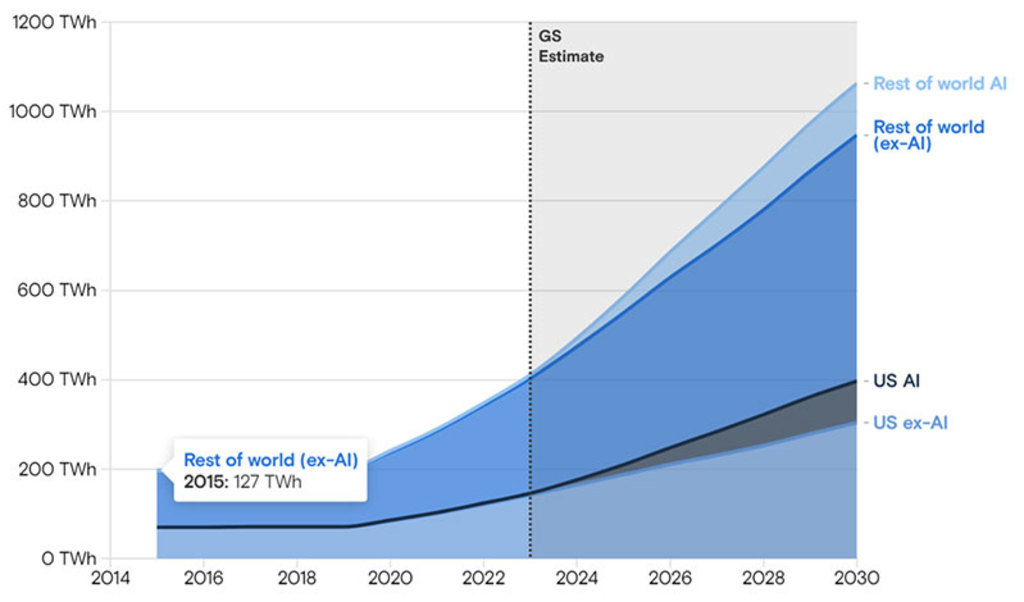
Source: Masanet et al. (2020), Cisco, IEA, Goldman Sachs Research.
Heat advisory
All that concentrated computational power is also generating lots of heat, straining data center cooling systems and putting processing performance at risk.
Standard data centers running on CPU chips are recommended to work in a range of 18-27 °C. But power consumption of next-generation AI chips (GPUs) is four times that, pushing temperatures well beyond optimal operational bands.3,4 Above 40 °C, failure rates increase by a rate of 30% for every five-degree increase. 5
Extreme heat waves are also increasing outside air temperatures, further straining data center cooling systems. In 2022, high temperatures in the UK forced shutdowns of cloud service in both Google and Oracle data centers.6
Data center dilemmas: more energy and water
Air cooling is energy intensive, consuming around 40% of a data center’s power supplies.7 Accelerated processing is driving those costs even higher. 8 That has pushed data center operators to integrate evaporative cooling that exploits the higher heat-absorbing capacity of water. This way, they can boost cooling with less energy and less cost compared to air-only systems.9,10
Moreover, evaporative cooling also humidifies data center air, reducing electrostatic discharge that can damage equipment and diminish performance. It also reduces the need for the harmful chemical refrigerants used in some forms of direct-air cooling. 11
Greater energy efficiency also means lower emissions, an increasingly powerful metric for data centers as they strive to achieve their own decarbonization targets as well as attract sustainably minded end-customers.
However, evaporative cooling can also be water intensive.12 Until now, air-cooling in combination with evaporative cooling has been sufficient for dissipating heat. But the technical evolution from CPUs to GPUs implies that next-generation data centers will also consume significantly more water. That’s a big problem for data centers in water-stressed areas where utilities may withhold water withdrawal permits.
That’s left the industry searching for more water-efficient evaporative technologies such as closed-circuit or adiabatic cooling that eliminate water loss.
Figure 2 – A closer look at evaporative cooling in data centers
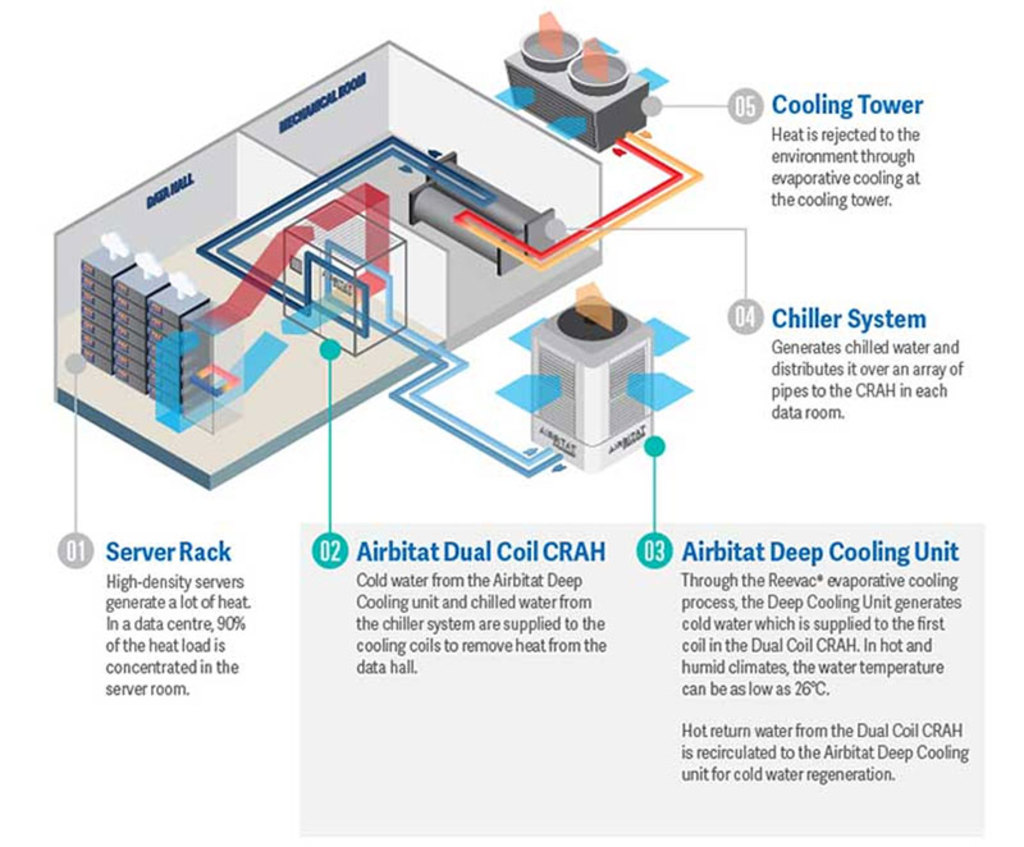
Source: Techwire Asia, ST Engineering, 2022. Evaporative cooling is a solution that cools ambient air and direct to server racks in data centers. It uses chilled water to absorb heat which then evaporates and is vented outside or recirculated in a closed-circuit to eliminate water loss.
Stay informed on Climate investing
Liquid-based cooling is heating up
Water’s thermal capacity is 3,000 times higher than air’s, meaning it can absorb more heat using less energy and at less cost compared to air-based counterparts. This makes liquid-cooling solutions essential for the future of data center infrastructure.
Due to the need for more efficient innovations, the global data center cooling market was valued at USD 15.9 billion in 2023 with a CAGR of over 13.5% from 2024 through 2032. 13
Figure 3 – Global data center cooling market size, 2022-2032 (USD in billions)
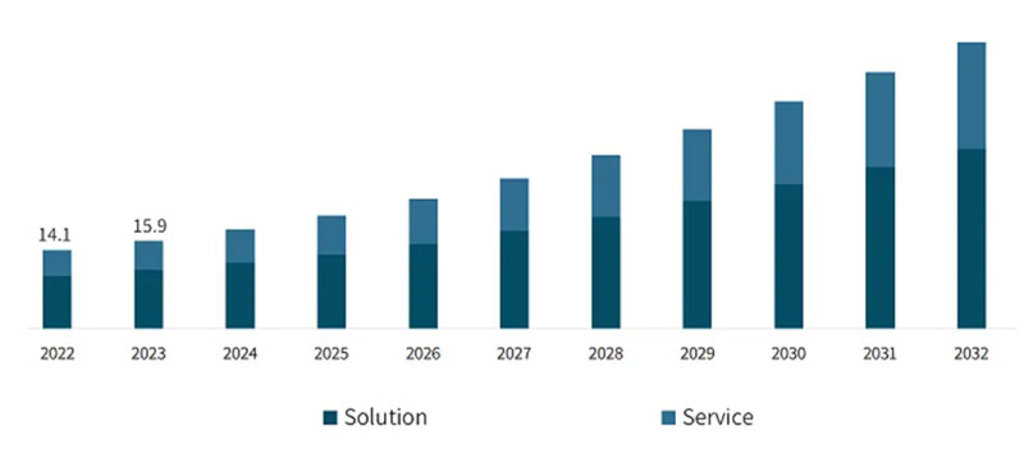
Source: Global Market Insights, April 2024.
Interest in direct-liquid cooling (DLC), in particular, is heating up. DLC systems push cool water through pipes and tubes placed next to high-heat sources including rear-doors of server racks and even directly to chips.14 A recent market study shows 11% of data center operators currently use DLC and are eager to expand, while 61% are considering it for the future. 15
Another form of DLC, liquid immersive cooling, is also gaining traction among cutting-edge chip and enterprise server manufacturers. It involves submerging chips or entire servers in a thermally (but not electrically) conductive liquid increasing heat-transfer performance even more. Nvidia’s* CEO, Jensen Huang, revealed in March that its next iteration of servers will be liquid cooled.16
Water needed for more than cooling
To prevent mineral scaling, corrosion, and microbial growth, highly pure water with low conductivity is needed for liquid-based solutions, creating investment opportunities for solution providers across the water value chain. That means water analytics that measure pH, ions, and microbial levels will be crucial for maintaining water quality.
Beyond measurements, potential water treatment methods are also extensive and include ion exchange, reverse osmosis, or the addition of anti-corrosion, anti-scaling, and biocidal agents.
While liquid-cooling is the future, air-based cooling won’t disappear any time soon. That’s because the resource efficiency and cost effectiveness of cooling systems is affected by many variables including computing capacity, geographic climate, local energy grids, regulations as well as overall environmental impact. For these reasons major data center operators including Meta, Alphabet, Amazon, and Microsoft* as well as other Big Tech and AI leaders are investing in multiple cooling technologies that can be dynamically adapted to optimize energy and water resources as well as overall operational costs.
With clouds come rain
The increase in hyper-scaled, cloud-computing and AI trends means water will remain a critical part of data center performance, forging new streams of long-term growth for Robeco’s Sustainable Water strategy. The strategy invests in companies providing resource-efficient technologies for cooling systems.
Beyond investments in cooling system manufacturers, the water strategy invests in companies providing a full suite of water-related technologies and engineering services. These include basic water infrastructure (e.g., pumps, valves, and tubing) analytic testing, purifying treatments, recycling, and wastewater management, all of which will be needed to ensure optimal (and sustainable) data center performance.
Whether on the ground or in the cloud, opportunities are always afloat within the water strategy; and the team remains vigilantly on the lookout for water companies that can capitalize on cloud computing’s potential to generate abundant revenue rains.
*The Robeco Sustainable Water strategy is not invested in any of the stocks listed, nor should these references be considered as recommendations to buy, sell, or hold these or any securities.
Footnotes
1 Goldman Sachs, May 2024. ‘AI poised to drive 160% increase in power demand.’
2 Ibid.
3 Recommended ranges are from the American Society of Heating, Refrigerating and Air-conditioning Engineers (ASHRAE). Data Center Knowledge, January 2023. ‘Hot in Here: Is raising temperatures in data centers good for hardware?’
4 Robeco, November 2023. ‘The energy challenge of powering AI chips.’
5 Data Center Dynamics, November 2023. ‘The effects of high temperatures on hard drives.’
6 Bloomberg. July 2022. ‘Google, Oracle data centers knocked offline by London heat.’
7 US Department of Energy. May 2023. ‘DOE announces $40 million for more efficient cooling for data centers. ’
8 CRAC and CRAH are the two most common systems for air-based cooling. Like air conditioners, CRAC units use refrigerants and compressors, while CRAH units use chilled water and control valves for cooling.
9 https://www.computerweekly.com/blog/Ahead-in-the-Clouds/Why-water-usage-is-the-datacentre-industrys-dirty-little-secret, https://portacool.com/how-does-evaporative-cooling-work/
10 Air is a poor heat absorber and converter. One liter of water can pull 3000 times more energy (heat) than 1 liter of air. https://adwatec.com/benefits-of-water-cooling/efficiency/
11 See footnote 7.
12 In cases where the evaporated water that absorbs the heat isn’t recaptured within a closed-loop system.
13 https://www.gminsights.com/industry-analysis/data-center-cooling-market
14 https://sustainability.fb.com/2023-sustainability-report/ – Meta’s data centers rely on water for evaporative cooling during summers (and humidification during winters).
15 Uptime Institute, July 2022. ‘Direct liquid cooling: pressure is rising but constraints remain.’
16 Data Center Dynamics, March 2024. ‘Nvidia’s CEO confirms upcoming system will be liquid cooled.’
重要資料
本網站僅供《證券及期貨條例》(香港法例第571章)及其附屬法例所界定之專業投資者瀏覽及使用。 投資涉及風險。過往表現並不代表未來表現。本網站所載資料僅供參考之用,並不構成任何投資建議,亦非作出買賣任何證券或採納任何投資策略之要約或招攬。投資者不應僅憑本網站提供之資料作出投資決定,在作出任何投資決定前,應徵詢獨立意見(包括有關稅務影響之意見)。投資者應確保完全理解投資產品的相關風險,亦應考量自身投資目標及風險承受水平。投資乃閣下之個人決定。除非銷售投資產品的中介人已向閣下告知該投資產品適合閣下,並已解釋其符合閣下投資目標之原因,否則閣下不應投資。請參閱相關發售文件或其他法律文件,以獲取包括風險因素在內的進一步詳情。 本網站由荷寶投資管理香港有限公司發布,該公司受香港證券及期貨事務監察委員會(「證監會」)規管(中央編號:APU851)。本網站未經證監會審閱。 無法保證任何投資產品可實現其投資目標。概不就任何投資產品之表現或投資回報作任何聲明或承諾。投資的價值或會波動。本網站所載過往表現、推算或預測,均不應視作未來表現之保證或指標,且概不提供任何明示或暗示之保證。本網站內容建基於相信為可靠之來源,惟因應資料傳遞技術特性及須採用多項數據來源(包括第三方內容),故概不保證其準確性。所述觀點僅乃截至上述日期,或會隨市況變化而改變,可予更改而毋須另行通知。該等意見可能有別於其他荷寶投資專業人士之意見。因使用本材料或當中所載任何評論、意見或估算而引致之直接、間接或相應損失,荷寶概不承擔法律責任。荷寶並無責任更新本網站或任何網站內容。未經荷寶事先書面許可,不得複製、分發或刊發本網站任何材料。 除非另有說明,資料來源:荷寶。