
Head of SI Thought Leadership and Climate & Biodiversity Strategist


• 市場觀點
Asia makes huge strides in commitment to climate investing
Investors in the Asia-Pacific (APAC) region have moved ahead of Europeans in making tackling global warming a priority, the fourth Robeco Global Climate Investing Survey shows.
作者



概要
- Commitments to climate investing and net zero rise significantly in Asia
- Regional differences also in motivations and perceived headwinds
- Much progress in accounting for emissions and use of engagement
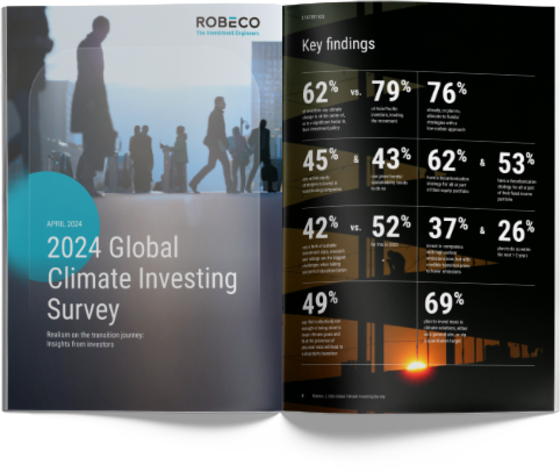
The number of APAC investors for whom climate change is central to, or a significant part of, their investment policy was 79%, rising above Europe (76%) for the first time, and well above North America, where interest has fallen to a new low of 35%.
Even greater enthusiasm is shown in the longer-term aspirations of APAC investors, where 87% said climate investing would be a priority in two years’ time, this time slightly below the 89% of European investors committed to it, but still significantly above the 56% of North Americans for whom it will be significant.
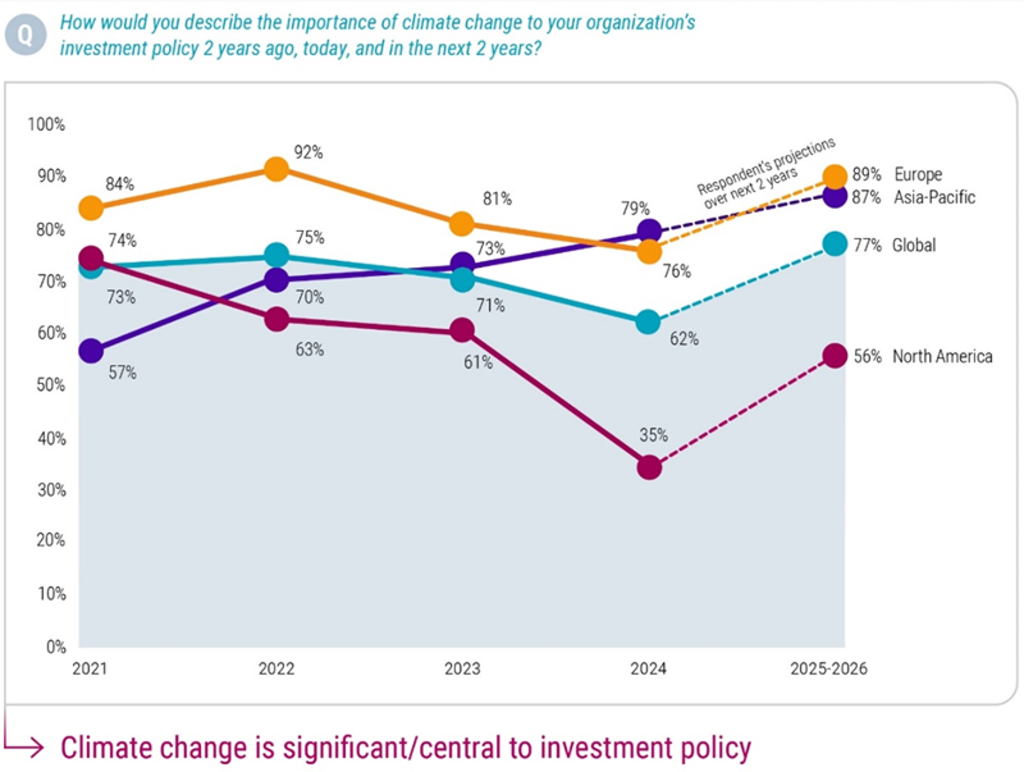
Source (for all graphics): Robeco Global Climate Investing Survey, May 2024.
"One of the key themes this year is the strong progress by investors in the APAC region on climate investing," says Lucian Peppelenbos, Climate and Biodiversity specialist at Robeco. "Investors in this region are embracing investing in climate solutions and in the climate transition, two areas where we see great momentum in the market, in spite of the weakening climate action by political leaders.”
Wide regional differences
It was the first time in the four-year history of the survey of 300 international investors that such wide regional differences in attitudes have become apparent. It is partly thanks to the huge progress seen in Asia – the world’s highest-emitting region where some say the battle to tackle global warming will be won or lost.
It is also due, however, to a backlash against climate investing in North America over the perceived cost to returns of integrating environmental, social and governance (ESG) factors into investments. The slump in climate prioritization brought the global average of investors making climate a priority down from 71% to 62%, though the two-year projection showed an upswing to 77%.
Commitments to achieving net-zero emissions also rose in Asia, with 26% of investors now making a public commitment to decarbonize portfolios by the 2050 deadline, up from 20% in the previous survey. The net-zero commitment has remained stable in Europe at 37% but has fallen further in North America from 19% to 13%.
Greenwashing seen as biggest problem in Asia
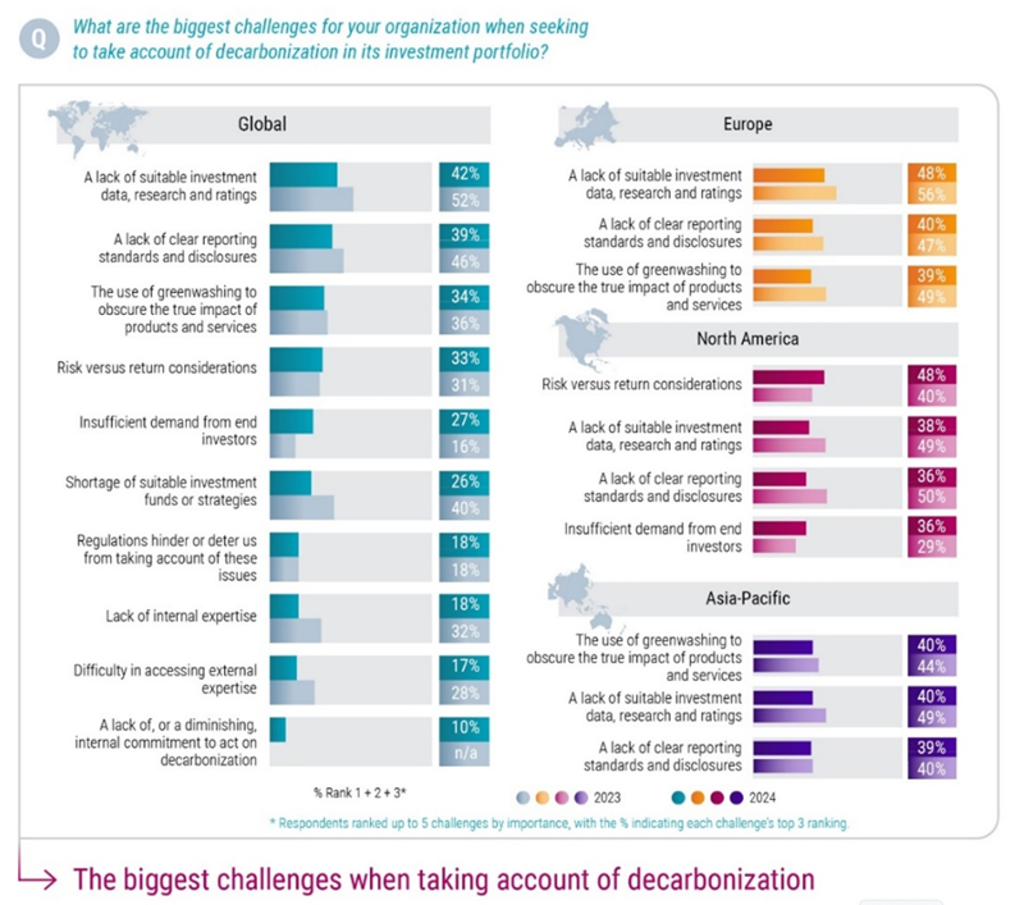
There were also regional differences in what investors see as the main headwinds to implementing decarbonization strategies. Challenges around data, research, reporting standards and disclosure have diminished since 2023, along with challenges over accessing expertise and finding suitable products and strategies. But each region had a differing top concern.
In Asia, 40% of those surveyed cited the use of greenwashing to obscure the true impact of investment strategies as the main threat, along with a lack of suitable investment data, research and ratings (also 40%) and a lack of clear reporting standards and disclosures (39%). All were considered slightly less problematic compared with last year.
However, in North America, risk versus return considerations have increased as a challenge, in line with the growing ESG backlash, with 48% citing this as their top concern, up from 40% in 2023. In Europe, the biggest challenge was seen as the data issue – though this has dropped to 48% from 56% last year – while the perceived greenwashing threat also dropped, to 39% from 49%.
Half are now calculating emissions
More than half of investors in Asia-Pacific (52%) have now calculated the carbon footprint of their portfolios, using Scope 1 and Scope 2 emissions data, up from the 45% that had done so in 2023. Similar progress was seen in the number of investors taking steps to gain a forward-looking view on what pathway investee companies are on, and how that aligns with the Paris Agreement, with 45% of APAC investors now doing so compared with 35% in 2023.
And Asia now leads with the number of investors trying to measure Scope 3 emissions, which occur across the entire value chain and are far harder to calculate. Some 38% in APAC are using available data, modeling and best estimates to look at Scope 3, significantly up from 13% last year. This compares with 34% of European investors and just 13% in North America.

全球多元趨勢投資
荷寶精選趨勢投資策略的一站式平台
Developed markets are still preferred
However, while Asia has shown itself to be the new kid on the block when it comes to prioritizing climate investing, developed markets remain the preferred destination for investment funds, rather than the more nascent emerging markets. The survey showed that 60% of APAC investors have made direct investments via listed securities in commercially mature climate solutions in developed markets compared to 34% in emerging markets – almost identical to the situation in Europe.
The lack of more developed sustainable investing taxonomies in Asia also impacted the figures. Only 20% of APAC investors said they had adopted a sustainable taxonomy to identify and measure climate solutions compared to 44% in Europe, where the EU’s Sustainable Finance Disclosure Regulation (SFDR) and EU Taxonomy have helped to define standards.
Equities rule while green bonds rise
In terms of asset classes, investing in active equity strategies that specifically target allocations to transition-oriented companies remains the favored approach in both APAC and Europe, with 54% following this path. There was slightly more interest in investing in green bonds (52%) in Asia than in Europe (51%), and in transition-oriented fixed income strategies generally (39% vs. 37%).
Finally, the use of active ownership through engagement and stewardship was also more popular in Asia, where 38% said they encouraged external equity managers to adopt climate voting policies, compared to 29% in Europe. Some 38% in APAC said they had partnered with other asset owners to undertake collective engagement on climate issues against 30% in Europe, though in-house engagement capabilities have thus far been weaker in Asia.
下載刊物

More insights from the Global Climate Survey 2024
重要資料
本網站僅供《證券及期貨條例》(香港法例第571章)及其附屬法例所界定之專業投資者瀏覽及使用。 投資涉及風險。過往表現並不代表未來表現。本網站所載資料僅供參考之用,並不構成任何投資建議,亦非作出買賣任何證券或採納任何投資策略之要約或招攬。投資者不應僅憑本網站提供之資料作出投資決定,在作出任何投資決定前,應徵詢獨立意見(包括有關稅務影響之意見)。投資者應確保完全理解投資產品的相關風險,亦應考量自身投資目標及風險承受水平。投資乃閣下之個人決定。除非銷售投資產品的中介人已向閣下告知該投資產品適合閣下,並已解釋其符合閣下投資目標之原因,否則閣下不應投資。請參閱相關發售文件或其他法律文件,以獲取包括風險因素在內的進一步詳情。 本網站由荷寶投資管理香港有限公司發布,該公司受香港證券及期貨事務監察委員會(「證監會」)規管(中央編號:APU851)。本網站未經證監會審閱。 無法保證任何投資產品可實現其投資目標。概不就任何投資產品之表現或投資回報作任何聲明或承諾。投資的價值或會波動。本網站所載過往表現、推算或預測,均不應視作未來表現之保證或指標,且概不提供任何明示或暗示之保證。本網站內容建基於相信為可靠之來源,惟因應資料傳遞技術特性及須採用多項數據來源(包括第三方內容),故概不保證其準確性。所述觀點僅乃截至上述日期,或會隨市況變化而改變,可予更改而毋須另行通知。該等意見可能有別於其他荷寶投資專業人士之意見。因使用本材料或當中所載任何評論、意見或估算而引致之直接、間接或相應損失,荷寶概不承擔法律責任。荷寶並無責任更新本網站或任何網站內容。未經荷寶事先書面許可,不得複製、分發或刊發本網站任何材料。 除非另有說明,資料來源:荷寶。