

Portfolio Manager


• 月度展望
High yield – Please make me good, but not just yet
Despite their persistent valuation advantage over equities, high yield credits are very much a guilty pleasure right now, with credit conditions tightening and recession always just over the horizon, says multi-asset investor Aliki Rouffiac.
作者

概要
- High yield credits still represent better value than equities
- Long tail of rate hikes and negative economic data all point to spreads widening
- Employ an active strategy and favor the quality end of the high yield spectrum
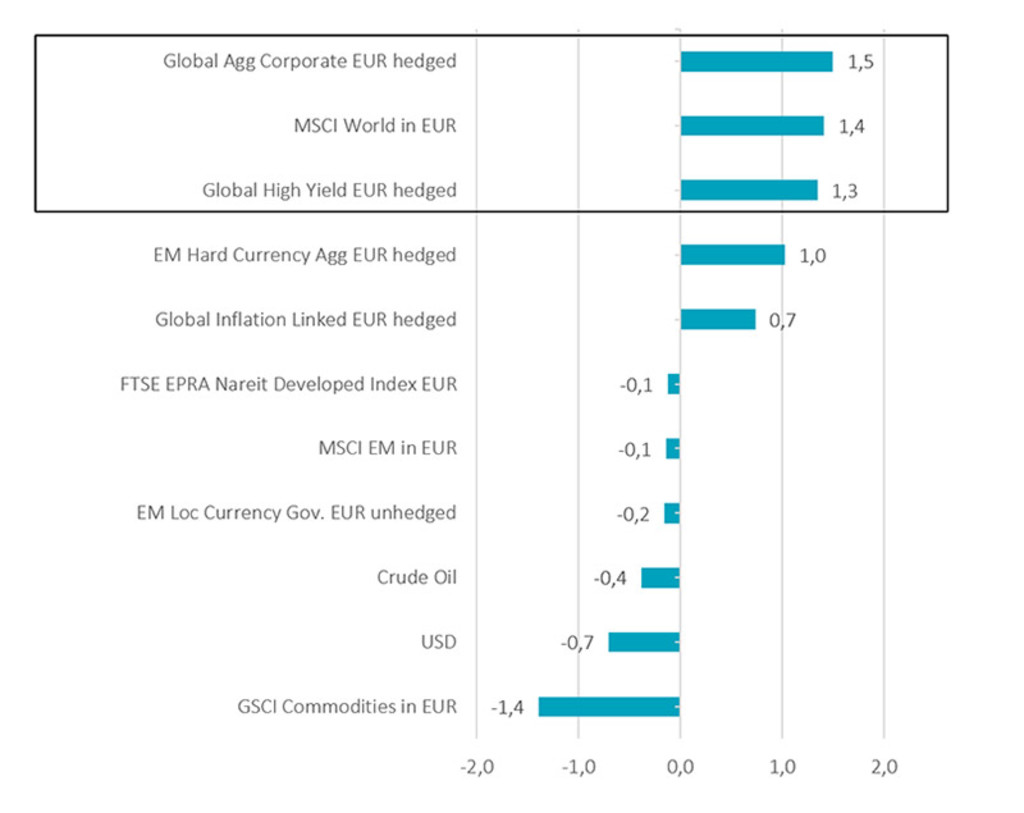
Investors are navigating a very uncertain economic environment where opportunities to generate alpha or find diversification are increasingly dependent on where we are in this cycle. Risky assets have fared well in 2023 so far, with high yield –an asset investors shunned in 2022 – delivering similar returns per unit of risk as global equities. However, it’s not all good news, as recent performance means that high yield bonds are now priced to perfection, leaving less room to generate future returns through spread tightening or to compensate for the risk of a much-anticipated recession.
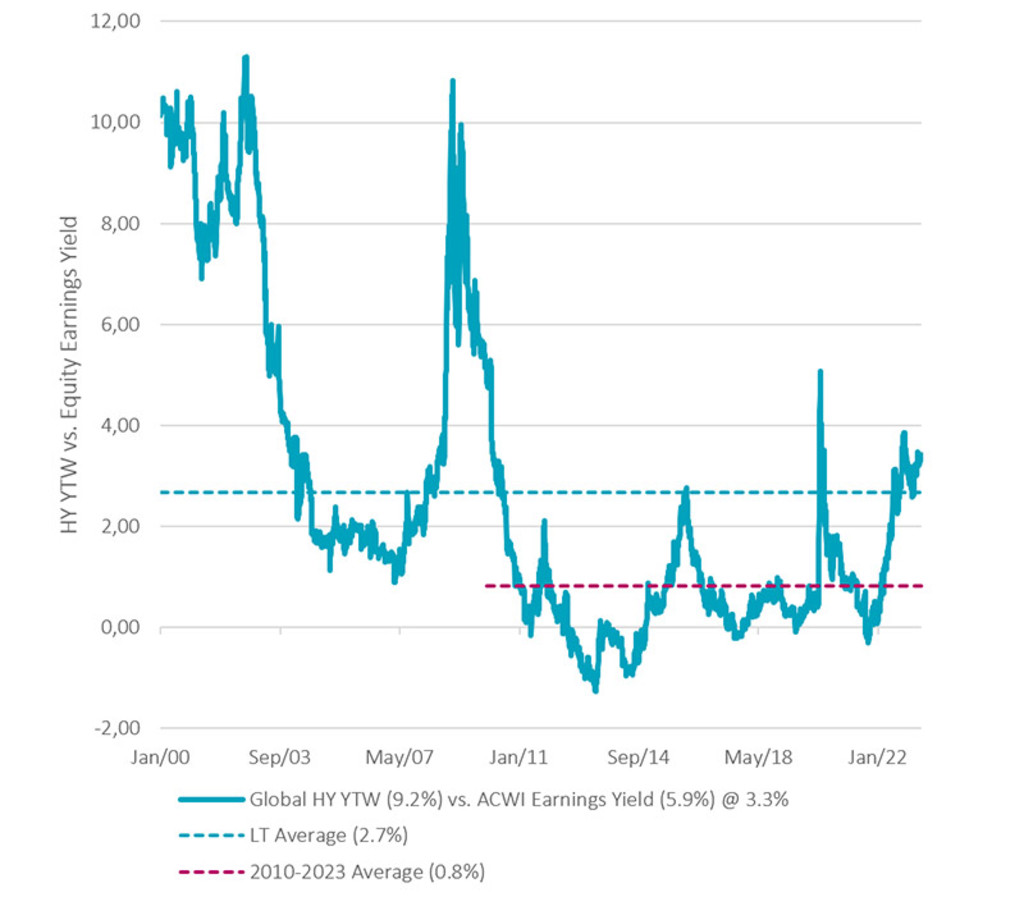
“The reality is high yield still offers a more attractive valuation proposition relative to equities, so if you are sanguine over the recession risks the opportunity is intact,” says Rouffiac, portfolio manager with Robeco Sustainable Multi-Asset Solutions. She points to the historic high differential of the global high yield index versus the global equity earnings yield, which is at 3.3% – higher than the long-term average of 2.7% and way above the 2010-2023 average of 0.8%.
Figure 1: Year-to-date annualized risk-adjusted returns
Source: Bloomberg, Robeco
Figure 2: Global high yield vs equities yield differential
Source: Bloomberg, Robeco
Markets are pricing in widely varied scenarios as return expectations and correlations between risky and ‘riskless’ assets are painting either a picture of complacency or that of an imminent recession, depending on your point of view.
“As one of the steepest and fastest hiking cycles approaches an end, you would expect markets to start reflecting a clearer, more uniform outlook, but the rangebound environment since the beginning of the year has provided scant guidance,“ says Rouffiac.
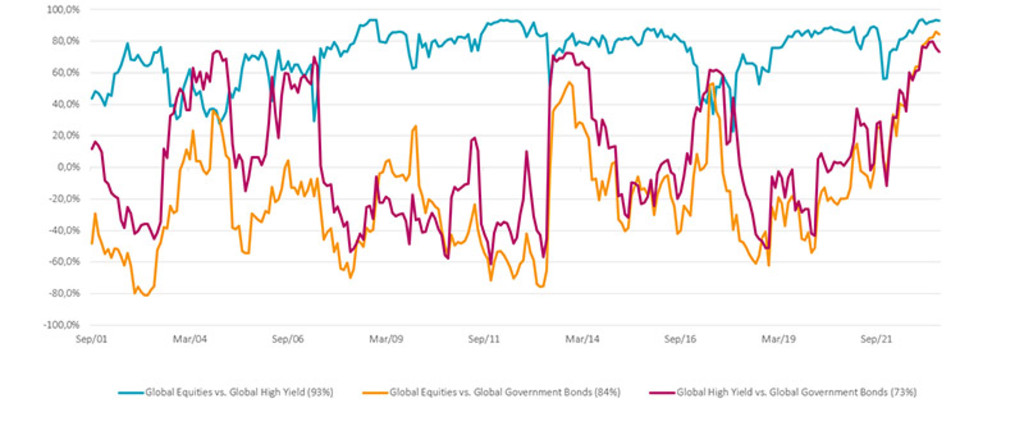
Figure 3: Equities, high yield and bonds are showing reduced diversification benefits
Source: Bloomberg, Robeco, 28 April 2023. Rolling 12-month correlation.
Policy rate expectations point towards rate cuts starting during the third quarter of the year, suggesting that a recession is not far off. On the other hand, equity and credit markets are yet to price in a meaningful probability of recession within 2023. Current spreads are consistent with default rates close to historic averages and global equity multiples suggest earnings remain supportive and above levels expected ahead of a recession.
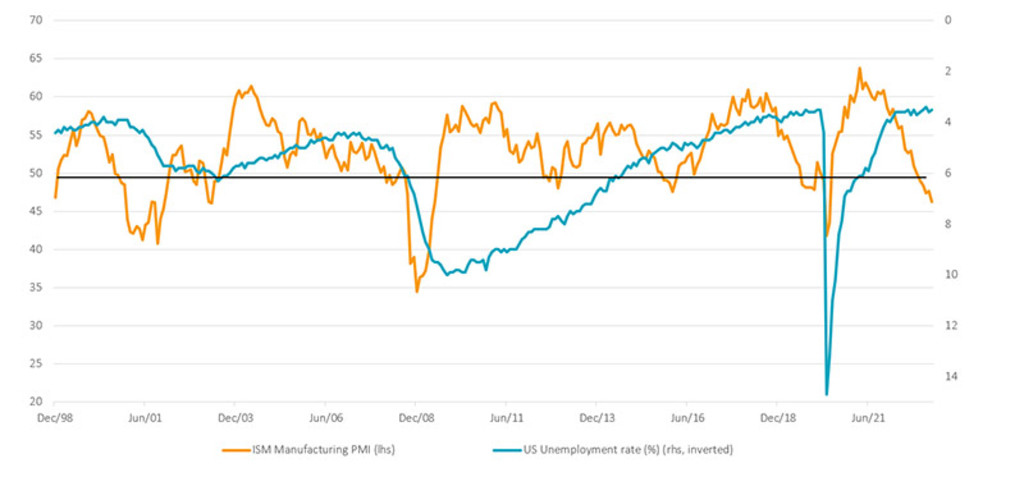
“Looking for cues in the latest macro data, one cannot overlook the conundrum that is the level of US unemployment compared to cyclical indicators,” says Rouffiac. Historically, the US ISM Manufacturing index below 50, pointing to a contraction, would typically coincide with an unemployment rate of at least 6%, and a rising risk of recession. However, we are yet to see an unemployment rate higher than 3.7%, even though the ISM has been sub-50 since November 2022.
Figure 4: Current US ISM Manufacturing – Unemployment gap at odds with historical record
Source: Bloomberg, Robeco, Bank of America as at 31 Mar 2023
Credit fundamentals will eventually reassert themselves
“It’s clear the strength of the labor market has supported a more benign economic environment where default rates for companies have stayed below historic averages,” says Rouffiac.
This is even though financing costs have markedly increased as central banks continue to tighten monetary policy. Less favorable credit conditions for commercial and industrial loans to large and medium-sized firms in the US, a leading indicator of default rates, suggest that the likelihood of higher rates of defaults is increasing.
“To put that into perspective, if the unemployment rate increases to 6% over the next 12 months, we could expect default rates to rise to 8% and spreads to widen to levels between 800-1,000 bps.”
This would not bode well for high yield credit, and current spreads of 550 bps (for global high yield) are not recession-proof. Nevertheless, for now, leverage remains low and interest coverage high in the US high yield space. This in turn suggests healthy credit fundamentals are still supportive of a lower default rate environment.
獲取最新市場觀點
訂閱我們的電子報,時刻把握投資資訊和專家分析。
Figure 5: US high yield spreads vs. default rates
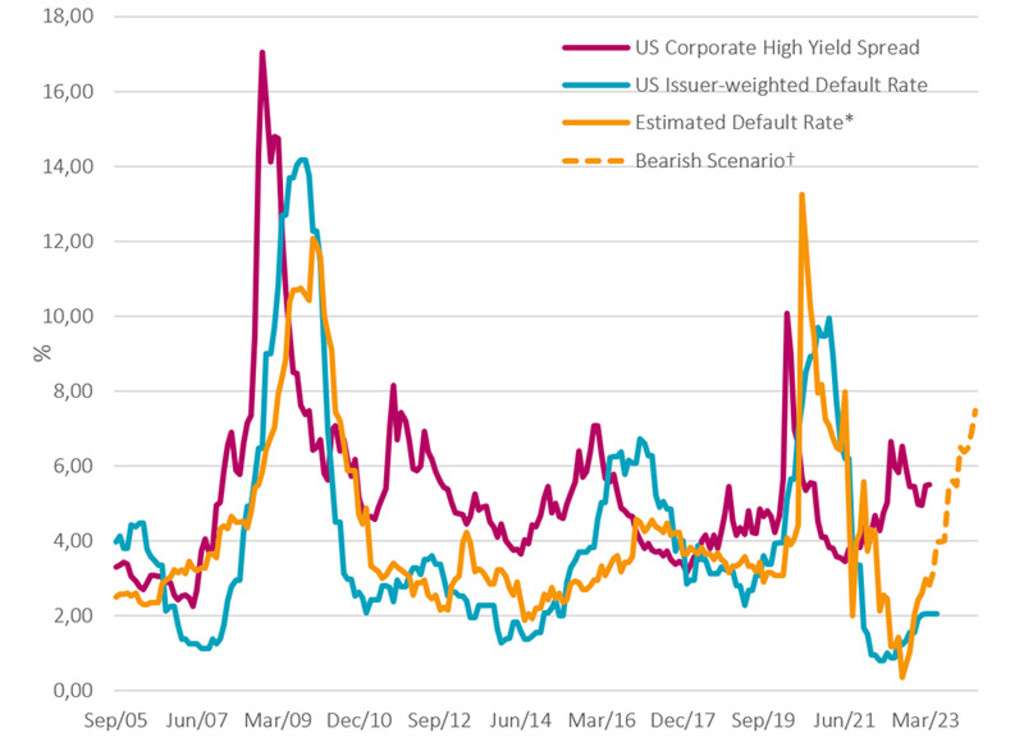
* The estimated default rate is based on the regression of US 12m default rate with Tightening Standards of C&I Loans for Large and Medium firms (1Y lag) and 1Y Change in unemployment rate (1Q lag)
† Estimated Default Rate assuming US Unemployment rate increases to 6% in the next 12 months
Source: Bloomberg, Robeco, Bank of America as at 28 April 2023
Figure: 6: US high yield credit fundamentals
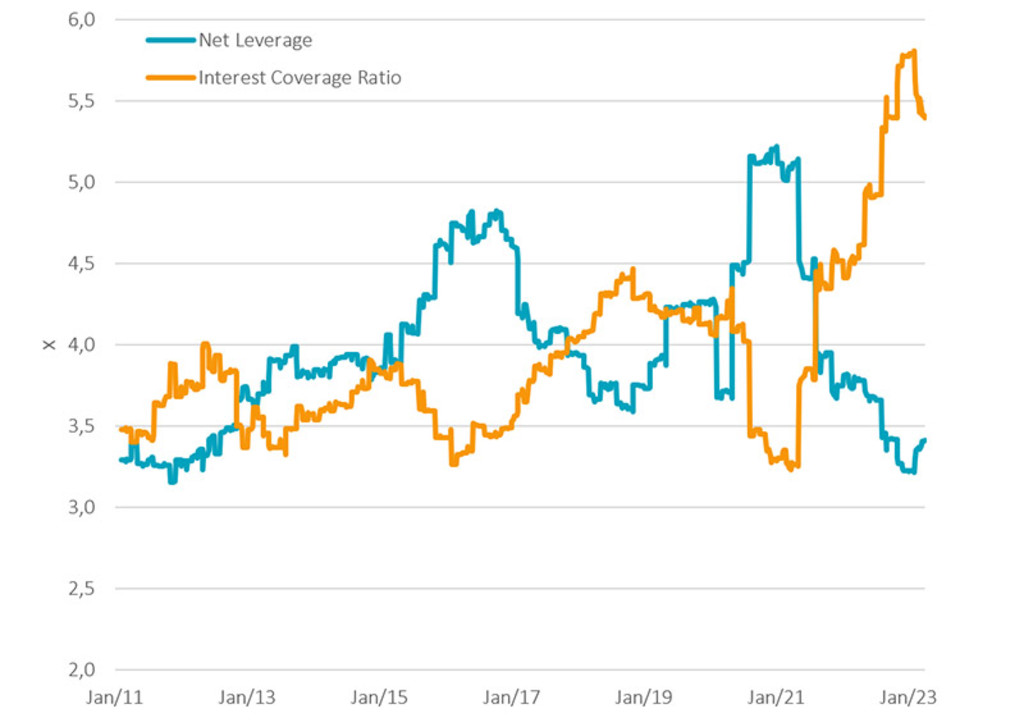
Source: Bloomberg, Robeco, Bank of America as at 31 March 2023
Enjoy it while it lasts
Love it or hate it, high yield is offering a better alternative relative to equities on valuation grounds, but the asymmetric risk of holding this asset during the late-cycle phase has increased the opportunity cost for multi-asset investors.
“The recent narrative favors a shift to a more cautious approach, with a move towards the higher-quality spectrum of the high yield space and active management to filter credit selection,“ says Rouffiac.
重要資料
本網站僅供《證券及期貨條例》(香港法例第571章)及其附屬法例所界定之專業投資者瀏覽及使用。 投資涉及風險。過往表現並不代表未來表現。本網站所載資料僅供參考之用,並不構成任何投資建議,亦非作出買賣任何證券或採納任何投資策略之要約或招攬。投資者不應僅憑本網站提供之資料作出投資決定,在作出任何投資決定前,應徵詢獨立意見(包括有關稅務影響之意見)。投資者應確保完全理解投資產品的相關風險,亦應考量自身投資目標及風險承受水平。投資乃閣下之個人決定。除非銷售投資產品的中介人已向閣下告知該投資產品適合閣下,並已解釋其符合閣下投資目標之原因,否則閣下不應投資。請參閱相關發售文件或其他法律文件,以獲取包括風險因素在內的進一步詳情。 本網站由荷寶投資管理香港有限公司發布,該公司受香港證券及期貨事務監察委員會(「證監會」)規管(中央編號:APU851)。本網站未經證監會審閱。 無法保證任何投資產品可實現其投資目標。概不就任何投資產品之表現或投資回報作任何聲明或承諾。投資的價值或會波動。本網站所載過往表現、推算或預測,均不應視作未來表現之保證或指標,且概不提供任何明示或暗示之保證。本網站內容建基於相信為可靠之來源,惟因應資料傳遞技術特性及須採用多項數據來源(包括第三方內容),故概不保證其準確性。所述觀點僅乃截至上述日期,或會隨市況變化而改變,可予更改而毋須另行通知。該等意見可能有別於其他荷寶投資專業人士之意見。因使用本材料或當中所載任何評論、意見或估算而引致之直接、間接或相應損失,荷寶概不承擔法律責任。荷寶並無責任更新本網站或任何網站內容。未經荷寶事先書面許可,不得複製、分發或刊發本網站任何材料。 除非另有說明,資料來源:荷寶。