

Portfolio Manager

• 市場觀點
How M&A, IPOs and a bit of GENIUS are driving fintech fever
A series of successful IPOs and M&As combined with the passage of the groundbreaking US GENIUS Act are rapidly expanding fintech solutions in financial markets and creating significant opportunities for Robeco’s FinTech strategy.
作者




Portfolio Manager

Portfolio Manager

FinTech/New World Financials Analyst
概要
- Capital market activity is roaring back to life
- Landmark legislation is laying foundations for tokenization of assets
- Fintech strategy well positioned as structural momentum accelerates
In our 2025 Outlook at the start of the year, we anticipated a resurgence in private and public fintech funding which began to materialize in late spring with a wave of IPOs. Online brokerage platforms WeBull and eToro went public in April and May, respectively, while neobank Chime followed in June, closing the month 28% above its listing price and reaching a market value of USD 13 billion.
Though stellar in their own right, the star performer in this season of launches is stablecoin issuer Circle. It made an exceptional debut, with its share price increasing almost ninefold at its peak before closing in June with a market capitalization of USD 40 billion. And there’s more capital action still to come. Klarna, a buy-now-pay-later provider has already initiated its IPO process, and digital wealth manager Wealthfront confidentially filed for an IPO last month.1
Private fintech funding also continued with Ramp, a spend-management fintech, which raised another USD 200 million in its latest funding round, lifting its valuation to USD 16 billion. Additionally, payment processor Stripe acquired crypto wallet provider Privy for an undisclosed amount, while accounting software provider Xero acquired bill payments platform Melio for USD 2.5 billion. Robust capital market activity signals growing confidence in a diverse and broadening fintech market, creating significant growth opportunities for the FinTech strategy over the short-, mid- and long-term.
Robust capital market activity signals growing confidence in a diverse and broadening fintech market
Genius in motion means more tokens
Stablecoins, once a crypto novelty, are set to become mainstream with the passage of the GENIUS Act (Guiding and Establishing the National Innovation for US Stablecoins Act of 2025) in the US Senate. This landmark legislation will most likely allow banks and regulated issuers to release tokenized US dollars by the end of this summer. That’s the first step in legitimizing stablecoins in cross-border and domestic payments, but also for corporate treasury operations and financial services infrastructure.
The swiftness of response from retail commerce leaders is significant. Both Amazon and Walmart are exploring their own stablecoin issuance which could save them substantial amounts in fees.2 Meanwhile, in partnership with Shopify, Coinbase introduced its stablecoin payment stack built on its base layer-2 blockchain.3 The technology, which went live in June, seamlessly integrates US dollar coin (USDC) payments into Shopify’s processing systems for vendors. These modular stacks leverage programmable payment flows that replicate traditional e-commerce logic4 and will enable tokenized payments to be easily adopted and scaled by online vendors.
Additionally, Fiserv’s forthcoming launch of FIUSD (a US dollar-backed stablecoin) on the Solana blockchain, supported by Paxos and Circle, demonstrates how core banking infrastructure is integrating with blockchain, offering 24/7 settlement and embedded compliance tools. These announcements indicate that stablecoins’ programmable logic and real-time interoperability serve as a foundation for future financial services.
Both Amazon and Walmart are exploring their own stablecoin issuance which could save them substantial amounts in fees
獲取最新市場觀點
訂閱我們的電子報,時刻把握投資資訊和專家分析。
Simply stellar stablecoins
Stablecoin issuers primarily earn revenue through interest on fiat currency by depositing it in banks or purchasing US Treasury bills. By the end of June, stablecoins on public blockchains totaled USD 254 billion, with USDT 159 billion (Tether) and USDC 61 billion (Circle). For comparison, the US Federal Reserve’s M2 money supply (a measure of how much fiat currency is circulating in the US economy) was USD 22 trillion at the end of May. In an X post, US Treasury Secretary Scott Bessent projected stablecoins could reach a market size of USD 3.7 trillion by 2030, indicating potential adoption beyond digital assets.5
This adoption should be tracked by transaction volume growth (albeit with distortions from bots and high-frequency trading). Figure 1 shows adjusted transaction volumes growing 104% year-on-year to over USD 800 billion in June. JP Morgan CEO Jamie Dimon says his firm moves about USD 10 trillion daily – taken as a proxy for stablecoin volumes, it is clear there is significant room for growth.
Figure 1 – Stablecoin adjusted transaction volumes are growing rapidly
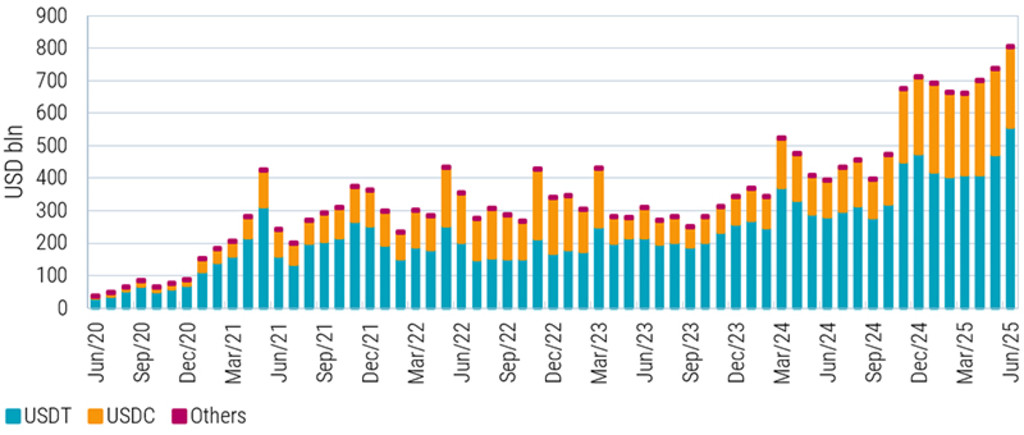
USDT = US dollar tether stablecoin backed by digital currency provider, Tether. USDC = US dollar backed stablecoin offered by Circle, a leading digital infrastructure provider. Source: Allium, Visa, Robeco
The implications of tokenization
Both Visa and Mastercard, giants in traditional commercial payment-settlement systems, have invested heavily to incorporate stablecoin use into their networks. Visa’s CEO, Ryan McInerney, has expressed optimism about stablecoin’s future, but stresses the need for trust, ease-of-use, and scale.
Although stablecoin adoption beyond the digital asset ecosystem is still in its early stages, it appears to be more of a threat to the business models of card issuers than to payment network companies. Visa and Mastercard’s tokenization and merchant network capabilities remain a powerful moat to connect the traditional system with the crypto world, although it does put a question mark around terminal growth. Share prices of both Visa and Mastercard reached all-time highs in June but contracted 5.5% by the end of the month.
Also in June, Robinhood’s ‘To Catch A Token’ event focused on their development of a layer-2 blockchain optimized for real-world assets. This blockchain infrastructure enables the seamless transfer of assets at any time. Robinhood announced stock tokens on listed US equity, such as Nvidia, Microsoft, and Apple, while also offering tokenized shares of OpenAI and SpaceX to users in Europe. Ironically, the regulatory challenges are greater in the US than in Europe, although Robinhood and Coinbase are reportedly in discussions with the SEC to smooth issuance without added legal complexity.
We are confident that the buildout of robust technological infrastructure that is governed by regulatory oversight are strong signals of structural tailwinds that will spur legitimacy, acceptance and growth of tokenization in the wealth management industry. Clearly, Robinhood and Coinbase are on the forefront of these efforts. Robinhood’s stock increased 13% on the day of the event and added 151% year-to-date, despite volatility in April.
Footnotes
1‘Robo-advisor Wealthfront files confidentially for an IPO.’ Bloomberg, June 2025.
2Walmart and Amazon Are Exploring Issuing Their Own Stablecoins, The Wall Street Journal, 13 June 2025.
3Layer-2 networks are built atop the original blockchain base layer and provide additional functionality and flexibility to blockchain architecture. Layer-2 stacks are making blockchain transactions cheaper, faster and more flexible, which will promote scale and adoption for real-world financial transactions.
4Essentially mirroring fiat workflows – from customer checkout, payment authorizations, digital wallet connections, on-chain ledgering, escrow-based captures and refunds.
517 June 2025, X post from the account of US Treasury Secretary, Scott Bessent
Important note:
The companies referenced are for illustrative purposes only in order to demonstrate the investment strategy on the date stated. The companies are not necessarily held by the strategy. This is not a buy, sell or hold recommendation, nor should any inference be made on the future development of the company.
重要資料
本網站僅供《證券及期貨條例》(香港法例第571章)及其附屬法例所界定之專業投資者瀏覽及使用。 投資涉及風險。過往表現並不代表未來表現。本網站所載資料僅供參考之用,並不構成任何投資建議,亦非作出買賣任何證券或採納任何投資策略之要約或招攬。投資者不應僅憑本網站提供之資料作出投資決定,在作出任何投資決定前,應徵詢獨立意見(包括有關稅務影響之意見)。投資者應確保完全理解投資產品的相關風險,亦應考量自身投資目標及風險承受水平。投資乃閣下之個人決定。除非銷售投資產品的中介人已向閣下告知該投資產品適合閣下,並已解釋其符合閣下投資目標之原因,否則閣下不應投資。請參閱相關發售文件或其他法律文件,以獲取包括風險因素在內的進一步詳情。 本網站由荷寶投資管理香港有限公司發布,該公司受香港證券及期貨事務監察委員會(「證監會」)規管(中央編號:APU851)。本網站未經證監會審閱。 無法保證任何投資產品可實現其投資目標。概不就任何投資產品之表現或投資回報作任何聲明或承諾。投資的價值或會波動。本網站所載過往表現、推算或預測,均不應視作未來表現之保證或指標,且概不提供任何明示或暗示之保證。本網站內容建基於相信為可靠之來源,惟因應資料傳遞技術特性及須採用多項數據來源(包括第三方內容),故概不保證其準確性。所述觀點僅乃截至上述日期,或會隨市況變化而改變,可予更改而毋須另行通知。該等意見可能有別於其他荷寶投資專業人士之意見。因使用本材料或當中所載任何評論、意見或估算而引致之直接、間接或相應損失,荷寶概不承擔法律責任。荷寶並無責任更新本網站或任何網站內容。未經荷寶事先書面許可,不得複製、分發或刊發本網站任何材料。 除非另有說明,資料來源:荷寶。