

Client Portfolio Manager


• 市場觀點
Why emerging markets are back in focus
Emerging markets (EM) are stepping into the spotlight as developed economies grapple with volatility and policy uncertainty. With global dynamics shifting, EMs are showing strength across asset classes, and active investors are taking notice.
作者

Meena Santhosh



Client Portfolio Manager

Head of Fixed Income Asia
概要
- Emerging markets are outperforming developed markets across asset classes
- Global structural shifts are reshaping the financial order
- Turning complexity into opportunity in emerging markets requires active management
The global market shake up over the past two months has been revealing. US exceptionalism is fading and long-held relationships like the correlation between a strong dollar and lower Treasury yields have faltered. Central banks are struggling with persistent uncertainty created by tariffs and the Fed faces a difficult trade-off: managing tariff-induced inflation versus supporting weakening growth.
Against this backdrop, structural shifts in the global economy coupled with geopolitical conflict, trade fragmentation and fiscal pressures, are challenging traditional investment approaches. Despite global trade tensions, emerging markets are benefiting from easing inflation, improved balance sheets, and a weaker US dollar – conditions that support more accommodative monetary policies.
With growing uncertainty around US policies, diversification has become essential. Portfolio reallocations away from the US already appear to be underway, as investors adopt a more selective global perspective to maintain resilient portfolios.
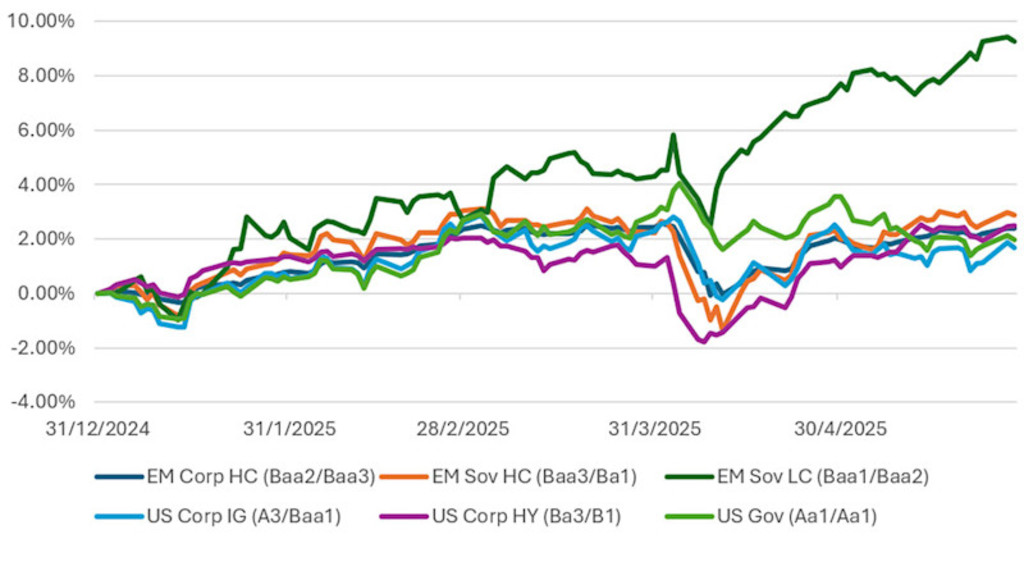
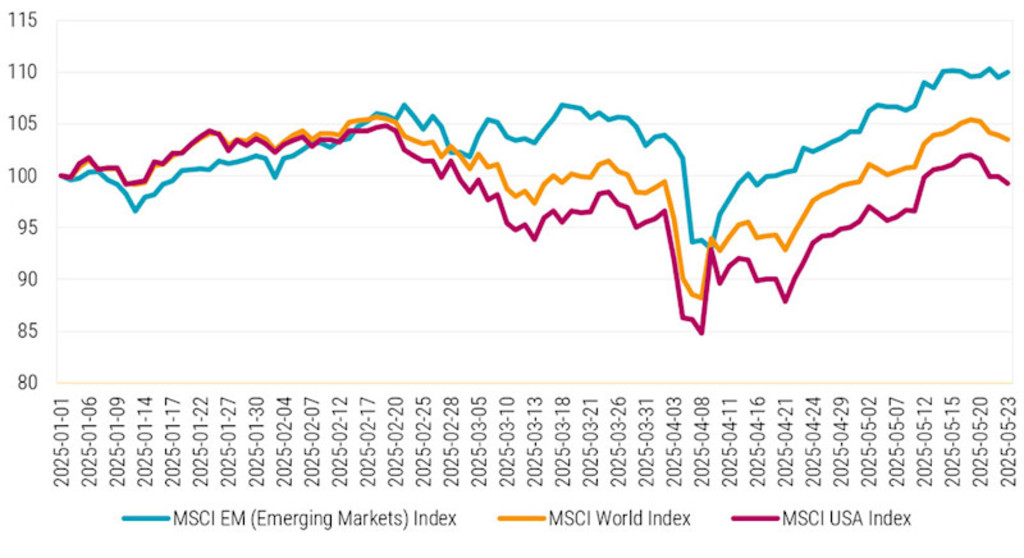
Emerging markets, by contrast, are now in a cyclically strong position, having moved past their post-Covid defaults – a challenge still prevalent in developed market credit. Far from being defined by volatility and political risk, they have shown resilience, outperforming developed markets during this turmoil. Year to date, in the EM bond market, corporates have outperformed US high yield and global investment grade, offering higher returns for similar or better credit ratings. EM debt has exhibited less volatility than US high yield, while offering more yield and wider spreads than investment grade. Similarly, in the equity market, the MSCI EM equities have returned 7.4% (see Figure 2), outperforming US equities and global indices, highlighting their resilience in a volatile macro landscape.1
What’s behind the rise of emerging markets in both equity and fixed income? Structural changes in trade flows, monetary independence, and internal resilience are transforming EM from a cyclical trade into a strategic allocation.
Figure 1 - EM bonds have outperformed in 2025
Source: Bloomberg, Robeco, May 2025.
Past performance is no guarantee of future results. The value of your investments may fluctuate.
Figure 2 - MSCI EM equities have outperformed in 2025
Source: MSCI to 23 May 2025.
Past performance is no guarantee of future results. The value of your investments may fluctuate.
Emerging markets take the lead in trade and growth
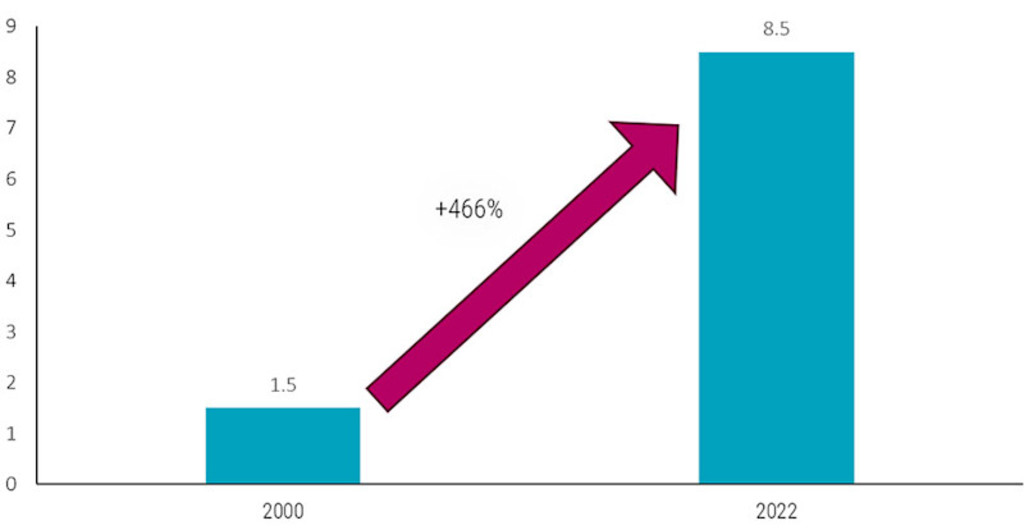
The US remains an important economic force, but its dominance as an export destination for emerging markets has structurally declined, shifting from 20% in 2000 to 14% today. Meanwhile, EM exports have surged by over 460% (see Figure 3). This has been driven by intra-regional trade, the rise of large Asian emerging economies, and EM-led global value chains. Trump’s new round of trade negotiations is likely to accelerate the importance of emerging markets as export and trade hubs. At the same time, we’ve seen a decline in US consumer dominance and a rise in consumer demand across emerging markets, particularly in countries like China.
Figure 3 - EM global exports (USD, trillion) are playing a bigger role in EM growth
Source: Robeco, World Bank data as of end December 2024.
The growth gap between EM and DM is widening
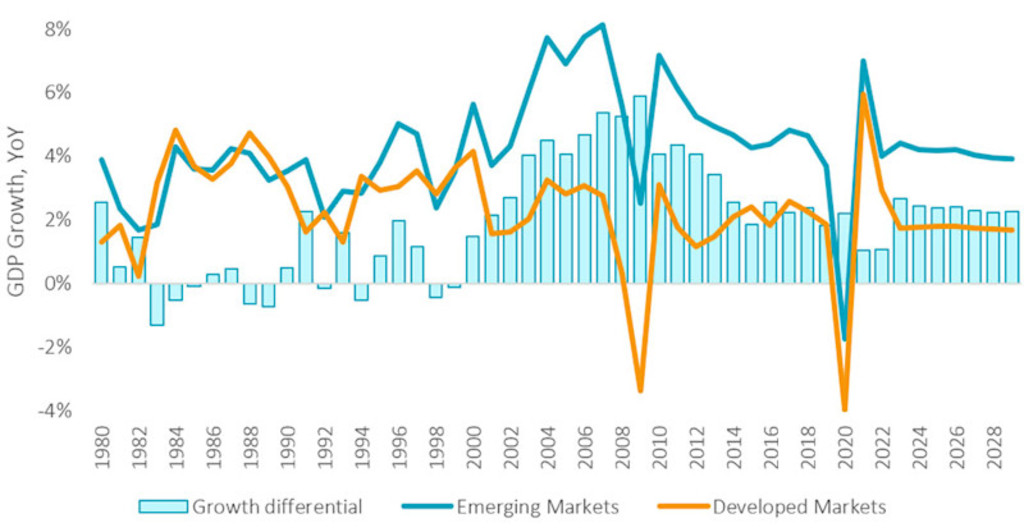
EMs have outgrown DMs for decades, but returns haven’t always followed. This time, more resilient fundamentals and greater monetary autonomy could change that. With developed economies facing headwinds, such as lingering inflation, housing market dysfunction and consumer stress, growth is shifting toward emerging economies. The IMF’s April 2025 forecast2 now sees advanced economy growth at just 1.4%, with the US at 1.8% amid rising uncertainty. In contrast, emerging markets are expected to grow 3.7% in 2025, with only modest downward revisions for countries most impacted by trade measures.
In particular, strong growth is anticipated for India, ASEAN and the Middle East. The more positive projections can be attributed to the healthy balance sheets many EM economies possess with low debt levels. Aside from China, EM debt represents just 25% of outstanding world debt.3 A split from the US in setting monetary policy has also shaped EM economies, with many countries staying ahead of the curve in recent years, often entering easing cycles before the Fed. Together, these factors suggest that EM’s structural strength and growth may now be more likely to translate into investment performance than in the past.
Figure 4 - GDP growth in emerging markets
Source: World Bank, IMF, April 2025.
Past performance is no guarantee of future results. The value of your investments may fluctuate.
Emerging markets reshape the financial order
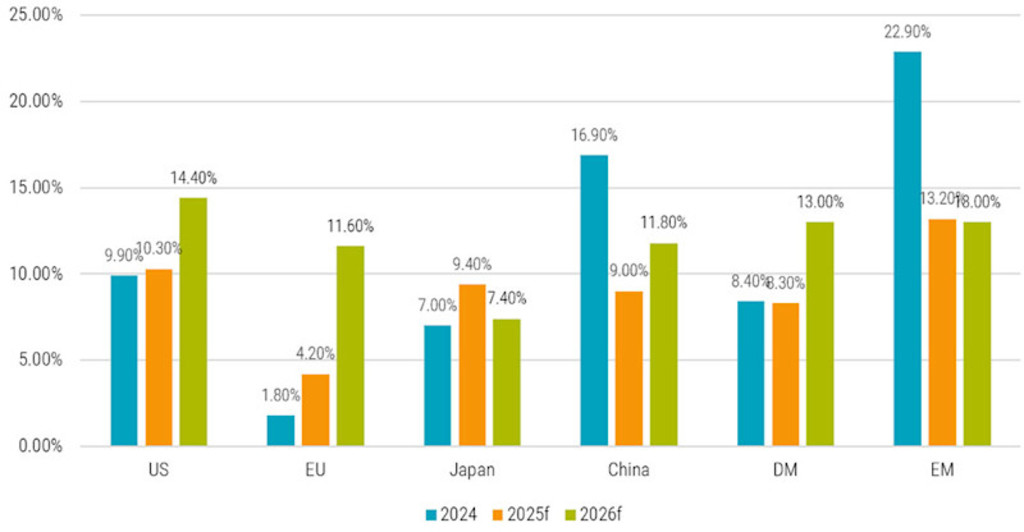
Earnings growth further supports EM’s structural appeal. EM companies are expected to post double-digit earnings growth through 2026, outpacing both the US and broader developed markets. This strong outlook emphasizes the maturity of many emerging market economies.
Figure 5 - Projected earnings growth for EM in 2025 and 2026
Source: MSCI, IBES, 30 April 2025.
This graph is for illustrative purposes only.
Asia's large surpluses make it a formidable investor
Some of the financial power within emerging markets is already becoming apparent. Since 2010, 12 key Asian economies have accumulated more than USD 8.5 trillion in current account surpluses. Yet only a fraction of that, USD 2.3 trillion, has been held in official foreign exchange reserves. The remaining surplus is increasingly in the hands of private sector entities and is being actively invested outside the traditional reserve channels like US Treasuries. While the US continues to be the world’s largest net borrower, many Asian economies are still among its biggest lenders.
There are some interesting shifts underway. Although US public debt keeps climbing, it’s now largely funded by private investors rather than official institutions like central banks and sovereign wealth funds. At the same time, Asian investors have reduced their share of US Treasury holdings, which have either remained flat or declined. In contrast, their exposure to US equities has grown notably from just over 2% to nearly 7% in recent years.4 This changing investment behavior could have important implications. A shift could impact both US markets and Asia’s financial landscape, with a repatriation of capital strengthening Asian bond market fundamentals and boosting IPO activity across the region.
Selecting the best opportunities across regions and asset classes
A common misconception is to view emerging markets as a single, uniform block. In reality, EM is one of the most diverse investment universes. Regional growth drivers differ significantly: India and ASEAN benefit from strong domestic demand and digitalization, while Latin America is more cyclical, with exposure to commodities and attractive real yields. EMEA markets, meanwhile, are shaped by geopolitical dynamics and reform pathways. This diversity extends across asset classes too. Equities can offer exposure to structural growth, while EM debt, both sovereign and corporate, can deliver attractive yields and diversification, with different roles depending on market cycles.
Robeco’s active approach is built for complexity
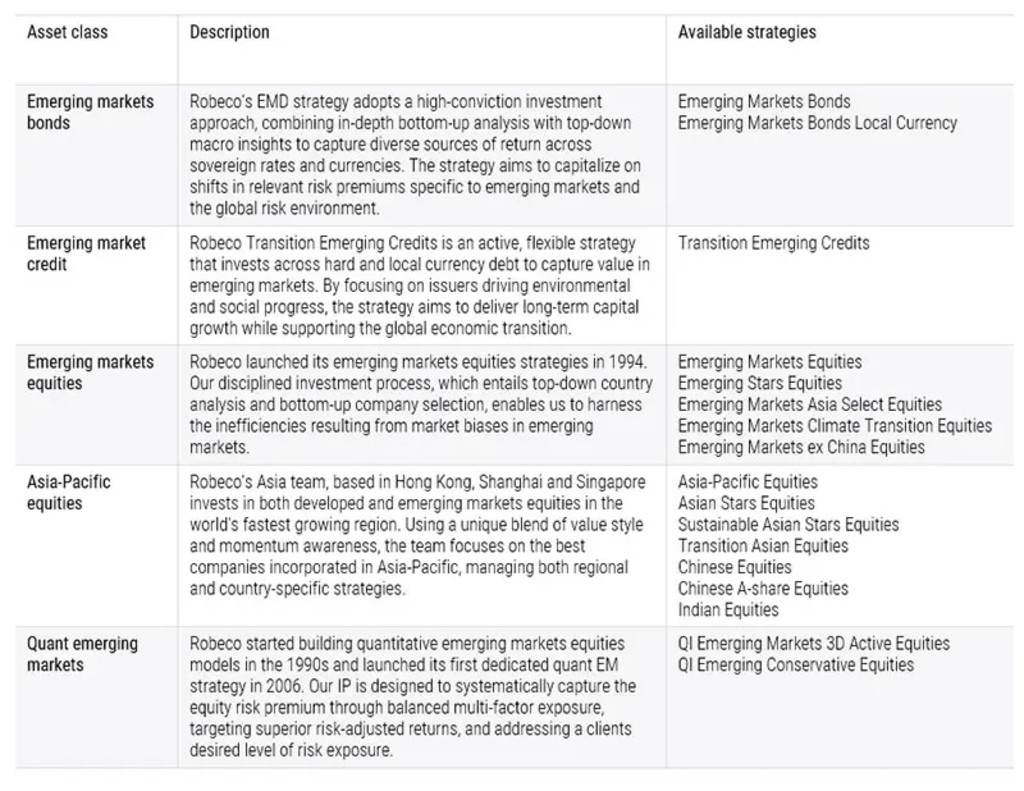
In such a varied landscape, an active investment approach is crucial. Finding value in diverse economies requires local insights and disciplined research and the flexibility to adjust to market conditions and diverging economic policy. Robeco’s broad range of emerging market strategies are designed to manage this complexity and target the best opportunities.
Table 1 - Robeco’s EM strategies span sovereign and corporate debt as well as equities

Discover emerging opportunities
For investors focused on long-term investing with real diversification, EM exposure is critical.
Footnotes
1Past performance is no guarantee of future results. The value of your investments may fluctuate.
2See: https://www.imf.org/en/Publications/WEO/Issues/2025/04/22/world-economic-outlook-april-2025
3BofA Global Research, BIS, Bloomberg. “Size and Structure of Global Emerging Markets Tradable Debt.” As of July 1, 2024
4Asian ownership of US equities US Treasury, CEIC, HSBC
重要資料
本網站僅供《證券及期貨條例》(香港法例第571章)及其附屬法例所界定之專業投資者瀏覽及使用。 投資涉及風險。過往表現並不代表未來表現。本網站所載資料僅供參考之用,並不構成任何投資建議,亦非作出買賣任何證券或採納任何投資策略之要約或招攬。投資者不應僅憑本網站提供之資料作出投資決定,在作出任何投資決定前,應徵詢獨立意見(包括有關稅務影響之意見)。投資者應確保完全理解投資產品的相關風險,亦應考量自身投資目標及風險承受水平。投資乃閣下之個人決定。除非銷售投資產品的中介人已向閣下告知該投資產品適合閣下,並已解釋其符合閣下投資目標之原因,否則閣下不應投資。請參閱相關發售文件或其他法律文件,以獲取包括風險因素在內的進一步詳情。 本網站由荷寶投資管理香港有限公司發布,該公司受香港證券及期貨事務監察委員會(「證監會」)規管(中央編號:APU851)。本網站未經證監會審閱。 無法保證任何投資產品可實現其投資目標。概不就任何投資產品之表現或投資回報作任何聲明或承諾。投資的價值或會波動。本網站所載過往表現、推算或預測,均不應視作未來表現之保證或指標,且概不提供任何明示或暗示之保證。本網站內容建基於相信為可靠之來源,惟因應資料傳遞技術特性及須採用多項數據來源(包括第三方內容),故概不保證其準確性。所述觀點僅乃截至上述日期,或會隨市況變化而改變,可予更改而毋須另行通知。該等意見可能有別於其他荷寶投資專業人士之意見。因使用本材料或當中所載任何評論、意見或估算而引致之直接、間接或相應損失,荷寶概不承擔法律責任。荷寶並無責任更新本網站或任何網站內容。未經荷寶事先書面許可,不得複製、分發或刊發本網站任何材料。 除非另有說明,資料來源:荷寶。