

Client Portfolio Manager


• 月度展望
Emerging markets debt: Coming of age
A weakening dollar and improving fundamentals are making emerging markets debt an attractive asset class in its own right, says fixed income specialist Meena Santhosh.
作者

Meena Santhosh

Head of Multi Asset & Equity Solutions, Co-Head Investment Solutions
概要
- Shift in US exceptionalism weighs on upward dollar strength
- Emerging markets bonds are now a USD 8 trillion asset class
- Picking winners, avoiding losers vital for navigating EMD portfolios
Once seen as a niche area due to the instability of some developing nations, bonds issued by countries and companies across Asia, Africa and Latin America now have a market value of more than USD 8 trillion.
And now a potential weakening of the US dollar due to uncertain trade policy, the introduction of a universal tariff level, and the threat of additional tariffs from President Trump are set to benefit emerging markets, many of which are exporters of commodities. This boosts their revenue when sales in dollars are converted into the local currency.

US exceptionalism
“The US dollar currently stands at its strongest level since the 1980s when adjusting for inflation differentials,” says Santhosh, Client Portfolio Manager with the Robeco fixed income investment team. “Now, US policy uncertainty and a shift in US exceptionalism as seen with Trump 2.0 are weighing on that long-standing upward dollar trend.”
“This policy unpredictability and trade war uncertainty, combined with progressive changes in Europe’s fiscal and defense policies, creates scope for reallocations away from the US that could start to dampen the two-decade-long USD bull market.”
“EMD has had a difficult performance over the past 15 years, but that weakness has primarily been a function of dollar strength, rather than overall emerging market weakness. This may be set to change.”
“Emerging markets have strong potential to benefit from this, particularly the commodity-linked regions, while also providing strong growth prospects for those countries in Central Europe, the Middle East and Africa (CEEMEA) that are integrated into Europe’s industrial supply chains.”
The EMD universe has grown enormously in the past two decades
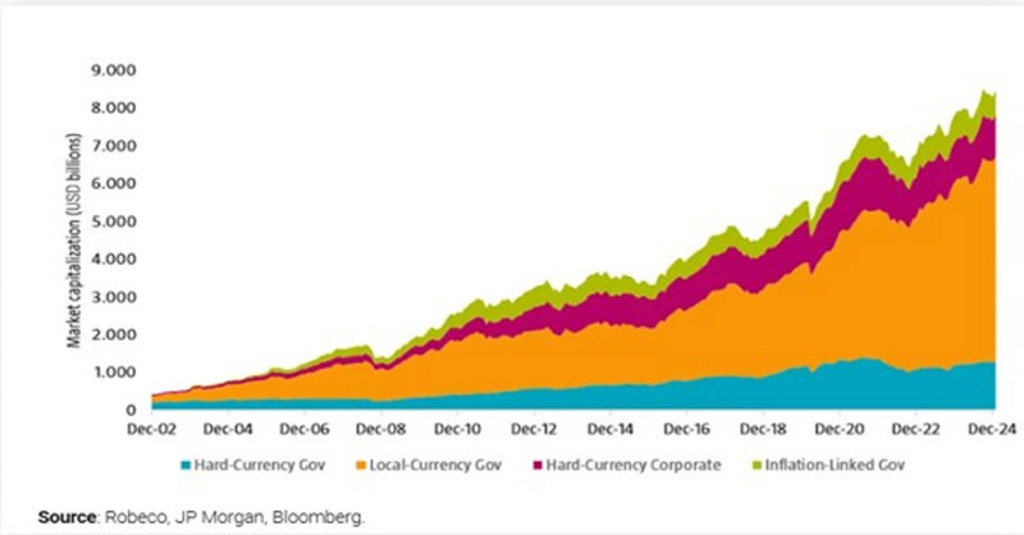
Source: Robeco, JP Morgan, Bloomberg
Post-pandemic aftermath
The EMD asset class was badly hit by both the Covid pandemic and Russia’s invasion of Ukraine that badly disrupted supply chains and led some countries to default on their sovereign debt repayments. This brought a high number of bond rating downgrades.
“Many of these countries that went into debt distress on the back of these shocks, along with countries that have also faced persistent headwinds more broadly such as Argentina, have since had restructurings finalized, and in some cases, fully resolved,” says Santhosh.
“Emerging market fundamentals are now back on improving trajectories as economic growth has recovered, national reserves have been rebuilt, and countries have worked with the IMF to improve their fundamentals. This is reflected in the ratings trend, which is now showing strong net upgrades.”
“Spreads – the difference between the yield on EMD and that of top-rated developed market government bonds – are trending tighter as a reflection of a more stable and robust asset class. This is paving the way for a healthier overall outlook for the emerging market landscape going forward.”
獲取最新市場觀點
訂閱我們的電子報,時刻把握投資資訊和專家分析。
Picking winners, avoiding losers
Any future imposition of US tariffs will lead to asymmetric effects across different industries and sectors in both cost and supply chains. Emerging markets are leading producers of commodities ranging from palm oil and rice, to oil, precious metals and timber. Manufactured goods range from textiles and cars to chemicals and higher-tech semiconductors, all of which have attracted tariffs.
“A reliance on emerging market exports of manufactured goods to the US can become much more of a vulnerability compared to commodities,” Santhosh says. “Commodity exports might be less affected as they are harder to replace domestically, and generally are less subject to end-market industrial policy.”
“Generally, those emerging market companies that do export manufactured goods are more developed than the commodities exporters, and so their bonds trade at tighter spreads, which makes them relatively more stable.”
Alpha opportunities in EMD
“Over the last 10 years, a large proportion of active managers outperformed the passive products such as Exchange-Traded Funds (ETFs) after fees within EMD,” adds Colin Graham, co-head of Robeco Investment Solutions. “So there is definitely a stronger case for deploying active management in the EMD space, versus asset classes at the other end of the spectrum such as US equity.”
“Some countries are also less likely to be affected by tariffs or a future trade war, or have more bargaining power to get around them,” Santhosh says. “This makes it important to be more selective when choosing which emerging market bonds to buy.”
“It remains a case-by-case analysis, given that some countries, including Mexico, may be more likely to be able to reach agreements with the US compared with geopolitical rivals such as China.”
An expansive EMD universe
The EMD asset class has grown over the past two decades, reaching a market capitalization above USD 8 trillion at the end of 2024. This now represents about 11% of the global bond market, with debt issued in local currency rather than hard currencies such as the dollar leading its growth.
“Many large countries, such as Brazil, China and India have been able to issue government debt in their own local currency, meaning they no longer rely solely on the narrower market for hard-currency funding,” Santhosh says.
“Compared to conventional asset classes that make up most of a global multi-asset market portfolio, the average returns of hard-currency EMD can provide higher additive returns and diversification from other high yielding assets alongside a multi-asset portfolio,” Graham adds.
“Our research has shown that on a historical basis, a mix of EMD and high yield tends to offer a more stable overall excess return profile, especially when accounting for performance differences over time between local and hard-currency debt. This perhaps makes the case for EMD to be considered more seriously as part of the long-term strategic asset allocation for balanced multi-asset portfolios.”
重要資料
本網站僅供《證券及期貨條例》(香港法例第571章)及其附屬法例所界定之專業投資者瀏覽及使用。 投資涉及風險。過往表現並不代表未來表現。本網站所載資料僅供參考之用,並不構成任何投資建議,亦非作出買賣任何證券或採納任何投資策略之要約或招攬。投資者不應僅憑本網站提供之資料作出投資決定,在作出任何投資決定前,應徵詢獨立意見(包括有關稅務影響之意見)。投資者應確保完全理解投資產品的相關風險,亦應考量自身投資目標及風險承受水平。投資乃閣下之個人決定。除非銷售投資產品的中介人已向閣下告知該投資產品適合閣下,並已解釋其符合閣下投資目標之原因,否則閣下不應投資。請參閱相關發售文件或其他法律文件,以獲取包括風險因素在內的進一步詳情。 本網站由荷寶投資管理香港有限公司發布,該公司受香港證券及期貨事務監察委員會(「證監會」)規管(中央編號:APU851)。本網站未經證監會審閱。 無法保證任何投資產品可實現其投資目標。概不就任何投資產品之表現或投資回報作任何聲明或承諾。投資的價值或會波動。本網站所載過往表現、推算或預測,均不應視作未來表現之保證或指標,且概不提供任何明示或暗示之保證。本網站內容建基於相信為可靠之來源,惟因應資料傳遞技術特性及須採用多項數據來源(包括第三方內容),故概不保證其準確性。所述觀點僅乃截至上述日期,或會隨市況變化而改變,可予更改而毋須另行通知。該等意見可能有別於其他荷寶投資專業人士之意見。因使用本材料或當中所載任何評論、意見或估算而引致之直接、間接或相應損失,荷寶概不承擔法律責任。荷寶並無責任更新本網站或任何網站內容。未經荷寶事先書面許可,不得複製、分發或刊發本網站任何材料。 除非另有說明,資料來源:荷寶。