
Co-Portfolio Manager
• 市場觀點
Japan's Green Transformation Plan to boost smart energy investments
Japan’s Green Transformation (GX) Plan is a bold new strategy aimed at transitioning the world’s fourth largest economy away from fossil fuels and toward cleaner energy sources. Equally ambitious financing should catalyze investments across diverse smart energy solutions, from renewables and smart grids to smart cars and energy-saving equipment.
作者


Equity Analyst
概要
- Plan aims to both energize and decarbonize Japan’s economy
- The near 1 trillion-euro investment rivals the US IRA in size and ambition
- Substantial tailwinds expected for smart energy solutions in Asia and Japan
Japan’s momentous move was motivated by the need to decarbonize the economy to combat climate change, ensure energy security, spur green innovation and clean economic growth. Though it has made some progress in the two decades since the enactment of the Kyoto Protocol (the world’s first legally binding climate treaty), Japan still ranks fifth in global emissions and performs worse than China in emissions per capita.1
Part of the problem is a heavy reliance on fossil fuels (nearly 100% of which are imported) which the GX Plan aims to reduce through generous investments in clean technologies and negative taxes on carbon. 2
Figure 1 – Japan wants to kick its fossil fuel habit
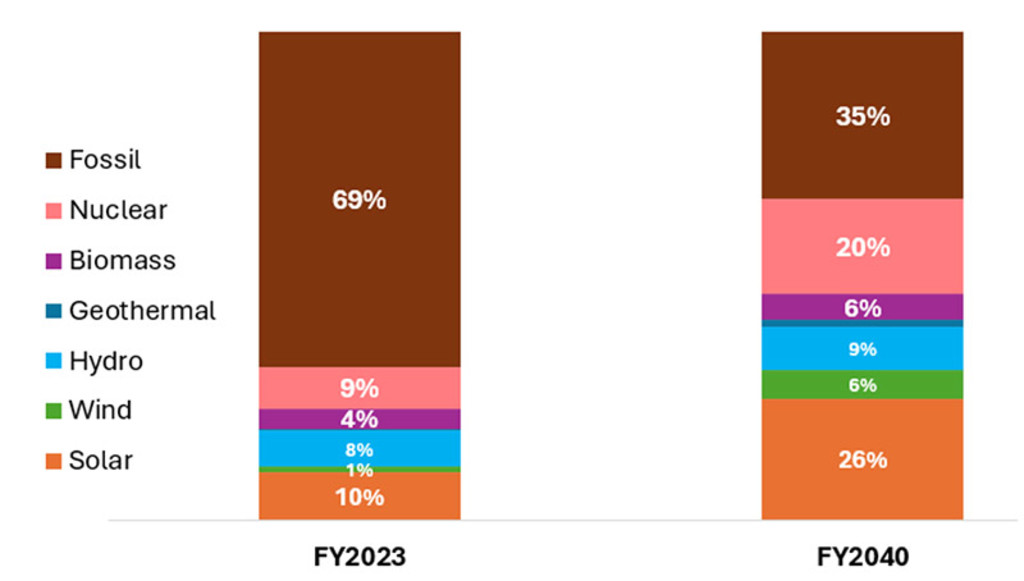
The bulk of Japan’s energy supplies stems from fossil fuels, which are almost fully imported. Source: Energy mix from Japan’s 7th Strategic Energy Plan, Agency for Natural Resources and Energy, UBS, 2025. Climate Bonds Initiative, 2024.
To achieve its goals, nearly 1 trillion euros in investments will be raised over the next decade through public and private sources.3 The goal is to first incentivize companies to innovate their way toward a net-zero trajectory before applying penalties on laggards.
Nearly 1 trillion euros in investments will be raised over the next decade through public and private sources
Japan’s GX rivals US IRA
The comprehensiveness of the roadmap combined with extraordinary scale of financing – which is more than 3 times larger than the US Inflation Reduction Act (IRA) as a share of country GDP – demonstrates Japan’s credible commitment to using the net-zero transition to rev up innovation and future economic growth.
Figure 2 – Japan GX Plan vs US IRA
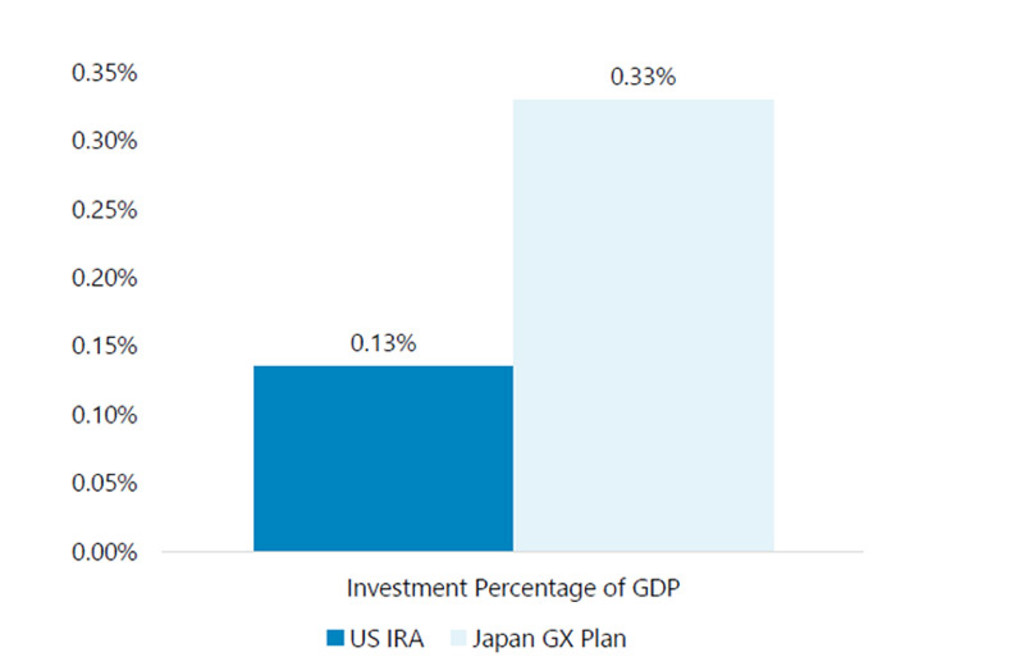
Japan’s annual public spending on clean energy investments is 3x larger than the US’s IRA in terms of GDP. Source: US Senate; Rhodium Group; GR Japan; Statista; Jefferies, 2024.
As with the IRA in the US, the GX plan is designed to facilitate the clean shift through substantial investments in renewable energy, electric vehicles, and improvements in energy efficiency for buildings and infrastructure. The IRA experience in the US suggests that Japan’s initiative could generate beneficial tailwinds for companies within these industries.
Since the IRA enactment, investments in manufacturing and deployment of clean technologies reached USD 493 billion – a 70% increase compared to pre-IRA levels.4 Investments in emissions-reducing technologies in Q2 2024 alone represented 5.5% of all US private investments (see Figure 3).5
Growth and earnings resulting from company capex into clean and emissions-reducing technologies should continue to steadily unfold as deployment and adoption increase in the years ahead.
Figure 3 – US IRA has helped push private investments into clean energy solutions
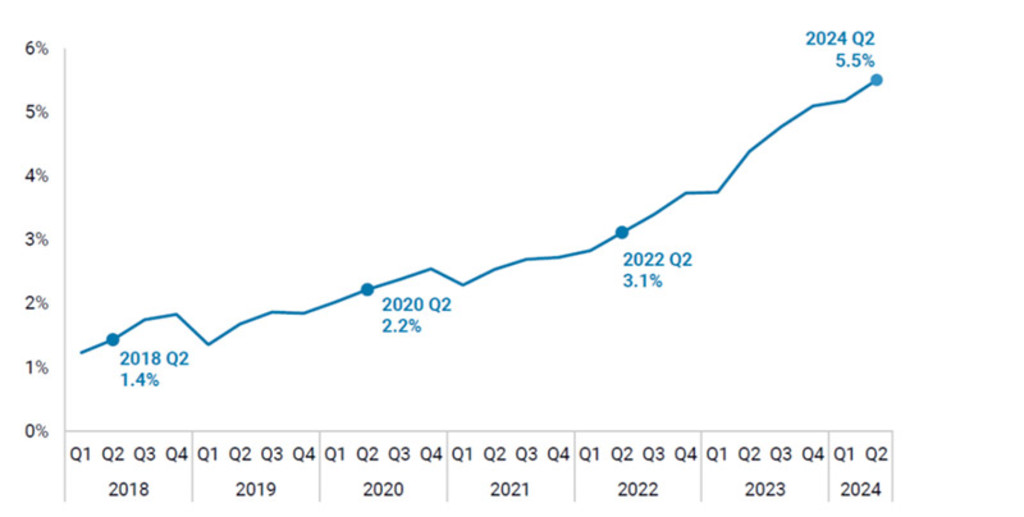
The graph shows clean investments as a share of total US private investment in structures, equipment and durable consumer goods. Source: Rhodium Group/MIT-CEEPR Clean Investment Monitor, 2024.
Japan issues world’s first ‘green govies’
A key component of the funding strategy is the issuance of EUR 131.5 billion in climate transition bonds over the next ten years.6 These transition bonds, or ‘green govies’, are meant to kickstart the investment cycle. All other financing (around EUR 855 billion) will come from a mixture of private financing, emissions pricing and a carbon levy on fossil fuel imports.
The plan is also noteworthy for its emphasis on transitioning without derailing Japan’s overall economic growth. It’s hoped that this strong initial signal combined with seed funding should help steer companies toward reducing emissions.
Proceeds from financing will be allocated to various green initiatives including decarbonizing the energy sector, supporting renewable technologies, and promoting energy efficiency in housing and buildings. Later funding will come from carbon pricing and fossil import levies which should also pressure companies to invest in decarbonizing solutions.
Leveraging its ‘league’ and leadership
Another unique twist is the creation of a ‘GX League’, a voluntary group of nearly 750 of Japan’s high-emitting companies, that will pilot the emissions pricing mechanism to work out kinks before it goes mandatory in 2026. The league could also be critical for unlocking capex toward decarbonizing strategies from key industry players across Japan’s economy.
It’s a smart move, as Japan’s lead in hydrogen fuels cells, automotive batteries, semiconductors, and electronic equipment gives it a head start in innovating and scaling low-carbon solutions across many industries. Japan intends to leverage its expertise to decarbonize its economy and also create a clean tech engine to spur economic growth and leadership in Asia – a space now dominated by China.
One great investment strategy deserves another
Like the GX Plan, the Robeco Smart Energy Strategy (the Strategy) applies a comprehensive, multi-sector approach to investing in decarbonization. From upstream energy generation via renewables to downstream consumption from consumers and industrial users, the Strategy invests in the same target areas and companies poised to benefit from the GX spending, many of which are local names and lesser known internationally.
Figure 4 – Investing along a multi-trillion-dollar clean energy value chain
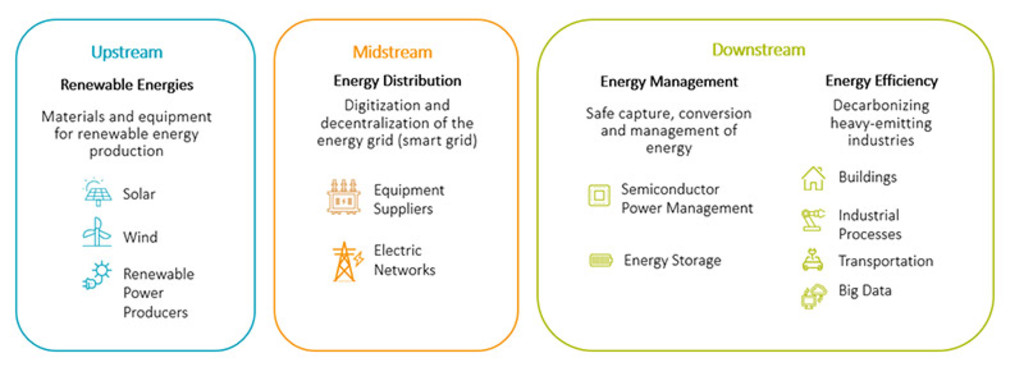
Source: Robeco, Smart Energy Strategy, 2025
The GX Plan stipulates that electric vehicles must comprise 20% of all new car sales by 2030, which should notably advance the development and adoption of electric vehicles, batteries, and automotive semiconductors – key components of the Strategy’s energy efficiency and power management clusters. And with a goal of 36-38% renewables in the energy mix, renewable generation should also see substantial growth, lifting the performance potential of the Strategy’s renewable holdings.
Figure 5 – GX Plan investments by sectors
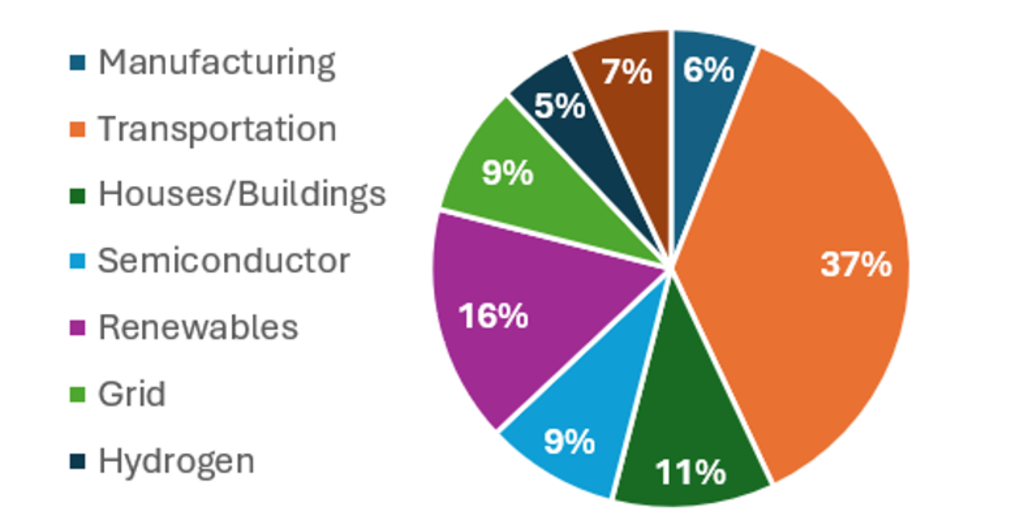
Transportation and renewable energy generation account for over half of planned investments. Source: Jefferies, METI, GR Japan, 2024.
Grid operators and suppliers should benefit from upgrades and expansion that facilitate renewable integration as well as meet the rising power needs of next-generation chips and hyper-scaled data centers. Already in 2024 alone, no less than 27 grid-scale battery and energy storage projects valued at EUR 217 million were approved by municipalities to enhance transmission grids from Hokkaido, Tohoku, and Tokyo in the north, to Chubu, Kansai and Kyushu in the south.7
Promoting sustainable living environments is also a key GX-objective which will benefit companies specializing in energy-efficient construction materials, insulation, and smart-home technologies, providing tailwinds for companies within the Strategy’s energy efficiency cluster.
Conclusion
The GX plan is comprehensive, competitive, and sustainable. Robeco’s Smart Energy strategy employs a similar approach, leaving it well positioned to benefit from the attractive opportunities created by Japan’s once-in-a-century transformation.
Footnotes
1 Japan - Countries & Regions - IEA
2 Climate Bonds Initiative
3 EUR 986.5 billion or JPY 150 trillion. Converted using Japan’s average EUR/YEN exchange rate over FY 2023 (1 EUR = 152.04 JPY), the year the GX Plan was announced. Source: World Currency Exchange Rates
4 Investment reached USD 493 billion in the two years post-IRA compared to USD 288 billion in the two years pre-IRA.
5 Clean Investment Monitor, August 2024. Rhodium Group, MIT Center for Energy and Environmental Policy Research.
6 EUR 131.5 billion = JPY 20 trillion. The first issuance JPY 1.6 trillion with 5 and 10-year maturities was in February 2024. Conversion done using EUR/YEN exchange rate over FY 2023 (1 EUR = 152.04 JPY), the year the GX Plan was announced. Source: World Currency Exchange Rates
7 Japan Energy Hub. January 2025. 27 grid-scale BESS projects secure 34.6B yen through METI's FY2024 storage subsidy program. Conversion rate of 1 EUR = 159.28 JPY, the average rate over FY 2024. Source: World Currency Exchange Rates
了解最新的可持續性市場觀點
訂閱我們的電子報,探索塑造可持續投資的趨勢。
重要資料
本網站僅供《證券及期貨條例》(香港法例第571章)及其附屬法例所界定之專業投資者瀏覽及使用。 投資涉及風險。過往表現並不代表未來表現。本網站所載資料僅供參考之用,並不構成任何投資建議,亦非作出買賣任何證券或採納任何投資策略之要約或招攬。投資者不應僅憑本網站提供之資料作出投資決定,在作出任何投資決定前,應徵詢獨立意見(包括有關稅務影響之意見)。投資者應確保完全理解投資產品的相關風險,亦應考量自身投資目標及風險承受水平。投資乃閣下之個人決定。除非銷售投資產品的中介人已向閣下告知該投資產品適合閣下,並已解釋其符合閣下投資目標之原因,否則閣下不應投資。請參閱相關發售文件或其他法律文件,以獲取包括風險因素在內的進一步詳情。 本網站由荷寶投資管理香港有限公司發布,該公司受香港證券及期貨事務監察委員會(「證監會」)規管(中央編號:APU851)。本網站未經證監會審閱。 無法保證任何投資產品可實現其投資目標。概不就任何投資產品之表現或投資回報作任何聲明或承諾。投資的價值或會波動。本網站所載過往表現、推算或預測,均不應視作未來表現之保證或指標,且概不提供任何明示或暗示之保證。本網站內容建基於相信為可靠之來源,惟因應資料傳遞技術特性及須採用多項數據來源(包括第三方內容),故概不保證其準確性。所述觀點僅乃截至上述日期,或會隨市況變化而改變,可予更改而毋須另行通知。該等意見可能有別於其他荷寶投資專業人士之意見。因使用本材料或當中所載任何評論、意見或估算而引致之直接、間接或相應損失,荷寶概不承擔法律責任。荷寶並無責任更新本網站或任何網站內容。未經荷寶事先書面許可,不得複製、分發或刊發本網站任何材料。 除非另有說明,資料來源:荷寶。