

荷寶全球趨勢投資總監


• 年度展望
Nine themes poised to reshape portfolios and the future
Polarization continued to rock geopolitics, national politics, and financial markets in 2024. Ironically, last year’s turbulence has left thematic investing even better positioned to benefit from opportunities.
作者

熱門關鍵詞
概要
- From stalwarts to start-ups, the business of finance is booming
- Broader growth as AI tools are practically applied across sectors
- Reshoring and regulation should boost robotics and automation
But how so? Why should 1. January 2025 mark the start of an investment reversal? The answer lies within markets operating in extremes that should eventually revert to a mean. This year, we expect a broadening of performance, or at least of attention. The yearslong “passivization” trend – where investments are funneled into an increasingly concentrated basket of AI-linked stocks – is likely to continue. However, this time round, we expect growth to expand to include the derivatives of AI success – the practical AI use cases – which until now have been largely overlooked by markets.
2025 should also see some important drivers of structural change – from the implementation of Trump’s post-election promises to key regulatory decisions in global markets. In reaction, we will also see a slew of new business plans and budgets on the corporate level, all of which will be influenced by supply chain dynamics, potentially higher funding rates, and intensified M&A. Much awaits in 2025. Here we summarize the analyses and insights driving our high-conviction themes for the coming year.
Fintech enjoyed a powerful comeback in 2024, supported by strong operational results, attractive valuations and optimism surrounding Trump 2.0. Traditional financials buoyed by ‘higher for longer’ rates also thrived, boosted by Net Interest Income (NII) across the board. Looking ahead, economic growth, less regulation, and fintech IPOs should continue to feed the momentum into 2025. While the interest rate cycle may be nearing its peak, we don’t foresee a sharp erosion of banking profits as many banks continue to benefit from strong fee-based income streams less sensitive to interest rate changes. Lower rates, meanwhile, could also stoke more M&A activity, unlocking scale, innovation and profits in both fintech and financials.
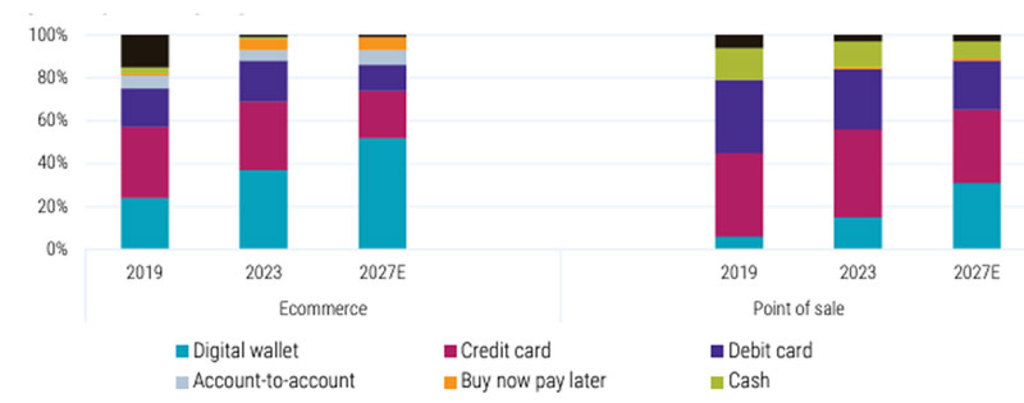
In the consumer space, the appetite for immersive, personalized experiences across travel, entertainment, and digital platforms is trending higher, benefitting providers of digital payment solutions for consumers and merchants (e.g., digital wallets, contactless payment systems and buy-now-pay-later financing). More digitization means more demand for credit solutions and cross-border transactions, especially in underserved markets, boosting demand for traditional payment companies like Visa. Broadening markets and less emphasis on the Magnificent Seven, should also benefit financials, specifically fintech, which is brimming with overlooked and underappreciated AI and Big Tech innovation.
Figure 1 – Digital wallets gaining market share online and in stores (point-of-sale)
Source: Worldpay, Robeco, June 2024.
2. Digital Innovations – AI must show real gains rather than peddle potential
In 2024, AI proved again to be the driving force for technological innovation and earnings growth. While capital investments in high-performance semiconductors and supportive infrastructure should continue, investors and corporates will increasingly demand tangible productivity gains rather than speculative potential. Gartner forecasts software sector revenue growth will accelerate to 14% in 2025, while cloud computing and software-as-a-service revenues are expected to expand at nearly twice that rate. This underscores the expanding influence of AI-enabled platforms in driving real digital transformation across the economy.
AI is also making inroads into the physical world. Connected robotic systems are leveraging real-time data from factories and supply chains via the cloud. Such technology arrives at a time when production bottlenecks and geopolitical security are spurring renewed interest in reshoring manufacturing. AI, robotics and automation will help overcome reshoring obstacles (e.g., high labor costs, worker shortages, and rapid operational scaling). As a result, we expect accelerated spending for new and retrofitted manufacturing facilities that integrate AI.
什麼是趨勢?
訂閱我們的電子報,即可掌握所有最新的主題投資趨勢。
3. Healthcare – diverse trends and innovation signal positive prognosis
Shortages of doctors and rising healthcare costs mean AI will be good medicine for healthcare. AI-powered advances in medical imaging and life science tools are already improving early detection, treatment outcomes, and the development of personalized therapies. On the dietary front, consumers are still under pressure and seeking value from purchases. Food producers with healthier and innovative products should be better protected from not only cost-inflation but also a host of other challenges such as the increasing use of appetite-suppressing GLP-1 drugs and the ‘Make America Healthy Again’ nutritional policies of the Trump administration. The shift towards healthy and sustainable foods benefit upstream ingredient companies, supporting superior growth compared to consumer-facing staples further downstream.
Trump’s healthcare agenda should also drive performance of Pharmacy Benefit Managers (PBMs), managed care networks, Medicaid beneficiaries and vaccines in the first half of 2025. For biopharmaceuticals, antibody-drug conjugates, RNA drugs, radioligand cancer therapy and lipoprotein A for cardiovascular disease will be key points of innovation. Longer term, population growth, higher life expectancies, shifting demographics, rising lifestyle disease burden and the emerging middle class will continue to drive strong demand for healthcare services.
Figure 2 – AI will add a healthy dose of value to key healthcare segments
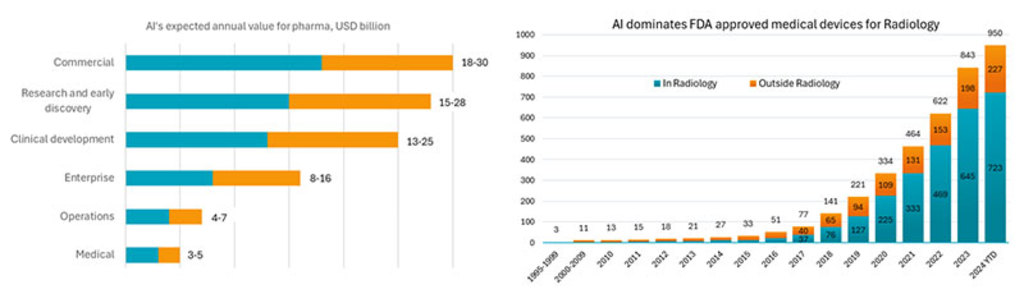
Left: Generative AI’s annual value add to the pharmaceutical value chain. Source: McKinsey, January 2024.
Right: Radiology dominates FDA’s list of approved AI and Machine Learning enabled medical devices. Source: US FDA, Morgan Stanley, Robeco
4. Circular Economy – stricter laws boost circular producers
A key principle of the circular economy is replacing hazardous substances with non-harmful alternatives and preventing their release into the environment. A recent example is the US FDA’s ban on Red No. 3, a petroleum-based, cancer-causing food and drug dye. Another is the FDA’s recent push to simplify product nutrition labels on food packaging. Both efforts will be key in driving growth among holdings that specialize in naturally non-toxic ingredients for food, pharma and personal care products. We also expect moves from a growing group of food chains dedicated to bio-labels and healthy food alternatives. Moreover, the EU’s newest packaging laws1 will also benefit holdings involved in recycling and biodegradable packaging.
5. Smart grids – the dual solution for rising security and power demands
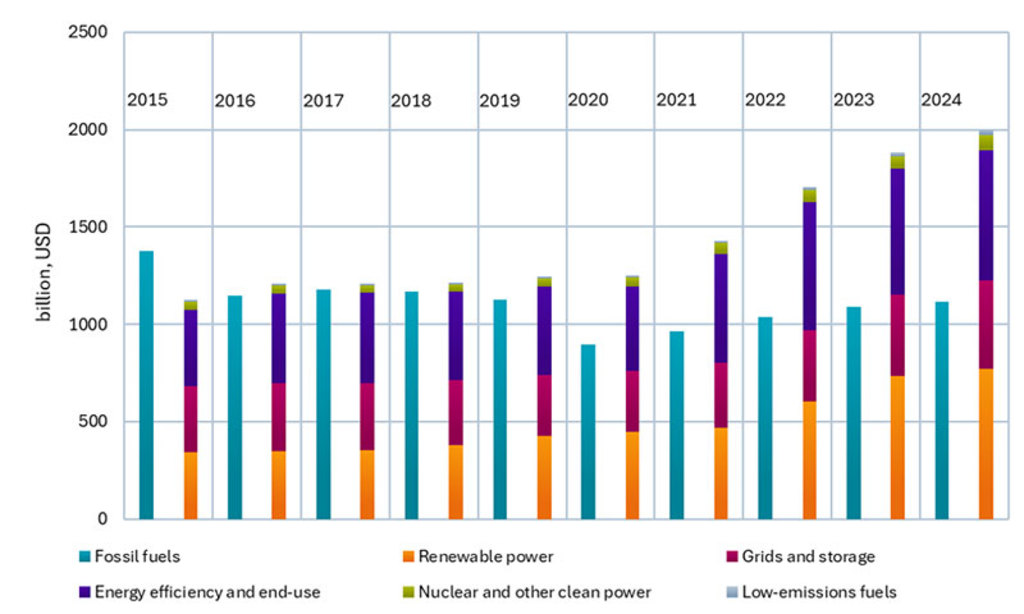
Global electricity demand is accelerating, highlighting the urgency of expanding infrastructure. The IEA projects that power consumption from data centers, AI, and cryptocurrency could double by 2026. In the near term, renewables, gas, and storage solutions are the best technologies to meet this surge in demand.
Meanwhile, energy security is high on the political agenda, and government incentives for clean energy infrastructure are spurring new construction projects to upgrade energy systems and modernize the grid. Global policy goals include tripling renewable energy and doubling efficiency by 2030. The Inflation Reduction Act supports US efforts, while the EU’s REPower Plan and Green Deal underpin Europe’s energy shift. Though policy risks may challenge offshore wind and higher-cost technologies, increased US protectionism could benefit US solar module manufacturers. Furthermore, growing power demand, driven by data center build-out, favors low-carbon, low-cost electricity developers/utilities.
Figure 3 – Global investments in clean energy are dwarfing fossil fuels
Source: IEA, Robeco, 2024.
6. Mobility – innovation and policies are revving EV markets
In 2024 China’s overall EV penetration rate almost reached 50%. 2 And if battery production levels are any indication, rates could reach as high as 75% in 2025 according to some industry experts.3 In Europe, new fleet CO2 emission standards will get even stricter, catalyzing new EV model launches and uptake from consumers. Consumer uptake and producer profitability will also be aided by the growing use of cheaper lithium iron phosphate (LFP) batteries. In 2025, lithium prices are likely to decline further, creating significant opportunities for smart mobility holdings when demand returns.
Assisted and autonomous driving (ADAS) will likely be a life-changing AI application, and 2025 looks set to be its break-out year as legislation by the UNECE4 could pave the way for rapid global growth in robotaxi services. Meanwhile, the Trump administration may be the catalyst that propels ADAS forward in the US.
7. Water – diverse demand makes the blue liquid an evergreen investment
Water challenges are set to intensify in 2025 as stringent regulations target pollutants like PFAS and biological threats such as algal blooms, bacteria, and viruses. Clean drinking water and micropollutant control remain bipartisan priorities in the US for 2025, positioning advanced water treatment and infrastructure providers for long-term growth.
In addition, the demand for treated water is intensifying from US-based industrial and municipalities, alongside reshoring trends for semiconductors and EVs and other manufacturing sectors. Moreover, growth in water demand among a range of industries (from chip plants and data centers to pharma and healthcare) are driving growth in advanced water testing and analytics, recycling, and wastewater management. Emerging technologies also play a pivotal role. AI applications in data centers are driving demand for efficient cooling systems, often requiring substantial water resources as air cooling becomes less effective.
8. Biodiversity – new laws and practices drive investments
Resource scarcity and degrading ecosystems keep boosting biodiversity on the corporate and political agenda. The EU's Nature Restoration Law, enacted in 2024, sets binding targets to rehabilitate EU ecosystems, benefiting such industries as engineering consultants, construction and forestry. Sustainable practices such as organic farming, agroforestry, and advanced land management should push biodiversity investments that improve soil health, water quality, and carbon sequestration. Treating hazardous waste such as PFAS is another essential aspect of pollution control that should promote biodiversity.
9. Smart materials and manufacturing – converging tailwinds support double-digit growth
Manufacturing capex and construction is growing stronger thanks to Trump’s ‘America first’ industrial policies. Though painful in the short-term, tariffs and trade tensions should accelerate investments in automation and robotics in response to reshoring trends. Anticipated fiscal stimulus should also reignite automation investments in China.
Electrification and automation segments expect robust growth rates in the mid-20% range, further supported by lower interest rates and the re-emergence of M&A activity. Inflationary pressures are expected to moderate in 2025, creating opportunities in commodities and critical minerals as demand stabilizes. Structural trends such as renewable energy adoption and energy independence should drive demand for lithium, copper, and rare earths, while decarbonization policies and financing from the EU Green Deal will provide tailwinds in energy-efficient materials.
Conclusion
The media and markets constantly remind us that AI is the future, sending investors ferociously clamoring for a ‘byte’. From healthcare and e-commerce to manufacturing and mobility, we recognize AI’s transformative potential across the entire economy. Yet, if decades of thematic investing have taught us anything, it’s that innovation doesn’t happen in isolation – regulation, macroeconomics, and resource scarcity are critical to its deployment, adoption and scaling. That’s why we analyze complex technological, political, and market currents to best position our themes to capitalize on the short and long-term growth these changes spawn. Closely navigating themes and impact enables us to shape portfolio returns and our clients the chance to help reshape the future.
Footnotes
1 Packaging and Packaging Waste Regulation (PPWR) of 2024
2 Robeco estimates, 2024.
3 Statements by William Li, CEO of NIO, a China-based EV manufacturer, CnEVPost, December 2024.
4 United Nations Economic Commission for Europe, an international standards-setting board for vehicles
重要資料
本網站僅供《證券及期貨條例》(香港法例第571章)及其附屬法例所界定之專業投資者瀏覽及使用。 投資涉及風險。過往表現並不代表未來表現。本網站所載資料僅供參考之用,並不構成任何投資建議,亦非作出買賣任何證券或採納任何投資策略之要約或招攬。投資者不應僅憑本網站提供之資料作出投資決定,在作出任何投資決定前,應徵詢獨立意見(包括有關稅務影響之意見)。投資者應確保完全理解投資產品的相關風險,亦應考量自身投資目標及風險承受水平。投資乃閣下之個人決定。除非銷售投資產品的中介人已向閣下告知該投資產品適合閣下,並已解釋其符合閣下投資目標之原因,否則閣下不應投資。請參閱相關發售文件或其他法律文件,以獲取包括風險因素在內的進一步詳情。 本網站由荷寶投資管理香港有限公司發布,該公司受香港證券及期貨事務監察委員會(「證監會」)規管(中央編號:APU851)。本網站未經證監會審閱。 無法保證任何投資產品可實現其投資目標。概不就任何投資產品之表現或投資回報作任何聲明或承諾。投資的價值或會波動。本網站所載過往表現、推算或預測,均不應視作未來表現之保證或指標,且概不提供任何明示或暗示之保證。本網站內容建基於相信為可靠之來源,惟因應資料傳遞技術特性及須採用多項數據來源(包括第三方內容),故概不保證其準確性。所述觀點僅乃截至上述日期,或會隨市況變化而改變,可予更改而毋須另行通知。該等意見可能有別於其他荷寶投資專業人士之意見。因使用本材料或當中所載任何評論、意見或估算而引致之直接、間接或相應損失,荷寶概不承擔法律責任。荷寶並無責任更新本網站或任何網站內容。未經荷寶事先書面許可,不得複製、分發或刊發本網站任何材料。 除非另有說明,資料來源:荷寶。