

Client Portfolio Manager


• 市場觀點
Is investment grade credit still worth considering?
Since the beginning of the year, we have highlighted the opportunities in high-quality investment grade and cross-over BB credits, noting how significant yield increases have enabled investors to earn quality income. Now that we are in the second half of the year, where do we stand?
作者


Portfolio Manager
概要
- Investment grade credit offers higher long-term returns than government bonds
- As rates ease and inflation moderates, bonds regain their role as diversifiers
- Increased dispersion in credit markets is good news for active managers
Bonds have historically served as a diversifier against riskier asset classes such as equities and commodities. However, in 2022, this relationship broke down as both bonds and equities sold off substantially due to spiking inflation and subsequent rate hikes. Typically, as shown in the chart below, correlations between equities and bonds have historically been negative when inflation eases, allowing bonds to regain their diversification benefits. We’ve seen this dynamic return more recently. As central banks begin cutting rates and core inflation eases below 3%, the stock-bond correlations should move back to negative. And high-quality fixed income will once again assume its role as a portfolio diversifier.
At the start of August 2024, equities sold off due to weaker US labor market data and geopolitical risks, while high-quality fixed income investments, such as US government bonds and investment grade credit, delivered positive total returns as Treasury yields dropped.
Investment grade credit, with its duration exposure has a built-in diversifier. This means that although corporate spreads might widen in response to disappointing economic data or volatility, investment grade credit also benefits significantly from a drop in interest rates, which protects total returns.
Stock-bond correlation
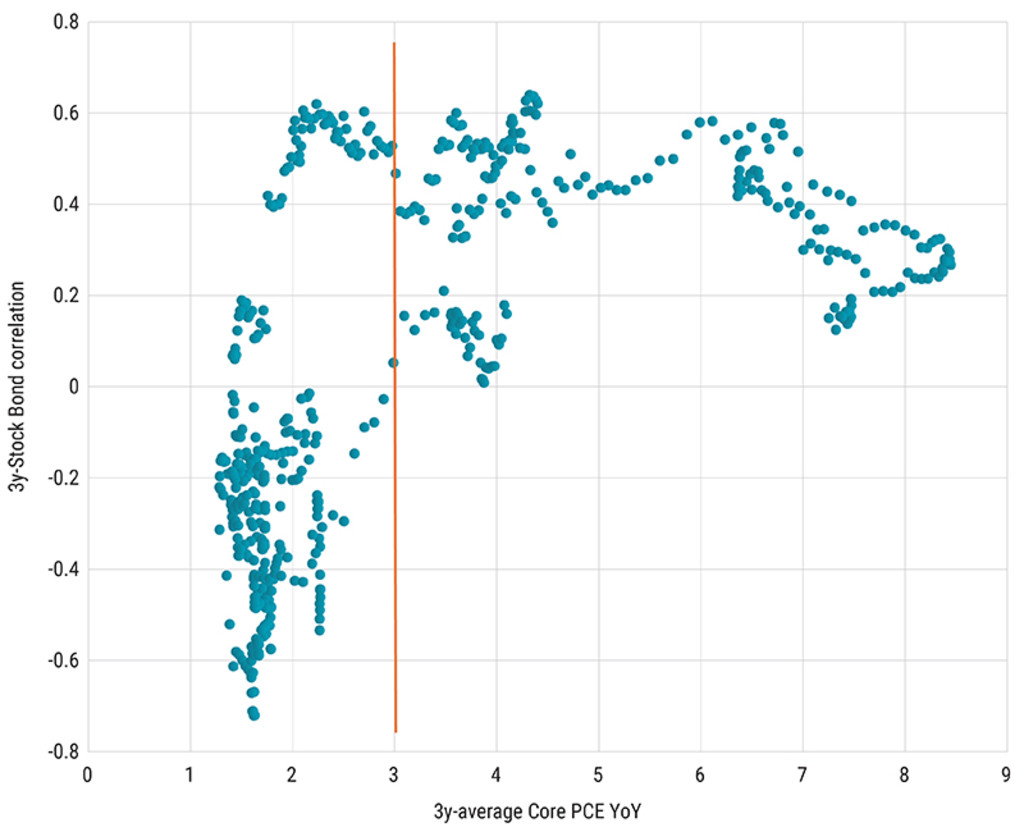
Source: Robeco, Bloomberg, as of 31 July 2024. Data 1973 onward monthly. Correlations have been calculated for the US stock and bond market. Core PCE: US Personal Consumption Expenditure Core Price Index.
Why not just Treasuries?
If yields are now more attractive and high-quality fixed income is expected to be a better diversifier going forward, why not invest in government bonds like US Treasuries rather than investment grade credit, given that government bonds already offer an attractive yield? The answer lies in the long-term performance of investment grade credit. It’s not so much about timing the market as it is about time in the market. Over the long term, investment grade credit has delivered higher total returns than government bonds. For example, global investment grade credit has delivered an annual total return of 3.6% over the last 24 years (2000-2023)1, compared to an average of 2.9% for global government bonds.2 Over the last five years, global investment grade credit has outperformed global government bonds by an average 1% per year.
Our base case anticipates moderating global growth without a recession, ongoing disinflation, and a pivot by central banks to a less restrictive policy stance. This creates a supportive backdrop for high-quality fixed income in general, and investment grade credit in particular. In this scenario, investors can enjoy both an attractive yield and yield pick-up over government bonds, and perhaps also benefit from further compression of credit spreads. If we are wrong and encounter much weaker growth or a recession, leading to some credit spread widening, a likely more aggressive response from central banks would lead to a rally in government bonds, protecting total returns on investment grade credits.
Standing out in today’s market
Technicals are also favorable, as the demand for credit remains strong with investors looking to lock in higher yields. Barring a major shock, there is little reason to think credit spreads should widen meaningfully from here. Corporate fundamentals for investment grade companies are very solid. The recent hiking cycle by central banks has not inflicted pain like previous cycles, as investment grade corporates were proactive in managing their debt levels and issuing debt at low yields during the low-rate environment of the Covid pandemic. Therefore, interest rate costs for investment grade companies are manageable.
Lastly, we expect increased dispersion in credit markets, which is good news for active and skilled credit managers. By focusing on high-quality credit selection, managers can identify resilient issuers, avoid potential pitfalls, and capture attractive risk-adjusted returns, ensuring that investment grade credit remains a compelling option even in uncertain times.
Footnotes
1 As measured by the Bloomberg Global Aggregate Corporate Total Return Index (EUR hedged)
2 As measured by the Bloomberg Global Aggregate Treasuries Index (EUR hedged)
重要資料
本網站僅供《證券及期貨條例》(香港法例第571章)及其附屬法例所界定之專業投資者瀏覽及使用。 投資涉及風險。過往表現並不代表未來表現。本網站所載資料僅供參考之用,並不構成任何投資建議,亦非作出買賣任何證券或採納任何投資策略之要約或招攬。投資者不應僅憑本網站提供之資料作出投資決定,在作出任何投資決定前,應徵詢獨立意見(包括有關稅務影響之意見)。投資者應確保完全理解投資產品的相關風險,亦應考量自身投資目標及風險承受水平。投資乃閣下之個人決定。除非銷售投資產品的中介人已向閣下告知該投資產品適合閣下,並已解釋其符合閣下投資目標之原因,否則閣下不應投資。請參閱相關發售文件或其他法律文件,以獲取包括風險因素在內的進一步詳情。 本網站由荷寶投資管理香港有限公司發布,該公司受香港證券及期貨事務監察委員會(「證監會」)規管(中央編號:APU851)。本網站未經證監會審閱。 無法保證任何投資產品可實現其投資目標。概不就任何投資產品之表現或投資回報作任何聲明或承諾。投資的價值或會波動。本網站所載過往表現、推算或預測,均不應視作未來表現之保證或指標,且概不提供任何明示或暗示之保證。本網站內容建基於相信為可靠之來源,惟因應資料傳遞技術特性及須採用多項數據來源(包括第三方內容),故概不保證其準確性。所述觀點僅乃截至上述日期,或會隨市況變化而改變,可予更改而毋須另行通知。該等意見可能有別於其他荷寶投資專業人士之意見。因使用本材料或當中所載任何評論、意見或估算而引致之直接、間接或相應損失,荷寶概不承擔法律責任。荷寶並無責任更新本網站或任何網站內容。未經荷寶事先書面許可,不得複製、分發或刊發本網站任何材料。 除非另有說明,資料來源:荷寶。