

• 市場觀點
Energy storage – the next challenge in the energy transition
Without energy storage, renewable energy’s potential can’t be fully harnessed, putting net-zero targets in jeopardy. But trade-offs and complexities in energy markets mean only a few players stand to benefit from the expansion of storage capacity.
概要
- Renewable energy’s share of the energy mix expanding
- Renewables are clean and abundant but also unreliable
- Lithium batteries to dominate storage and grow market share
Despite stiff headwinds, in 2023, clean energy investments reached USD 1.7 trillion, 65% more than fossil fuels. Ambitious transition targets assure investments in renewables and related technologies will rise further. At the COP28 in Dubai, the world agreed to triple renewable capacity by 2030. According to BNEF, energy storage investments must triple to USD 93 billion annually to reach net-zero.1
Renewable but unreliable
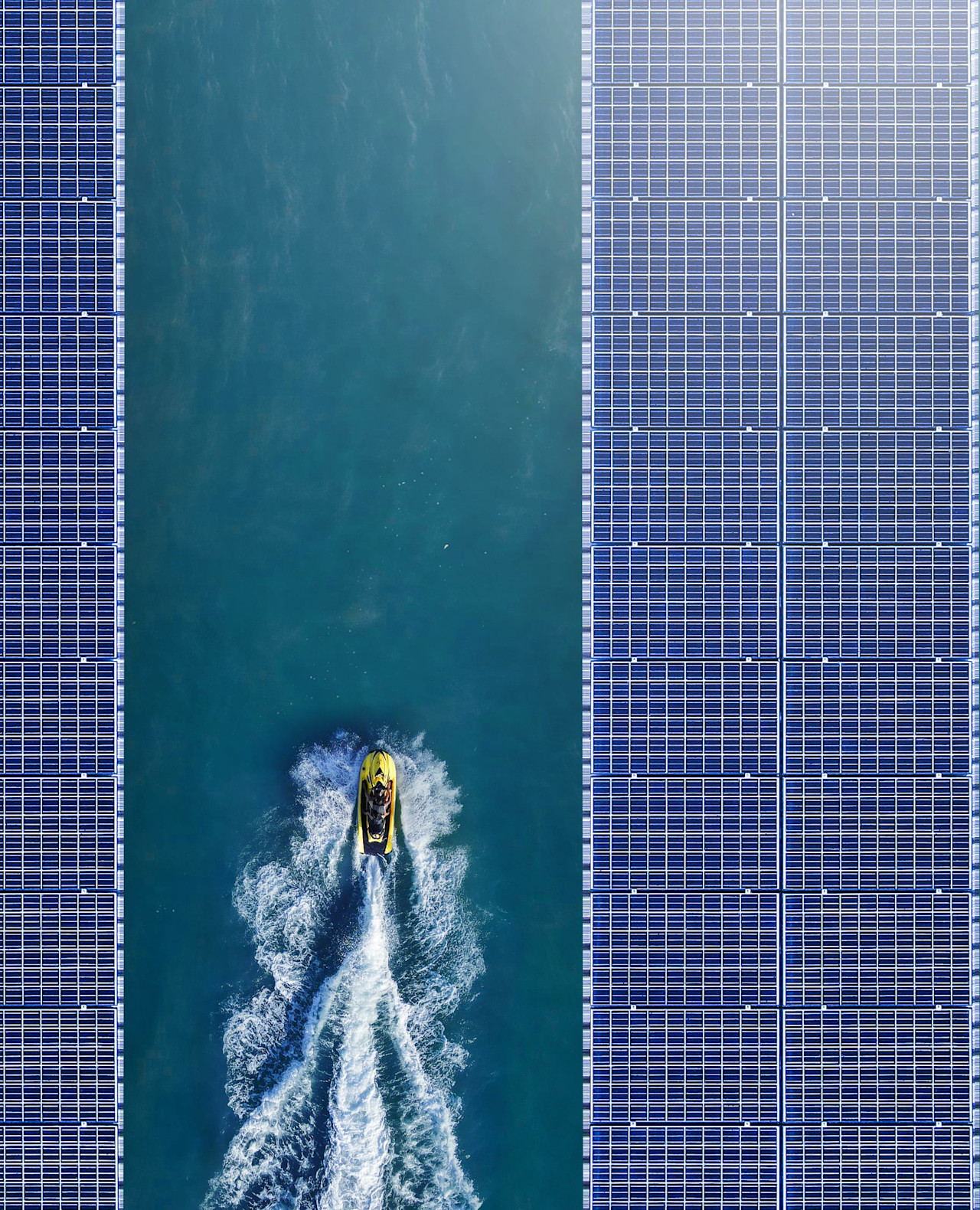
Solar and wind are naturally clean and abundant, but their supply is unreliable. Moreover, even when weather conditions are ideal, periods of peak renewable supply don’t always match peak periods of electricity demand. Energy storage bridges the gap by enabling surplus renewable energy generated at peak times to be stored and used later when energy demand is high (but renewable capacity is low).
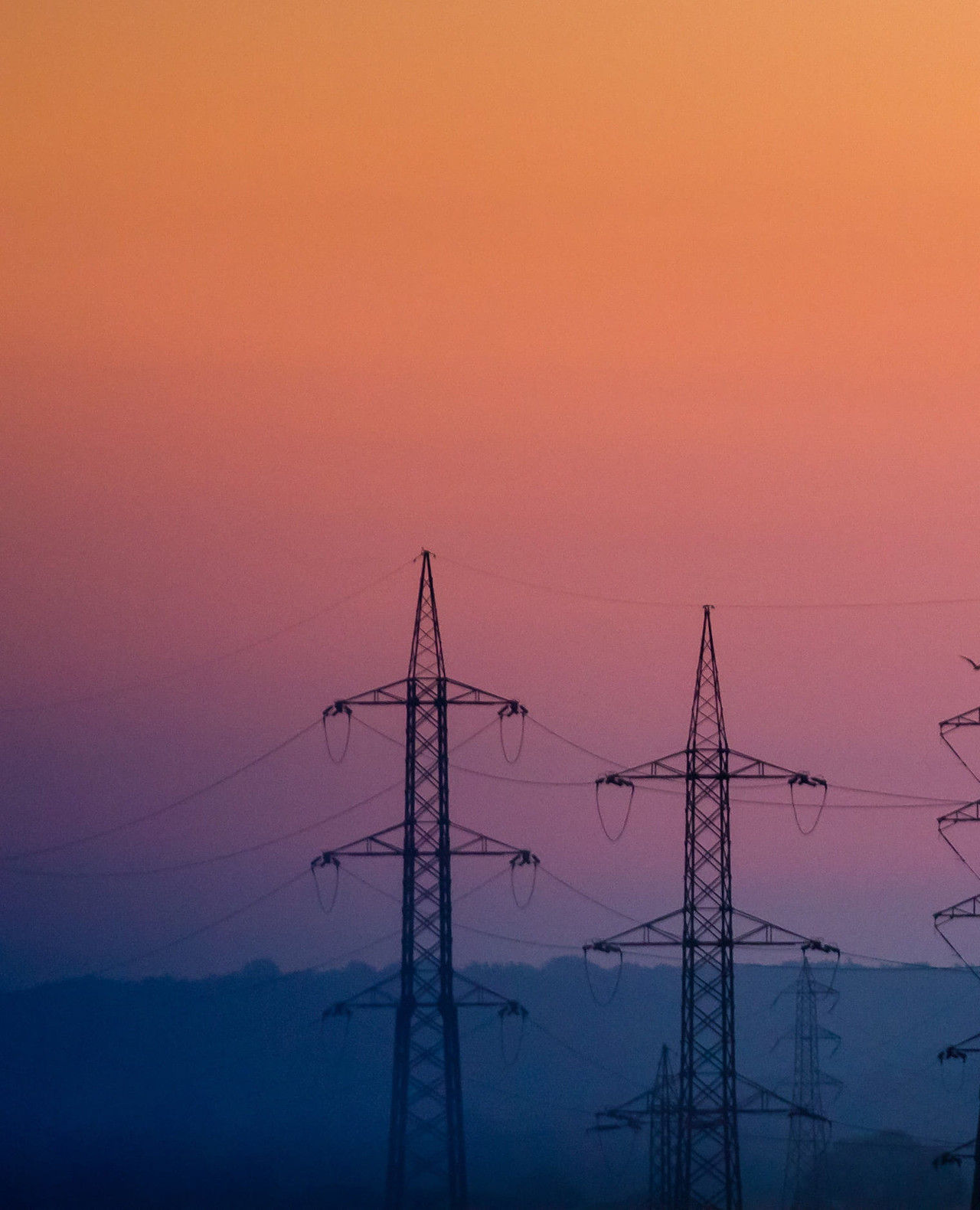
Too little renewable power when its needed is one problem, too much is another. When solar and wind is strong it can overload transmission lines, leading to congestion, diminished performance and even power outages. As a result, renewables must often be switched off or ‘curtailed’ to avoid system overload. In California, 1.9 TWh of solar generated energy was curtailed in 2022; the equivalent of powering 200,000 homes for an entire year.2 In 2020, the UK curtailed wind energy enough to power over one million homes annually.3
Curtailment not only wastes valuable energy resources, it also threatens to delay the rate of renewable expansion. Grid operators are hesitant to invest further in adding supply when revenues from renewables can’t be fully captured or maintenance costs covered.
No universal storage solution
Energy can be stored in many ways leading to a diverse array of storage technologies (see Figure 1). Technologies range from capturing the energy potential of electrochemical reactions inside battery cells to much larger methods such as the pumped hydropower installations that store the energy potential of water flows between massive reservoirs.
Each technology carries distinct characteristics that can be a strength or a weakness based on the market conditions in which it is applied. For example, supercapacitors use magnetic fields to store and deliver short bursts of high voltage energy, such as for turning EV motors on and off at a stop light. That makes them ideal for emergency back-up power in a hospital or public transport environment.
Figure 1 – Energy storage technologies by type, duration and end-use application
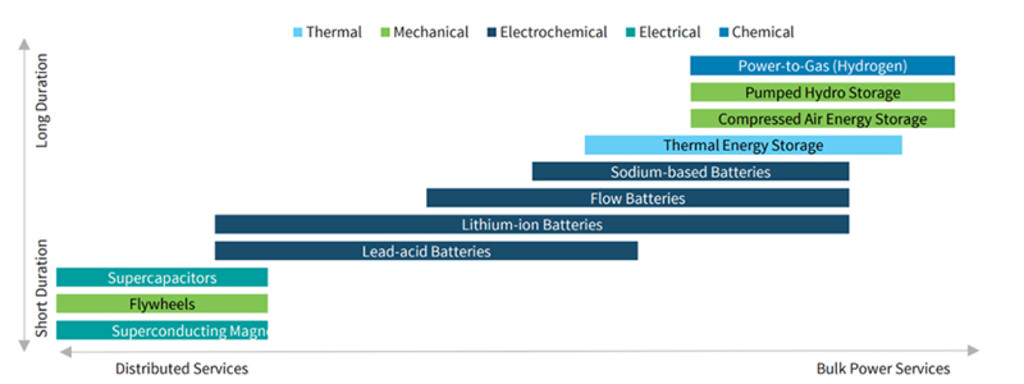
Source: Barclay Research, USAID, NREL, 2021. Distributed services refers to decentralized grids (even micro-grids) where energy must be delivered over smaller distances, small packets and in real-time in response to dynamically changing demand (e.g., residential solar). Bulk power services involve delivery of steady streams of high-voltage energy over long distances to large centralized systems (e.g. municipal coal, natural gas plants) that support base-load demand.
Pumped hydropower is known for its longevity and reliability, making it the most dominant of all installed storage by far. But it is limited to regions that are blessed with abundant water and space. It also suffers from delayed response time, making it less suitable for next-generation energy grids that require near-instantaneous on/off switching. But the biggest trade-offs involve duration and costs.
At one end are technologies that store lots of energy for long durations but which also tend to be infrastructure (and cost) heavy. At the other are those with rapid response times and less infrastructure but also of shorter durations (and costly per unit of energy). Batteries sit somewhere in the middle making them popular for a broad range of use cases.
Bullish on batteries
Thanks to EVs, battery technology has significantly advanced even at the large scales needed for power grids. More importantly, battery costs have dropped 80% over the past decade. Battery storage among utilities is expected to grow 29% annually (CAGR) through 2030 (see Figure 2) and 18% among commercial and industrial energy users such as data centers and hospitals that operate their own energy storage systems.
Figure 2 – Battery storage expected to surge through 2030
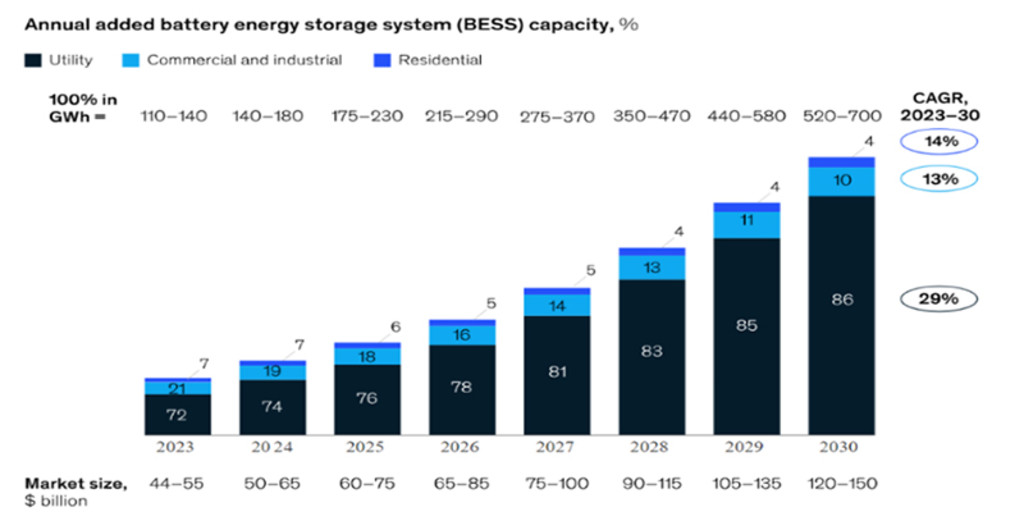
Source: McKinsey, 2023. Annual added battery energy storage system capacity, %. Figures may not sum to 100% because of rounding.
Batteries carry other advantages. They are cheap, easy to install, versatile, and – like supercapacitors – can deliver high voltage that can be rapidly dialed up or scaled back. This makes them ideal for helping grid operators cost-effectively smooth out the daily demand-supply imbalances that have intensified with renewable use. Moreover, they can also add to grid stability by taking energy off the grid to curb congestion (i.e., too much energy trying to flow through too few transmission lines). Likewise, batteries can deploy energy at temporary intervals to keep the grid humming at frequency flows mandated by local market laws.
But batteries are not without drawbacks. A storage duration of only 4-6 hours makes many battery types unsuitable for storage over weeks or seasons. Yet long-term storage is critical for fully capitalizing on renewable potential. Other battery types are also in development, these include redox flow, metal-air, and solid-state but while promising, they face grid-integration hurdles that we believe will limit wide-scale commercial deployment.
Investment outlook – storage plus solutions
We are bullish on lithium-ion batteries as they offer the most competitive and versatile solution to for utilities and grid operators. However, to fully capitalize on their potential, they need to be efficiently integrated into new or legacy grid infrastructure, a process that most often requires more layers of expert services. In our view, that puts providers of integrated storage providers and integrated energy operators in the best position to benefit from building structural drivers.
Integrated storage providers bundle storage solutions such as battery power with system integration and digital management services that help dynamically direct grid flows to match demand. Vertically integrated energy operators broaden service-bundling even further. They not only own solar and wind farms but also have the expertise to construct off-the-grid power supplies for remote or power-hungry customers such as data centers. This gives them control over (and revenue streams from) a diverse array of grid-scale services. Moreover, their project portfolios are expanding across geographies.
One of the US’ largest integrated operators with operations in 49 states is developing Florida’s largest solar-powered battery. Similarly, Australia’s leading renewable energy supplier is developing its largest battery project using Tesla-technology. In South America, Chilean operators are adding battery storage next to critical solar installations in the Atacama Desert. In the UK, energy operators are converting grid infrastructure once powered by coal for use as battery storage facilities.
As renewable targets and installations expand, the need for storage solutions is intensifying. Efficient and versatile storage is key. But efficient integration and power-flow management are equally important for maximizing the gains from renewables.
This leaves integrated service providers with the greatest potential for profitably solving grid-storage issues.
We would like to thank Patricia Garcia Abad for her valuable research and contributions to this article.
Footnotes
1BloombergNEF, Energy Transition Investment Outlook. 2023.
2WEF, 2023. ”Storage is the key to the renewable energy revolution”
3Lane, Clark and Peacock, LLP. January 2021. “Is Battery Storage a good investment.”
獲取最新市場觀點
訂閱我們的電子報,時刻把握投資資訊和專家分析。
重要資料
本網站僅供《證券及期貨條例》(香港法例第571章)及其附屬法例所界定之專業投資者瀏覽及使用。 投資涉及風險。過往表現並不代表未來表現。本網站所載資料僅供參考之用,並不構成任何投資建議,亦非作出買賣任何證券或採納任何投資策略之要約或招攬。投資者不應僅憑本網站提供之資料作出投資決定,在作出任何投資決定前,應徵詢獨立意見(包括有關稅務影響之意見)。投資者應確保完全理解投資產品的相關風險,亦應考量自身投資目標及風險承受水平。投資乃閣下之個人決定。除非銷售投資產品的中介人已向閣下告知該投資產品適合閣下,並已解釋其符合閣下投資目標之原因,否則閣下不應投資。請參閱相關發售文件或其他法律文件,以獲取包括風險因素在內的進一步詳情。 本網站由荷寶投資管理香港有限公司發布,該公司受香港證券及期貨事務監察委員會(「證監會」)規管(中央編號:APU851)。本網站未經證監會審閱。 無法保證任何投資產品可實現其投資目標。概不就任何投資產品之表現或投資回報作任何聲明或承諾。投資的價值或會波動。本網站所載過往表現、推算或預測,均不應視作未來表現之保證或指標,且概不提供任何明示或暗示之保證。本網站內容建基於相信為可靠之來源,惟因應資料傳遞技術特性及須採用多項數據來源(包括第三方內容),故概不保證其準確性。所述觀點僅乃截至上述日期,或會隨市況變化而改變,可予更改而毋須另行通知。該等意見可能有別於其他荷寶投資專業人士之意見。因使用本材料或當中所載任何評論、意見或估算而引致之直接、間接或相應損失,荷寶概不承擔法律責任。荷寶並無責任更新本網站或任何網站內容。未經荷寶事先書面許可,不得複製、分發或刊發本網站任何材料。 除非另有說明,資料來源:荷寶。