
Portfolio Manager



• 月度展望
Land of the rising yield
One of the world’s largest experiments in financial engineering may be about to come to an end, spelling a new era of higher yields in Japan.
作者

概要
- Japan may end yield curve control and negative interest rate policy
- Tipping point reached for Japanese government bond yields to rise
- We believe the move creates a ‘shorting’ opportunity on any asset price falls
The country has battled with trying to achieve a 2% inflation rate for more than two decades, originally attempting to reach this level from below. While Japan has recently experienced higher inflation numbers, Japan’s central bank has not declared victory yet.
It’s been a long fight. To try to provoke inflation, a huge quantitative easing program was launched in 2001, followed by a globally unprecedented yield curve control (YCC) program in 2016 to artificially fix bond returns and stop the rise in the value of the yen, which was importing deflation. This was backed by a negative interest rate policy (NIRP) to encourage people to spend, and not save money at a loss.
Now, both the YCC and NIRP could be abandoned as Japan tries to bring inflation back to 2% and return to normal economics, says Mathieu van Roon, Portfolio Manager with Robeco Sustainable Multi Asset Solutions. That means Japanese government bond (JGBs) yields will finally start to rise, making the asset class less attractive to investors and creating an opportunity for ‘shorting’ this market.
“After several decades, we are finally at the tipping point for Japanese yields to move higher,” says Van Roon. “Ever since the Japanese economic bubble burst in the early 1990s, Japan has sought ways to exit deflation, but to no avail.”
“Recently, the sticky higher inflation rate, lower yen and higher level of economic growth have put pressure on the YCC and NIRP of the Bank of Japan. Does this mean the ‘death of the acronym’, or DOTA – as we refer to it tongue-in-cheek – for Japan?”
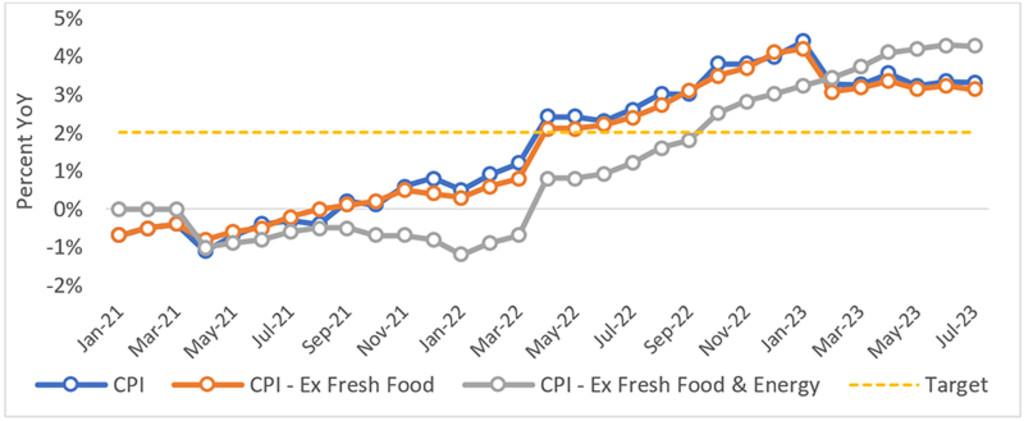
Japan’s inflation rates are above the 2% target. Source: Robeco, Bloomberg, Japanese Ministry of Internal Affairs and Communications (MIC), using data from 1 January 2021 to 31 July 2023.
Beginning of QE
Japan’s giant QE program began as a means of addressing a recession that started in 2001. In a QE program, the central bank electronically creates money and uses it to buy government bonds to increase financial liquidity and stimulate the economy.
“This failed to raise inflation and the sheer size of the program began to reach its limits after the central bank had bought nearly half of all of Japan’s outstanding government debt,” Van Roon says.
“To address this, YCC was introduced in January 2016, adding a yield target for short-term debt of -0.1% to fend off an unwelcome rise in the yen. Eight months later, a target of 0% for 10-year rates was added to pull up long-term yields.”
“Although YCC meant less debt needed to be bought by the BoJ – only at a level necessary to reach the target – it still meant that trading volumes dwindled, and yields became closely anchored to the target levels.”
獲取最新市場觀點
訂閱我們的電子報,時刻把握投資資訊和專家分析。
From deflation to inflation
In a different era, in which global inflation was sparked by the Russian war in Ukraine and the resulting spike in food and energy prices, inflation is now well above target in Japan, at about 3.1% excluding food, and 4.3% excluding food and energy.
“One factor driving up inflation is the fact that Japan currently imports most of its food and energy from abroad,” Van Roon says. “The longer the YCC continues, the higher the probability of disorderly yen weakness, and thus further importing inflation from abroad.”
“The broad-based sticky inflation with the lower yen in combination with Japan’s increased economic growth, and potentially further wage increases means, that we expect the inflation rate to stay well above the 2% target.”
“That means that the BoJ’s policies are bearing fruit, allowing them to further tweak or even abandon the YCC altogether – followed by ending the NIRP – and putting upward pressure on the 10-year yield.”
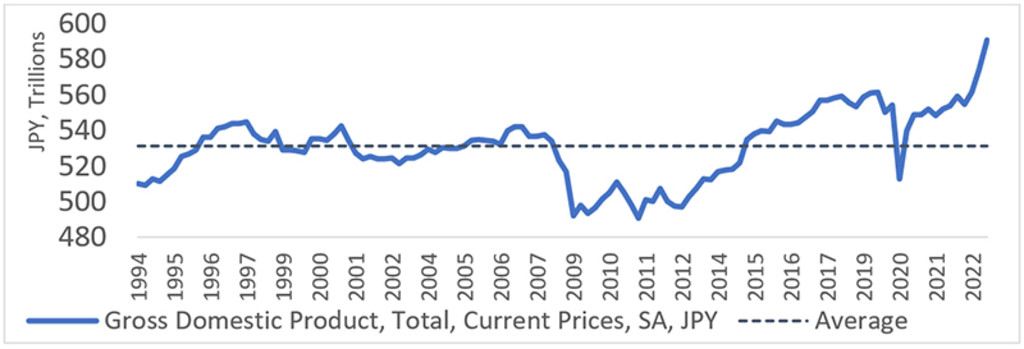
Japan’s GDP has been rising. Source: Robeco, Bloomberg, Japanese Cabinet Office, using data from 1 January 1994 to 31 December 2022.
Shorting opportunity
As bond prices move inversely to yields, a rising yield means the value of the bond falls, making them less attractive to investors. But it does also provide opportunity potential to short the market – where an investor expects the asset value to fall and monetizes the price differential using derivatives.
“We believe the 10-year yield will grind higher over the coming months at a slow but steady pace until the YCC is adjusted or abandoned, after which the upward pressure is even bigger,” Van Roon says. “Attempting to capitalize on this means choosing an instrument that can bear the slow movement (no high running costs) and which provides a more asymmetric pay-off.”
“While the yen and equity markets will react strongly to any adjustments in YCC or NIRP, the risk profile is much more symmetrical. So, we believe shorting the 10-year government bond (or using bond futures) is the most efficient means of doing this at the current yield levels of close to 0.6%.”
“Given the effectively lower and upper bound (0.5%-1.0%) in the yield range, there is more upside than downside. Shorting does mean paying the yield pick-up and roll-down – and potentially paying financing costs if futures are used – but these are thanks to the YCC being relatively benign and thus allowing us to hold the position for longer.”
重要資料
本網站僅供《證券及期貨條例》(香港法例第571章)及其附屬法例所界定之專業投資者瀏覽及使用。 投資涉及風險。過往表現並不代表未來表現。本網站所載資料僅供參考之用,並不構成任何投資建議,亦非作出買賣任何證券或採納任何投資策略之要約或招攬。投資者不應僅憑本網站提供之資料作出投資決定,在作出任何投資決定前,應徵詢獨立意見(包括有關稅務影響之意見)。投資者應確保完全理解投資產品的相關風險,亦應考量自身投資目標及風險承受水平。投資乃閣下之個人決定。除非銷售投資產品的中介人已向閣下告知該投資產品適合閣下,並已解釋其符合閣下投資目標之原因,否則閣下不應投資。請參閱相關發售文件或其他法律文件,以獲取包括風險因素在內的進一步詳情。 本網站由荷寶投資管理香港有限公司發布,該公司受香港證券及期貨事務監察委員會(「證監會」)規管(中央編號:APU851)。本網站未經證監會審閱。 無法保證任何投資產品可實現其投資目標。概不就任何投資產品之表現或投資回報作任何聲明或承諾。投資的價值或會波動。本網站所載過往表現、推算或預測,均不應視作未來表現之保證或指標,且概不提供任何明示或暗示之保證。本網站內容建基於相信為可靠之來源,惟因應資料傳遞技術特性及須採用多項數據來源(包括第三方內容),故概不保證其準確性。所述觀點僅乃截至上述日期,或會隨市況變化而改變,可予更改而毋須另行通知。該等意見可能有別於其他荷寶投資專業人士之意見。因使用本材料或當中所載任何評論、意見或估算而引致之直接、間接或相應損失,荷寶概不承擔法律責任。荷寶並無責任更新本網站或任何網站內容。未經荷寶事先書面許可,不得複製、分發或刊發本網站任何材料。 除非另有說明,資料來源:荷寶。