

Head of Multi Asset & Equity Solutions, Co-Head Investment Solutions


• 月度展望
Half-time report: Interesting times indeed
At the start of 2023 we expected a recession to soon materialize, the Fed to stop hiking as a result, and the US dollar to peak. That hasn’t happened and the US stock market has rallied back towards record levels. We knew at the time the outlook was uncertain so we listed 10 factors that could impact our view. Half-way through the year and a surprising seven out of ten have already come into play.
作者

概要
- The ‘Goldilocks’ scenario was powered by AI
- The 60/40 asset allocation is alive and well
- The recession is still just over the horizon
In our monthly outlook at the start of the year (A bevy of black swans: Surprises that could derail the 2023 outlook – January 2023) we explored some positive and negative scenarios and tail risks that weren’t part of our base case, but could yet impact markets and asset allocation. While risks may dominate the market psyche for short periods without changing our fundamental outlook, when priced in, they provide investment opportunities.
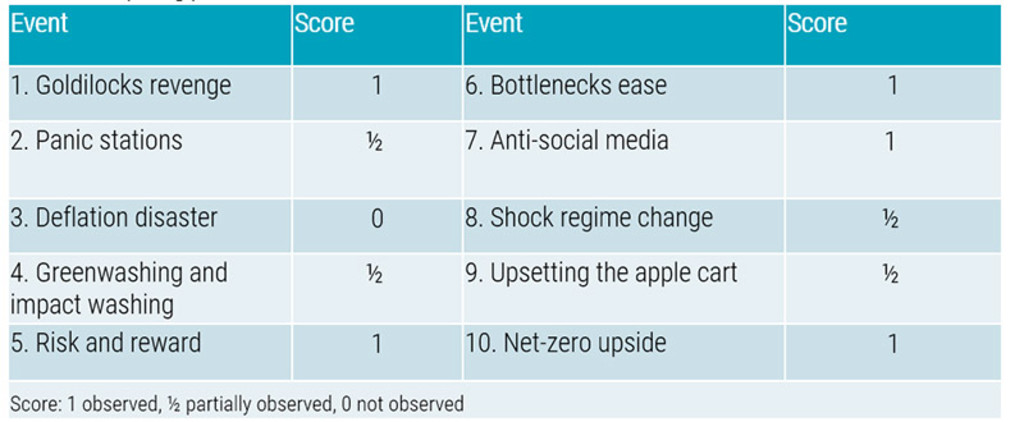
We are keeping score, and if these risks have been observed then we score a point, if not observed then no need to trouble the scorers, and we get half a point if an outcome is partially observed. Here is how the possible scenarios we identified at the start of 2023 are playing out so far:
Table 1: A surprising year in the markets
Source: Robeco
The first is ‘Goldilocks’ revenge’ – the economy won’t run too hot or too cold but just right. The economy has indeed shown resilience, despite a hawkish Fed and US equities and high yield have performed well. The AI ‘disinflationary’ gold rush has powered a narrow market with the top 2-3% of the S&P 500 index generating all the performance so far this year.
“We are still cautious and are now anti-consensus, continuing to reduce equity and high yield positions,” says Graham, senior portfolio manager with the Robeco Sustainable Multi-Asset Solutions team.
Panic stations – the Fed could review its inflation target
We posited that if the Fed becomes tired of low long-term rates, it could announce a break with the structural regime since the financial crisis and abandon its 2% inflation target. In the event the Fed and other central banks have stuck to their hawkish guns and inflation’s delayed return to 2% targets has been accepted by bond vigilantes, as has fiscal largesse.
“The rate cutting cycle will be a 2024 investment debate unless there’s a financial/economic accident,” says Graham.
Deflation disaster
We noted that by late 2023 deflation could have a higher number of hits than inflation according to newsflow data. So farhese fears have proved unfounded so far with labor markets and aggregate demand proving resilient, but Graham doesn’t rule out that deflation might be a destination much further down the line.
“Inflation will be stickier than economist models are predicting. Thus interest rates will need to be higher for longer so there is an increased chance of an inflation target undershoot,” he says.
Greenwashing and impact washing
It was obvious sustainability claims were coming under scrutiny from regulators, media and investors but we questioned whether it would prompt action from impacted institutions. Since the start of the year we have observed a split in US clients’ requirements on sustainability issues, downgrading of SFDR Article 9 funds to Article 8, and firms quitting the Net Zero Asset Management Initiative or stepping back from sustainability claims and delisting themselves from UN PRI.
“The regulatory environment continues to evolve, with marginally increased clarity in some areas. We have made it our mission to embrace the sustainability framework, and our SDG framework is available with open access for clients and academics,” says Graham.
Risk and reward
In 2022, risk-profile funds (cautious, balanced and aggressive) delivered returns within 50 bps of each other despite different levels of equity and bond allocations. Reality has bitten in 2023, and correlations have fallen.
“60/40 is alive and kicking and we continue to expect correlations to be lower than in 2022,” says Graham.
Bottlenecks ease
After Russia invaded Ukraine in 2022 it boosted commodity prices and exacerbated the cost-push inflation from post-Covid supply chain bottlenecks. These factors were expected to persist but commodity prices have fallen in 2023 and supply chain issues have eased considerably. This is good news in terms of the inflation fight but also underscores a cooling economy around the world.
“China’s consumers did not have the helicopter money benefit seen in US and Europe, hence are taking longer to recover. People have been disappointed by this sluggish growth in a major global engine like China but it is now priced into Chinese equity prices,” says Graham.
獲取最新市場觀點
訂閱我們的電子報,時刻把握投資資訊和專家分析。
Anti-social media
We anticipated there could be some regulation of large technology and social media platforms as data protection issues come to the fore, but it still hasn’t hit its stride despite it being a lawmaker focus in the US and Europe. This hasn’t impacted markets in 2023 with no change in equity market leadership, with big tech riding the AI wave.
“We continue to think that the stocks that led the last bull market will not lead the long-term recovery, so this is not a new bull market as far as we are concerned. We also expect big tech will look quite different in years to come,” says Graham.
Shock regime change
As the first year this century without a G7 election we wondered whether political turmoil impacting financial markets, as the UK endured in 2022 with three prime ministers and a brief gilt market crash, might strike somewhere else. In reality the incumbents have stayed in place so far.
“The real volatility in 2023 has stemmed from the liquidity mismatch that hit US mid-size banks, rather than the political sphere. Volatility in bonds is still elevated though and we can’t predict these tail risks, but whatever the event happens to be, it will create opportunities,” says Graham.
Upsetting the apple cart
Slow discovery of investments that were only funded because cash was ‘free’ was identified as a possible source of trouble at the start of the year, but so far a few real estate structures have collapsed but nothing big enough to spillover into public markets.
“This is still a clear and present danger so buyer beware as private assets were big beneficiaries of cheap money.”
Net-zero upside
The evidence about climate change continues to mount and COP27 highlighted that political will is key. In the long run, achieving energy security means investing more in green technologies and climate solutions to close the gap between ambition and implementation.
“We are experiencing continued commitment from governments, backed with actual cash, to fund the clean energy transition, more through necessity and FOMO rather than politicians having a vision. We also believe this additional spending will add to short-term inflationary pressures.“
Conclusion: Staying agile
We do not have perfect foresight on events that affect market returns, but a score of 7/10 is high given the tail risk nature of these events and the inherent contradictions. When we observe market pricing or volatility incorporating tail risks, we view this as opportunity to generate returns for clients. At Robeco, the Sustainable Multi-Asset Solutions team is prepared for a turbulent second half of 2023 and we continue to build more resilient portfolios by reducing equity and high yield exposures and adding to more countercyclical positions in portfolios.
重要資料
本網站僅供《證券及期貨條例》(香港法例第571章)及其附屬法例所界定之專業投資者瀏覽及使用。 投資涉及風險。過往表現並不代表未來表現。本網站所載資料僅供參考之用,並不構成任何投資建議,亦非作出買賣任何證券或採納任何投資策略之要約或招攬。投資者不應僅憑本網站提供之資料作出投資決定,在作出任何投資決定前,應徵詢獨立意見(包括有關稅務影響之意見)。投資者應確保完全理解投資產品的相關風險,亦應考量自身投資目標及風險承受水平。投資乃閣下之個人決定。除非銷售投資產品的中介人已向閣下告知該投資產品適合閣下,並已解釋其符合閣下投資目標之原因,否則閣下不應投資。請參閱相關發售文件或其他法律文件,以獲取包括風險因素在內的進一步詳情。 本網站由荷寶投資管理香港有限公司發布,該公司受香港證券及期貨事務監察委員會(「證監會」)規管(中央編號:APU851)。本網站未經證監會審閱。 無法保證任何投資產品可實現其投資目標。概不就任何投資產品之表現或投資回報作任何聲明或承諾。投資的價值或會波動。本網站所載過往表現、推算或預測,均不應視作未來表現之保證或指標,且概不提供任何明示或暗示之保證。本網站內容建基於相信為可靠之來源,惟因應資料傳遞技術特性及須採用多項數據來源(包括第三方內容),故概不保證其準確性。所述觀點僅乃截至上述日期,或會隨市況變化而改變,可予更改而毋須另行通知。該等意見可能有別於其他荷寶投資專業人士之意見。因使用本材料或當中所載任何評論、意見或估算而引致之直接、間接或相應損失,荷寶概不承擔法律責任。荷寶並無責任更新本網站或任何網站內容。未經荷寶事先書面許可,不得複製、分發或刊發本網站任何材料。 除非另有說明,資料來源:荷寶。