

Researcher


• 市場觀點
The next frontier in value investing in credits: integrating machine learning
Robeco is pushing the boundaries of value investing by augmenting its existing approach with machine learning (ML) techniques. By leveraging ML, we are able to enhance our assessment of bond valuations, leading to improved risk-adjusted returns for our multi-factor credit portfolios.
作者




Head of Quant Fixed Income and Lead Portfolio Manager

Researcher



Senior Sales Manager Belgium & Luxembourg
概要
- It is crucial to discern between undervalued bonds and those that are low-priced due to higher risk
- We have enhanced our existing value factor approach by incorporating machine learning techniques
- With ML, we can enhance our assessment of bond valuations and improve risk-adjusted returns
Traditionally, value investing in credits involves identifying undervalued bonds and capitalizing on their eventual price recovery to their fair value. For many years, Robeco has implemented a robust value factor that incorporates relevant risk measures and precise statistical techniques to estimate the fair value of corporate bonds. This value factor has been a key driver of the outperformance of Robeco’s multi-billion Multi-Factor Credits strategy since its inception in 2015.
Value investing in credits revolves around buying undervalued (‘cheap’) bonds and profiting from their subsequent recovery when prices revert back to expected (‘fair’) levels. Bonds can experience temporary misvaluations for many reasons, often related to investor behavior. For instance, when investors overreact to bad news, a bond’s price might drop beyond what the news justifies. Similarly, a bond’s price may decline excessively after a credit rating downgrade, surpassing what its revised rating implies.
However, it is crucial to discern between bonds that are undervalued and those that are low-priced due to higher risk. Avoiding these so-called ‘value traps’ is pivotal for successful value investing. The goal is to sidestep bonds that appear undervalued but are unlikely to rebound to higher price levels.
The academic literature contains various studies on factor investing in corporate bonds and the value factor in particular. A typical academic approach is to assess the extent to which a bond’s valuation is explained by its credit rating and time to maturity. The underlying assumption is that bonds with similar credit ratings and maturities have similar risk profiles, and thus should have similar valuations. Based on this approach, a value strategy aims to buy bonds whose valuations are significantly lower than their expected values. This value-based approach has demonstrated better risk-adjusted returns, as evidenced for example in our academic publication.1
However, this academic approach is not without limitations. Firstly, the bond’s credit rating serves as a decent but not perfect measure of its risk. This is mainly because credit ratings can be slow to adjust to new information, as they are typically updated only a few times per year. Secondly, to determine the extent of undervaluation, the bond’s valuation is compared to bonds with similar credit ratings and maturities using a linear estimation model.
However, the relationship between valuation and these factors is far from linear in reality. This becomes particularly evident for bonds with very high spread levels, where the linear estimation leads to less accurate valuations. Lastly, as the number of risk measures increases, the academic approach struggles to effectively handle interactions between the different risk factors.
Robeco’s approach to value investing
Building on the academic approach to value investing, Robeco developed an enhanced value factor and incorporates it into its multi-factor credit strategies. This enhanced value approach follows the same principle as the academic approach but introduces two important improvements. Firstly, it expands upon the credit rating by incorporating multiple, more accurate, and adaptive risk measures, such as leverage, distance to default, and equity volatility. Secondly, it moves beyond the simplistic ‘straight line approach’ by employing a curved line to estimate the fair value. This improved methodology better captures the non-linear nature of credit spread curves observed by investors in real-world scenarios and enhances the ability to differentiate between truly undervalued bonds from value traps.2
Robeco has successfully implemented this enhanced value approach in its multi-factor credits and high yield strategies. In the flagship Global Multi-Factor Credits strategy, the value factor has consistently been the strongest contributor to its outperformance since its inception. Remarkably, it has even performed well during periods when value strategies in equities have underperformed.3
獲取最新市場觀點
訂閱我們的電子報,時刻把握投資資訊和專家分析。
Taking things to the next level by integrating machine learning
Although Robeco’s enhanced approach to value has yielded positive results, with up to EUR 5 billion of client assets invested in strategies that utilize this factor, our latest research indicates that there is room for further improvement in fair value assessments, particularly in the higher risk segments of the credit market, such as high yield bonds. In these segments, where absolute spread levels are higher, a more precise approach is necessary to avoid value traps. As a result, following extensive research, we have decided to enhance our existing value approach by incorporating machine learning (ML) techniques, which are better equipped to assess the degree of undervaluation of bonds.
The specific ML technique we will employ, known as regression trees, is designed to better exploit the complex relationships and patterns that exist between the different risk measures we utilize. This enhanced methodology enables us to identify true value opportunities more effectively, leading to a further improvement in risk-adjusted returns. For more detailed technical information regarding the ML techniques we will be applying, please refer to the white paper on this topic.4
Improved risk-adjusted returns
The table below shows the research results for a global universe of corporate bonds over the research period from 1994 to 2022. The table shows the backtested outperformance, active risk (tracking error) and the return-to-risk ratio (information ratio) of the academic approach to value, the current Robeco approach, and the ML-based approach.
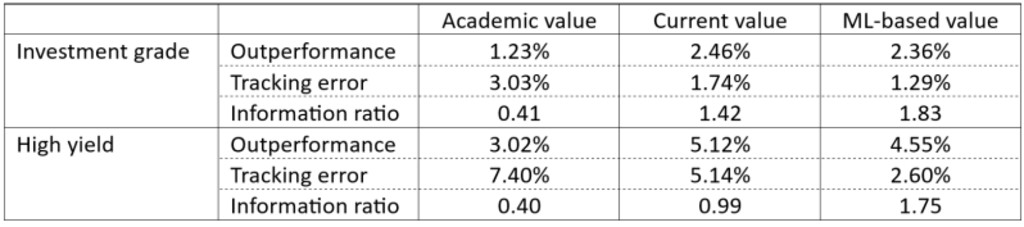
The key improvement of the ML-based compared to the current value approach lies in the reduction of active risk (tracking error). ML-based value excels in avoiding value traps within the higher risk segment of the market, resulting in lower exposure to bonds with the highest risk. In investment grade, this active risk reduction is achieved while delivering slightly lower levels of outperformance compared to the current approach. In high yield, although the level of outperformance is lower, the ML-based approach significantly reduces active risk, leading to a substantial improvement in the overall risk-adjusted performance of the strategy, as indicated by the information ratio. This highlights the ML-based value factor’s ability to generate attractive outperformance at a modest level of risk.
Implementation in existing strategies
Robeco’s Multi-Factor Credits, Multi-Factor High Yield, Conservative Credits, and Enhanced Index strategies offer balanced exposure to multiple factors. Value is one of the five factors alongside low-risk, quality, momentum and size. We will now complement the existing value factor with 50% ML-based value. This addition will primarily aim to reduce the risk contribution from the value factor, thereby improving risk-adjusted returns. By integrating ML-based value, the strategy will be better able to distinguish between truly undervalued bonds and value traps, resulting in more refined investment decisions.
Footnotes
1 Houweling & Van Zundert, 2017, “Factor Investing in the Corporate Bond Market”, Financial Analysts Journal.
2 Houweling, Van Zundert, Beekhuizen & Kyosev, 2016, “Smart Credit Investing: The Value Factor”, Robeco white paper.
3 Berkien & Houweling, 2021, “There’s no quant crisis in credits”, Robeco white paper.
4 Messow, ‘t Hoen & Houweling, 2023, “Enhancing the Value factor in Credits with Machine Learning”, Robeco white paper.
重要資料
本網站僅供《證券及期貨條例》(香港法例第571章)及其附屬法例所界定之專業投資者瀏覽及使用。 投資涉及風險。過往表現並不代表未來表現。本網站所載資料僅供參考之用,並不構成任何投資建議,亦非作出買賣任何證券或採納任何投資策略之要約或招攬。投資者不應僅憑本網站提供之資料作出投資決定,在作出任何投資決定前,應徵詢獨立意見(包括有關稅務影響之意見)。投資者應確保完全理解投資產品的相關風險,亦應考量自身投資目標及風險承受水平。投資乃閣下之個人決定。除非銷售投資產品的中介人已向閣下告知該投資產品適合閣下,並已解釋其符合閣下投資目標之原因,否則閣下不應投資。請參閱相關發售文件或其他法律文件,以獲取包括風險因素在內的進一步詳情。 本網站由荷寶投資管理香港有限公司發布,該公司受香港證券及期貨事務監察委員會(「證監會」)規管(中央編號:APU851)。本網站未經證監會審閱。 無法保證任何投資產品可實現其投資目標。概不就任何投資產品之表現或投資回報作任何聲明或承諾。投資的價值或會波動。本網站所載過往表現、推算或預測,均不應視作未來表現之保證或指標,且概不提供任何明示或暗示之保證。本網站內容建基於相信為可靠之來源,惟因應資料傳遞技術特性及須採用多項數據來源(包括第三方內容),故概不保證其準確性。所述觀點僅乃截至上述日期,或會隨市況變化而改變,可予更改而毋須另行通知。該等意見可能有別於其他荷寶投資專業人士之意見。因使用本材料或當中所載任何評論、意見或估算而引致之直接、間接或相應損失,荷寶概不承擔法律責任。荷寶並無責任更新本網站或任何網站內容。未經荷寶事先書面許可,不得複製、分發或刊發本網站任何材料。 除非另有說明,資料來源:荷寶。