
Portfolio Manager


• 市場觀點
Less waste, more value: the case for upstream circular solutions
‘Reduce, reuse, recycle’ is a widely recognized slogan of the circular economy. But those terms carry immensely different weights for firms and investors. We explain why recycling is a circular solution of last resort, while broadening to upstream solutions can help produce better outcomes for the environment and portfolios.
作者

概要
- Recycling and waste collection are low-value solutions
- Upstream solutions generate more value, eliminating waste before it starts
- Broader circular scope, boosts resource efficiency and return potential
Though recycling is important, it was never intended to be the poster child of the circular economy. That’s because it is insufficient and inefficient compared to upstream solutions that prevent waste from being created in the first place. In fact, the EU Commission, the globe’s foremost leader in driving circularity, underscored its preference for upstream solutions when it acknowledged that 80% of environmental impacts result from decisions made at the design stage of product development. 1
In a perfectly circular economy, recycling would be used sparingly if at all
The share of recycled materials used in the global economy now sits at around 7% and continues to fall.2 That means that the overwhelming majority of material stock introduced into the economy each year is from new inputs.
To be sure, regulatory action requiring greater recycled content and industry innovation in recycling technologies are boosting recycling’s impact and growing its deployment in absolute terms. But it’s simply not enough to keep pace with accelerating rates of production. Over the past five decades, the total volume of material produced annually has grown nearly threefold (270%).3 Without a significant slump in demand, it’s unlikely that recycling will ever catch up.
Figure 1 – New inputs dwarf recycled material
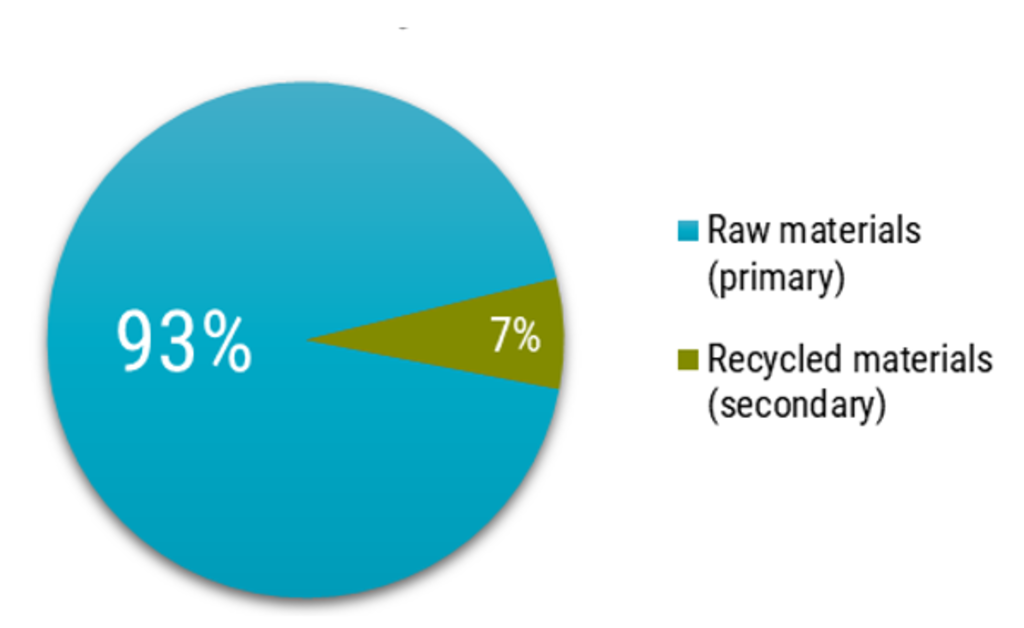
Annual material consumption in the global economy. Raw materials making their way into the economy from primary (virgin) sources far outweigh those used from existing materials which have been recycled (secondary).
Source: Circularity Gap Report, 2025.
什麼是趨勢?
訂閱我們的電子報,即可掌握所有最新的主題投資趨勢。
Recycling is a costly, low-value solution. For many industries, recycling and recovery costs – collection, sorting, cleaning and refining – are too high. For example, recycled broken or waste glass can be up to 20% more costly than virgin materials.4 In the US, the premium for recycled plastic over new polymers and resins has reached 25%.5 That’s a margin breaker given only 1% to 7% of consumers are willing to pay a premium for recycled content. 6
And processing costs are increasing as material mixes in waste streams become more sophisticated. The marginal value yield of multi-polymer plastics, mixed-fiber textiles, or multi-component electronics and machinery is much lower than for simpler materials such as glass or aluminum.7 In addition, recycled content is often lower quality and less functional, further limiting potential use cases and commercial value.
Figure 2 – Recycled plastic cost more than virgin (Europe)
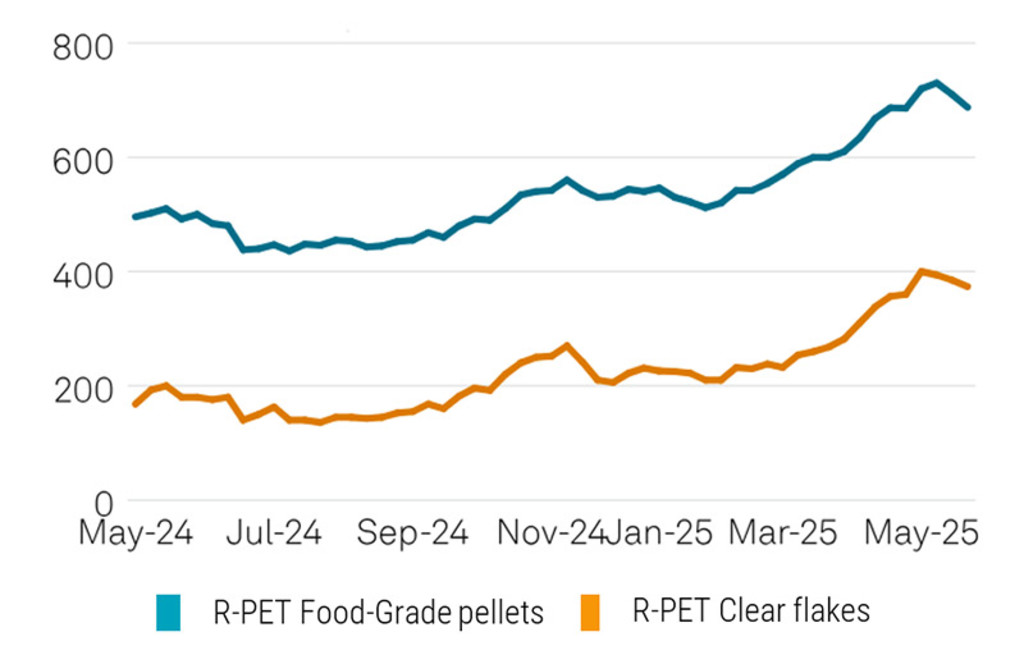
The graphic shows pricing spreads between two recycled PET plastic grades (Food-Grade pellets and Clear Flakes) and virgin PET plastic in Europe. Recycled plastics are significantly more expensive. In May, Food-Grade Pellets were priced EUR 700 / metric ton and EUR 400 higher than virgin PET pellets. Food-Grade pellets are processed according to stricter quality standards and can be used for things like food or medication packaging. Clear Flakes are used as feedstock for industrial applications with less stringent quality criteria.
Source: S&P Global Commodity Insights, June 2025
The power of upstream thinking
According to circular experts, waste and pollution are the result of flawed design.8 In a perfectly circular economy, recycling would be used sparingly if at all. Circular solutions are best applied upstream at the product’s original conception rather than at the end of a product’s life. That means designing products that are durable, repairable, modular, and biodegradable.9 It also includes companies whose innovative technologies enable their customers to use resources smarter so they can achieve more with less.
Building on this principle, the Circular Economy Equities strategy (the Strategy) maintains a tilt toward companies that are enabling or applying higher-value, upstream solutions. That significantly enlarges the opportunity set from a narrow focus on waste and recycling stocks to a broad basket of sectors and industries.
Robeco’s Circular Economy strategy maintains a tilt toward higher-value, upstream solutions
Examples of the Strategy’s broad sector exposure
Technology and Industrials – Though servicing vastly different industries, Cloudflare and Ashtead Group both promote circularity through shared platforms that replace on-premise asset ownership with on-demand access. Cloudflare leases cloud computing and network infrastructure to remote locations, eliminating the need for individual companies to build their own data centers.
Ashtead Group rents industrial equipment, from scaffolding and manlifts to conveyor belts and power tools. Product sharing models increase asset utilization rates and product longevity via centralized maintenance. More importantly, they enable an economy to get more done with fewer resources, decreasing the need the physical assets deployed across the economy.Manufacturing and Construction – Celestica and Cavco are two standouts that provide shared manufacturing services to multiple industries. Cavco focuses on prefabricated stationary homes, where scaled and streamlined in-factory manufacturing and assembly significantly reduces the excess material waste of onsite construction.
Celestica provides shared manufacturing of electrical components for customers across aerospace and energy systems to medical devices and diagnostic equipment. Strict manufacturing efficiency and tighter control over supply chain logistics help reduce resource use. Modular design encourages product refurbishments and repairs that extend product life.Consumer Staples and Materials – Moving closer to consumer goods, Sprouts Farmers and Sensient are good illustrations of the circular solutions in the food and agricultural sector. Sprouts is a supermarket focused on fresh, organic, and locally grown produce. Less packaging, chemical preservatives, and transport emissions translates to lower emissions and environmental footprint compared to processed food or meat alternatives.
Sensient focuses on supplying customers in the food, cosmetics and pharmaceuticals sectors with colors, flavors and specialty ingredients that are naturally regenerative, derived from plants and biological sources.Healthcare and Environmental Services – Halma and Galenica illustrate how circular solutions are being applied into health and environmental services. Halma develops technologies for safety, health and environmental monitoring – from clean water sensors to fire detection systems – that prevent risks and extend the useful life of assets. Galenica, through its pharmacy network and logistics operations, improves access to medicines while reducing inefficiencies and waste in healthcare delivery.
Broad style exposure
Too much focus on downstream recycling and waste management providers narrows the investment universe and limits exposure to attractive opportunities across industry value chains. Broadening the scope to upstream solution providers not only expands the portfolio’s return potential but also diversifies the portfolio’s exposure to different style factors including high-growth innovation, high-quality compounding cyclicals and defensive stalwarts (see Figure 3).
Figure 3 – Balancing growth and resilience
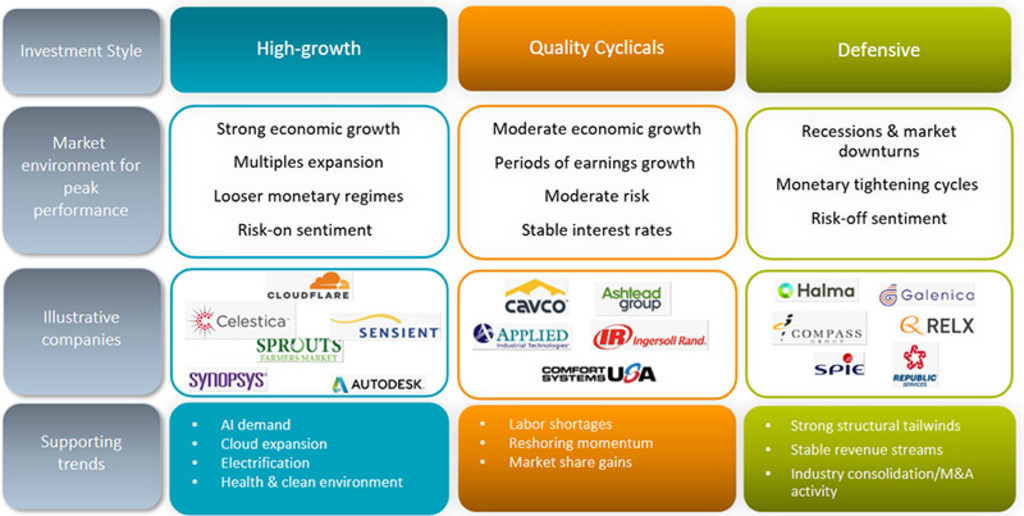
A tilt toward upstream solutions, broadens the investment scope across diverse industries and growth cycles, enhancing the portfolio’s return potential and long-term resilience in different market environments.
Source: Robeco, September 2025.
By moving away from recycling toward upstream solutions, the Strategy can tap into a diverse range of industries and companies with compelling business models and growing market share. Not only does this strengthen the portfolio’s potential to generate sustainable returns, it also enables it to invest in companies generating higher- value circularity and environmental impact.
Footnotes
1 EU Commission, State of the Union, Circular Economy, accessed September 2025.
2 Share or recycled material: 6.9% vs 9.1%, Circularity Gap Reports 2025 and 2018, respectively.
3 Material volume production: 27 billion (1970) vs 106 billion metric tons (2025). Circularity Gap Report, 2025.
4 ‘Distributors are at the center of circular solutions.’ BCG, November 2022.
5 ‘Impact on virgin vs recycled plastics.’ Briefing Note. Institute for Energy Economics and Financial Analysis, November 2024.
6 ‘Consumers are the key to taking green mainstream.’ BCG, September 2022.
7 US General Accountability Office (GAO), Textile Recycling Technologies. July 2024.
8 Ellen MacArthur Foundation, Eliminate waste and pollution webpage. Accessed September 2025.
9 Ellen MacArthur Foundation, The technical cycle of the Butterfly Diagram. Accessed September 2025.
Important note:
The companies referenced are for illustrative purposes only in order to demonstrate the investment strategy on the date stated. The companies are not necessarily held by the strategy nor is future inclusion guaranteed. This is not a buy, sell or hold recommendation, nor should any inference be made on the future development of these companies.
重要資料
本網站僅供《證券及期貨條例》(香港法例第571章)及其附屬法例所界定之專業投資者瀏覽及使用。 投資涉及風險。過往表現並不代表未來表現。本網站所載資料僅供參考之用,並不構成任何投資建議,亦非作出買賣任何證券或採納任何投資策略之要約或招攬。投資者不應僅憑本網站提供之資料作出投資決定,在作出任何投資決定前,應徵詢獨立意見(包括有關稅務影響之意見)。投資者應確保完全理解投資產品的相關風險,亦應考量自身投資目標及風險承受水平。投資乃閣下之個人決定。除非銷售投資產品的中介人已向閣下告知該投資產品適合閣下,並已解釋其符合閣下投資目標之原因,否則閣下不應投資。請參閱相關發售文件或其他法律文件,以獲取包括風險因素在內的進一步詳情。 本網站由荷寶投資管理香港有限公司發布,該公司受香港證券及期貨事務監察委員會(「證監會」)規管(中央編號:APU851)。本網站未經證監會審閱。 無法保證任何投資產品可實現其投資目標。概不就任何投資產品之表現或投資回報作任何聲明或承諾。投資的價值或會波動。本網站所載過往表現、推算或預測,均不應視作未來表現之保證或指標,且概不提供任何明示或暗示之保證。本網站內容建基於相信為可靠之來源,惟因應資料傳遞技術特性及須採用多項數據來源(包括第三方內容),故概不保證其準確性。所述觀點僅乃截至上述日期,或會隨市況變化而改變,可予更改而毋須另行通知。該等意見可能有別於其他荷寶投資專業人士之意見。因使用本材料或當中所載任何評論、意見或估算而引致之直接、間接或相應損失,荷寶概不承擔法律責任。荷寶並無責任更新本網站或任何網站內容。未經荷寶事先書面許可,不得複製、分發或刊發本網站任何材料。 除非另有說明,資料來源:荷寶。