
Portfolio Manager


• 市場觀點
Investing in defense as a sustainable investor
Investors are being urged to invest more in defense companies as European governments ramp up spending to counter Russia.
作者




Head of Sustainable Investing
概要
- Europe calls for higher defense spending to counter Russian threat
- Conventional weapons have always been investible for mainstream portfolios
- Controversial weapons like cluster munitions are always excluded
President Trump has called for all members of NATO to raise defense spending to at least 2% of GDP following Russia’s invasion of Ukraine, and for Europe to take more responsibility for its own security.
At an emergency summit in Brussels, EU leaders agreed on an EUR 800 billion ‘ReArm Europe’ plan to significantly boost defense spending to defend Ukraine itself, along with its own borders with Russia. This has led aerospace and defense stocks to outperform most other sectors as they benefit from the greater spending.
While investing in the makers of controversial weapons remains prohibited, it has always been possible at Robeco to invest in companies involved in conventional defense industries and their support services, and this may now increase, say Robeco’s multi-asset and sustainable investing specialists.
“We are trying to square a natural reluctance to invest in defense, due to its inherent association with unsustainable and undesirable conflicts, with the fact that we are multi-asset investors, and we want to balance the trade-off between risk, return and sustainability when it comes to defense spending,” says Aliki Rouffiac, Portfolio Manager with Robeco Sustainable Multi-Asset Solutions.
“Over the long term, we should position ourselves to benefit from the significant shifts in European policy to increase defense spending. The ReArm Europe plan means massive new investment to safeguard the security of the region.”
“If so, we expect that the weight of the aerospace and defense sub-industry sector will grow beyond the 2% current exposure in the Global Equity Index, while other parts of the market would also reap the benefits of higher spending.”
了解最新的可持續性市場觀點
訂閱我們的電子報,探索塑造可持續投資的趨勢。
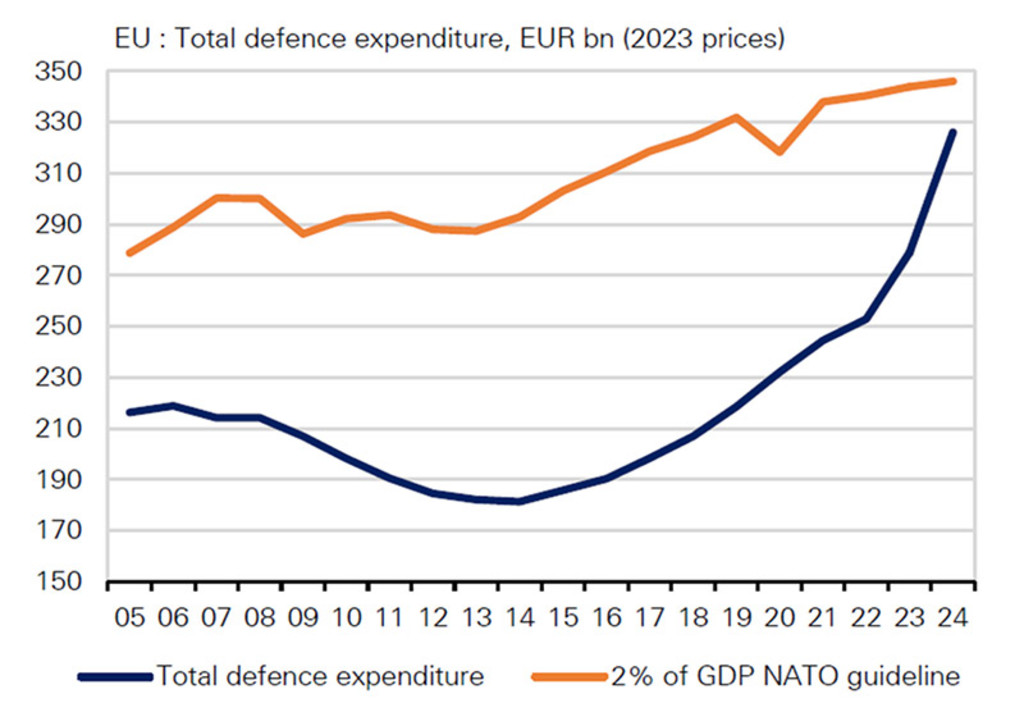
Source: Deutsche Bank, European Defence Agency. Note 2024 figure is estimate
Russia’s invasion of eastern Ukraine in February 2022, following its annexation of Crimea in 2014, changed not only the defense landscape, but also the global economy, triggering huge inflation in energy, food and commodities. Central banks are still battling with interest rates to tame the inflation.
Western spending on defense has been much lower than in Russia, which spends 5.86% of its GDP a year on defense.1 Of the 31 NATO members, eight still do not meet the 2% of GDP guidelines, with Spain spending only 1.28% and Italy 1.49%. Belgium, where NATO’s headquarters are located, spends just 1.30%. 2
The highest European spenders are Poland and the three Baltic states which all border Russia; the US spends 3.38% of GDP a year and has the highest military budget in the world of almost USD 1 trillion.
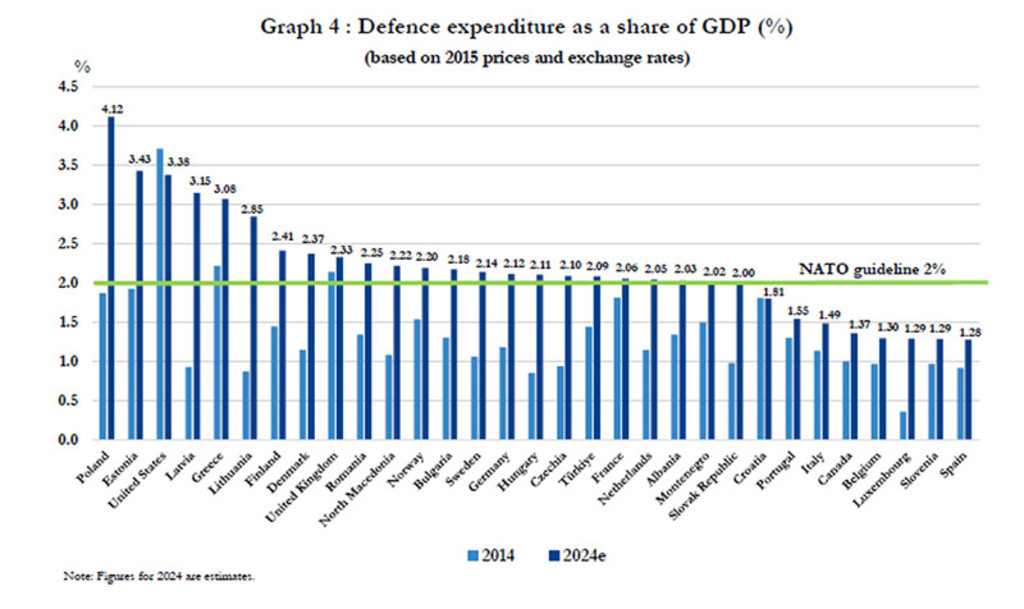
Defense spending by NATO members. Source: Forces News, NATO
Defense in mainstream portfolios
“As a responsible investor, it has always been the case that we can invest in defense for our mainstream investment portfolios, and obviously it is becoming more relevant now,” says Carola van Lamoen, Head of Sustainable Investing at Robeco.
“Our mainstream investment portfolios can invest in the defense industry, excluding only controversial weapons. At Robeco, we acknowledge the changing geopolitical landscape and the increasing responsibility of European governments for the continent's defense. This shift also comes with greater investments in the defense sector.”
“At Robeco, we are committed to integrating ESG principles, and we balance our clients’ goals of return, risk, and sustainability by taking into account their objectives and tailoring the outcomes accordingly.”
Excluded weapons
Robeco deems controversial weapons to be cluster munitions, anti-personnel mines, white phosphorus and depleted uranium ammunition, along with chemical, biological and nuclear weapons. Nearly all are banned under international treaties.3 These are part of Level One exclusions at Robeco and apply across the entire investment range, making the companies ineligible for investment.
Level Two exclusions are used by Robeco’s bespoke sustainable portfolios and go further by specifically barring a company for activities that are classified as unsustainable. Here, from a defense perspective, military contractors are excluded above certain revenue thresholds.
“Our most sustainable investment strategy range does not invest in defense because we do not define weapons as sustainable investment,” Van Lamoen says. “In other words: investing in defense can be responsible, but not sustainable.”
Investing more indirectly
There are also opportunities to invest in the non-lethal support industries that back armies and their infrastructure. Napoleon once said that “an army marches on its stomach”, meaning opportunities in catering and the related companies supplying troops. Investors can also look for high-end military uniform suppliers, logistics firms, satellite technology, or in banking providing loans to any of them.
Modern warfare also isn’t just on the battlefield, as seen when a North Korean hacking team allegedly stole over USD 1 billion worth of cryptocurrency. This brings opportunities for cybersecurity.
“This also supports an active management approach, as this goes hand in hand with our sustainable investing principles, by allowing for differentiation between companies that are investable versus those that are genuinely part of our exclusionary policies,” Rouffiac says.
“It’s more of an evolution rather than a revolution. The proposed plans to raise defense spending still need to be ratified by governments, and this may take time. And there could be a peace deal between Russia and Ukraine coming up, which would lessen the urgency of it. It means we should stay flexible in terms of our approach.”
Footnotes
1 https://data.worldbank.org/indicator/MS.MIL.XPND.GD.ZS?locations=RU
2 https://www.forcesnews.com/news/world/nato-which-countries-pay-their-share-defence
3 The Ottawa Treaty (1997) prohibits the use, stockpiling, production and transfer of anti-personnel mines. The Convention on Cluster Munitions (2008) prohibits the use, stockpiling, production and transfer of cluster munitions. The Chemical Weapons Convention (1997) prohibits the use, stockpiling, production and transfer of chemical weapons. The Biological Weapons Convention (1975) which prohibits the use, stockpiling, production and transfer of biological weapons. The Treaty on the Non-Proliferation of Nuclear Weapons (1968) limits the spread of nuclear weapons to the group of confirmed nuclear weapons states (the US, Russia, UK, France and China).
重要資料
本網站僅供《證券及期貨條例》(香港法例第571章)及其附屬法例所界定之專業投資者瀏覽及使用。 投資涉及風險。過往表現並不代表未來表現。本網站所載資料僅供參考之用,並不構成任何投資建議,亦非作出買賣任何證券或採納任何投資策略之要約或招攬。投資者不應僅憑本網站提供之資料作出投資決定,在作出任何投資決定前,應徵詢獨立意見(包括有關稅務影響之意見)。投資者應確保完全理解投資產品的相關風險,亦應考量自身投資目標及風險承受水平。投資乃閣下之個人決定。除非銷售投資產品的中介人已向閣下告知該投資產品適合閣下,並已解釋其符合閣下投資目標之原因,否則閣下不應投資。請參閱相關發售文件或其他法律文件,以獲取包括風險因素在內的進一步詳情。 本網站由荷寶投資管理香港有限公司發布,該公司受香港證券及期貨事務監察委員會(「證監會」)規管(中央編號:APU851)。本網站未經證監會審閱。 無法保證任何投資產品可實現其投資目標。概不就任何投資產品之表現或投資回報作任何聲明或承諾。投資的價值或會波動。本網站所載過往表現、推算或預測,均不應視作未來表現之保證或指標,且概不提供任何明示或暗示之保證。本網站內容建基於相信為可靠之來源,惟因應資料傳遞技術特性及須採用多項數據來源(包括第三方內容),故概不保證其準確性。所述觀點僅乃截至上述日期,或會隨市況變化而改變,可予更改而毋須另行通知。該等意見可能有別於其他荷寶投資專業人士之意見。因使用本材料或當中所載任何評論、意見或估算而引致之直接、間接或相應損失,荷寶概不承擔法律責任。荷寶並無責任更新本網站或任何網站內容。未經荷寶事先書面許可,不得複製、分發或刊發本網站任何材料。 除非另有說明,資料來源:荷寶。