
Portfolio Manager


• 市場觀點
Investing in sustainable cities
Urbanization is one of the dominant economic trends of the 21st century and more investable than ever, as developers and asset owners adapt to a changing climate.
作者


Portfolio Manager
概要
- The UN estimates 68% of humanity will live in cities or megacities by 2050
- Climate change and sustainability-focused policy measures are impacting relative property valuations
- Investment in reconstruction and redevelopment will accelerate
The world’s urban population is growing and the rural population has peaked, according to UN estimates. In developed countries typically around 80% of the population already live in urban areas. The UN expects growth will come from the developing world with India, China and Nigeria in the next two decades, accounting for more than a third of the expected growth up to 2050. Urbanization is closely correlated with economic development, meaning this isn’t necessarily a negative trend for the world economy, but it does present challenges given efforts to mitigate, slow or halt climate change.
Figure 1: Global urban vs. rural population growth 1950-2050
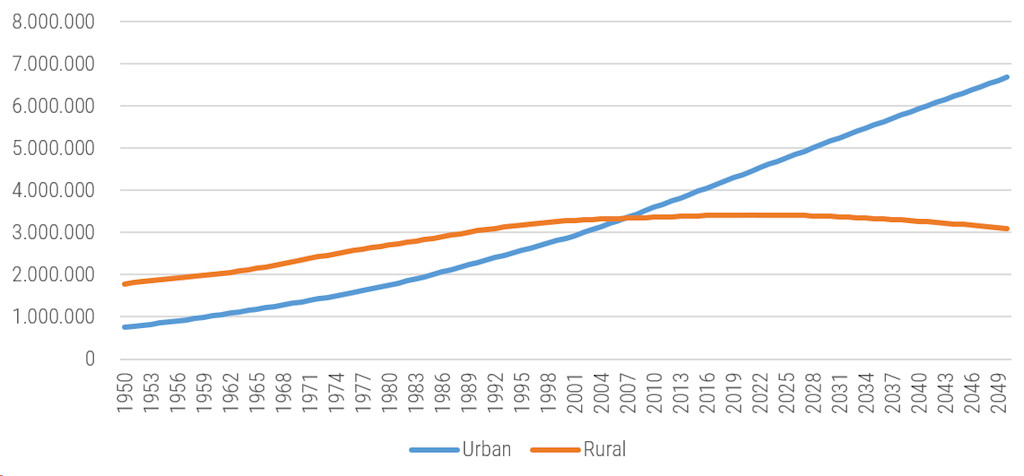
Source: UN World Urbanization Prospects 2018
Climate goals are unachievable without investing in urban infrastructure
Cities cover just 3% of the Earth’s land surface, but currently account for 75% of carbon emissions1.
Making our cities both livable and sustainable will require capital, planning and innovation on an unprecedented scale, representing a huge opportunity for long-term investors. Frameworks regulating property development are also becoming increasingly important as regional, national and local governments try to meet net-zero commitments. In the past the climate was always a given – a predictable background factor – but that era is over.
Building and renovating to hit net zero
Trends expected across all geographies in the coming decades range from upgrading the existing building stock including heating and ventilation, optimizing energy use, and employing better insulation or heat mitigation techniques (depending on geography), and potentially adapting existing commercial property to residential or mixed use. The International Energy Agency estimates total global floor area will have increased by 15% between 2022 and 2030 – equivalent to the existing floor area of North America2.
In the EU, where data on the age and energy classifications of both residential and commercial property is readily available, about one-third of all EU buildings are over 50 years old. Nearly 75% of the building stock is not energy efficient, with only about 1% undergoing renovation each year. However, the European Environment Agency said greenhouse gas emissions from EU buildings decreased by 31% between 2005 and 20213. This progress has been driven by higher energy efficiency standards for new buildings, energy efficiency improvements in existing buildings, decarbonization of the electricity and heating sectors, and warmer temperatures. The latter point has been complicated by increasing adoption of air conditioning in Europe to counter soaring summer temperatures4.
Home insurance markets in some areas have collapsed
Relative property valuations
The direct impacts of climate are also impacting relative property valuations. Both in the residential and commercial sectors, occupiers will choose the most energy efficient properties lowering long-term energy costs and limiting exposure to restrictions on use. Legacy buildings that are difficult to upgrade, or are located in less attractive geographies, have the potential to become stranded assets, which is already having an immediate impact on relative valuations5. For example, in Florida, increasingly prone to hurricanes and flooding, home insurance markets in some areas have all but collapsed, with premiums becoming unaffordable and some insurers refusing to write new business and withdrawing from the market altogether6. In many cases the property impacted is in areas of high demand like Miami Beach and Palm Beach, making due diligence and assessment of climate mitigation potential very important for long-term investors.
Investment implications
The key takeaway for investors is that while densification, household growth and household purchasing power remain as important as ever and are reason to invest in prime locations, the distinction between residential, retail and office is becoming more blurred.
Across the globe, and particularly in Asia, real estate companies increasingly operate integrated commercial assets, driven by urban densification and regulatory pressure for reduced energy intensity and water use. In the US, mixed-use development is also becoming the standard as office floors are added to malls and shopping centers, while in other cases lower floors in office buildings are converted to retail. As companies continuously exploit best use of their urban assets and landbank, the differences between different commercial segments and asset types will melt further.
The Robeco Sustainable Property Equities strategy looks for companies that continue to be best positioned to monetize one of the three trends; Sustainable Cities (urbanization and earth preservation), PropTech (technology), and Lifestyle (socio-demographic). We believe that the best way to capture alpha from the transition to sustainable cities is to remain focused on REITs that operate and develop high-grade real estate assets in prime locations and those who are at the forefront of greening their buildings. It is our conviction that the transition to sustainable cities will have a significant impact on future fundamentals – including rents and profitability – and we are adapting the portfolio to this new reality.
Footnotes
[1] UN Sustainable Development Goals Report 2022
[2] IEA: Technology and Innovation Pathways for Zero-carbon-ready Buildings by 2030 – September 2022
[3] Greenhouse gas emissions from energy use in buildings in Europe – EEA – October 2023
[4] Air conditioning is ‚exacerbating the climate crisis‘ but how many Europeans use it? – Euronews – August 2024
[5] In London, New York and Paris, a Giant Office Bet Is Going Wrong – Bloomberg – July 2023
[6] Insurers pull back as US climate catastrophes intensify – The Hill - June 2023
重要資料
本網站僅供《證券及期貨條例》(香港法例第571章)及其附屬法例所界定之專業投資者瀏覽及使用。 投資涉及風險。過往表現並不代表未來表現。本網站所載資料僅供參考之用,並不構成任何投資建議,亦非作出買賣任何證券或採納任何投資策略之要約或招攬。投資者不應僅憑本網站提供之資料作出投資決定,在作出任何投資決定前,應徵詢獨立意見(包括有關稅務影響之意見)。投資者應確保完全理解投資產品的相關風險,亦應考量自身投資目標及風險承受水平。投資乃閣下之個人決定。除非銷售投資產品的中介人已向閣下告知該投資產品適合閣下,並已解釋其符合閣下投資目標之原因,否則閣下不應投資。請參閱相關發售文件或其他法律文件,以獲取包括風險因素在內的進一步詳情。 本網站由荷寶投資管理香港有限公司發布,該公司受香港證券及期貨事務監察委員會(「證監會」)規管(中央編號:APU851)。本網站未經證監會審閱。 無法保證任何投資產品可實現其投資目標。概不就任何投資產品之表現或投資回報作任何聲明或承諾。投資的價值或會波動。本網站所載過往表現、推算或預測,均不應視作未來表現之保證或指標,且概不提供任何明示或暗示之保證。本網站內容建基於相信為可靠之來源,惟因應資料傳遞技術特性及須採用多項數據來源(包括第三方內容),故概不保證其準確性。所述觀點僅乃截至上述日期,或會隨市況變化而改變,可予更改而毋須另行通知。該等意見可能有別於其他荷寶投資專業人士之意見。因使用本材料或當中所載任何評論、意見或估算而引致之直接、間接或相應損失,荷寶概不承擔法律責任。荷寶並無責任更新本網站或任何網站內容。未經荷寶事先書面許可,不得複製、分發或刊發本網站任何材料。 除非另有說明,資料來源:荷寶。