

Investment Writer


• 市場觀點
How transition investing can meet the challenge
Before we developed our transition investment solutions, we had to fully understand the challenges at hand. Now, we're ready to share the key criteria we've used to establish strategies that effectively meet the transition challenge.
作者

Jessica Monkivitch
概要
- Transition is the journey in the investment process and sustainability is the destination
- Solutions should be forward-looking, region-specific, multifaceted and facilitate the transition
- We have the solutions to begin the journey, knowing we will need to adapt

Thu Ha Chow | Head of Fixed Income Asia, Portfolio Manager
The word ‘transition’ by its very nature implies moving from one place to another. Importantly it indicates a state of change. And change is not easy. The fact we find ourselves grappling with the complexities of moving the entire world to the 2050 goal of net zero is not surprising. Energy is a fundamental driver for the economy, but the shift to renewable energy is having wide-ranging reverberations on companies and countries.
Nonetheless, the energy transition is in full swing, with regulations and technologies increasingly being the driving forces. Yet, we are not moving fast enough to mitigate the impending climate changes that scientists are warning us about. So, what should we do?
The starting point is to understand the problem we are trying to solve. We asked Thu Ha Chow, Head of Fixed Income Asia, to break down the complexities of the transition by explaining where we are now, how we got here, and what we, as asset managers, are doing about it.
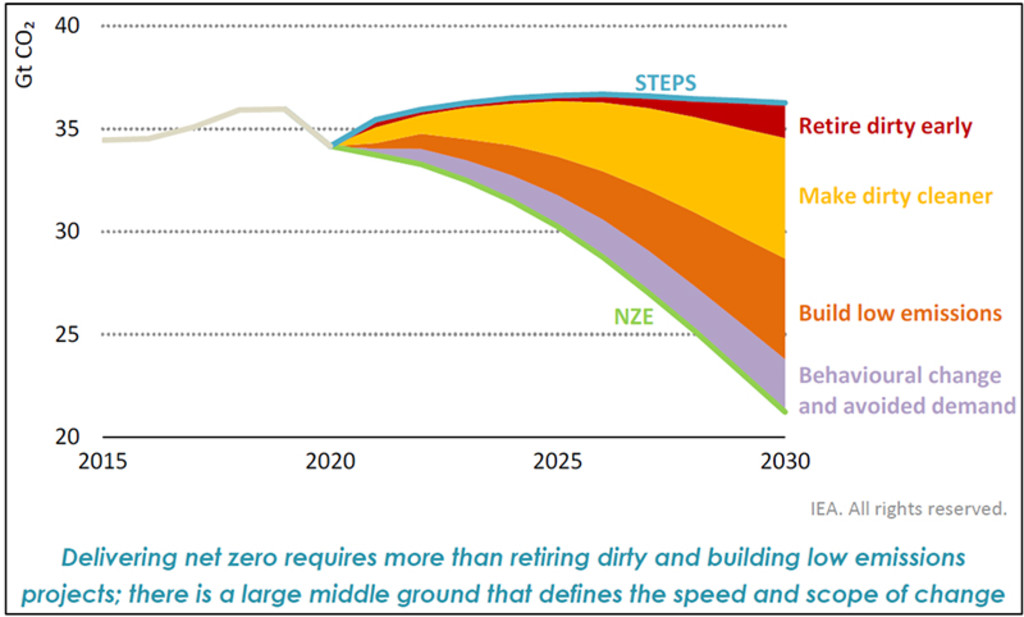
“Sustainable investing was the starting point. Here, we emphasized investing in companies and sectors that were green, usually defined as building low-emission alternatives such as renewable energy. However, if we look at the International Energy Agency’s (IEA) policy pathway,1 building low-emission structures only represents 15-20% of the reduction needed. The problem is, as we can see below, the bulk of the work is required in the yellow section: ‘make dirty cleaner’. This calls for transition investing, which focuses on supporting companies and sectors in improving processes to create greener practices.”
Figure 1: Emissions reductions for net zero emissions (NZE) by 2050 relative to the Stated Policies Scenario (STEPS)
Source: International Energy Agency
“Yet without sufficient clarity of what would be classified as transition activities, there was a gap in funding for fear of greenwashing. The publication of the G20 Transitional Finance Framework2 in 2022 was instrumental in establishing international guidelines and, subsequently, confidence. On the heels of this in early 2023, ICMA3 published a transition handbook, outlining a framework for how green, social and sustainability (GSS) bonds could be used not only as ‘sustainable’ investments but also as a part of the toolkit to enable companies and sovereigns that are not yet fully decarbonized to transition from brown to green. Thus, the term ‘transition investing’ arose to clarify and channel funding more effectively toward achieving net zero.”
Why start with a focus on Asia and emerging markets?
“We started in Asia and EM as this is where the funding gap is greatest, and where the harder-to-abate sectors reside, given these markets are resource and manufacturing hubs. However, the transition needs to happen globally if we are to reach net zero.”
So, if we recognize that transition investing is essential, what do we do next?
“Once we accept that transition is already in motion, as an asset manager we need to embrace transition investing as a part of sustainable investing. I like to use the analogy of a difficult car journey, so it might involve some off-road driving, you might end up on the beach, there will be deep crevices to cross. We might have to change tires halfway to tackle bumpy terrain. We might have to release the tire pressure to drive through thick sand.”
The energy transition impacts every aspect of our economy, from inflation to geopolitics
“We need a navigation plan in place and a starting point, but before we set off, we need to be prepared and we must expect the unexpected on route. The road ahead is unclear and there will be new challenges along the way.”
“You could say we are experiencing some bumps now with pushback from different areas on ESG investing, but this is just a part of the journey as we grapple with the reality of the transition. As asset managers navigating this brave new world, we need additional tools to navigate the transition landscape and we must keep thinking about how to refine or develop our toolkit.”
Where do we begin?
“We start by being adaptive, that is the nature of any good investing strategy. We have adapted before: we did it with the dotcom boom, and what we learned then was that we had to invest in more than just the hardware, we also needed to invest in the logistics companies, and software providers too. It is the same thing this time around. We need to tackle the financing of the transition with a broad-based approach.”
“The traditional investment lens, with our current economic models, doesn’t cover this. And we must recognize that the impact is not just a concern for sectors directly affected by policy, such as energy or transport; it extends to second and third-order impacts. The energy transition is impacting every aspect of our economy, from inflation to geopolitics.”
What is our role as asset managers?
“We need to finance adaptation and finance the change. By supporting businesses that are changing, we are supporting more resilient businesses. And as asset managers we can be the solution providers, undertaking the work to navigate and support the transition.
The speed and pathway toward the energy transition will shape the investment risks and returns for decades to come, so it is imperative to have an approach to manage this transition.”
And what approach should we take?
“When we thought about how to create the solutions, we came up with three key criteria that a good solution should meet:
We needed to develop a framework to identify transition opportunities using forward-looking metrics.
We had to recognize the multiple dimensions of the transition and the regional differences.
We should incorporate the philosophy that transition is the journey into the investment process, with the understanding that sustainability is the destination.
We believe that if a solution addresses these criteria, investors can identify the different opportunities across asset classes and regions as they emerge.
Our method is dynamic, allowing investors to capture alpha opportunities
It acknowledges that the interplay between the energy transition and various economic, financial, social, and political dynamics can result in multiple outcomes. This method is designed to be dynamic, allowing investors to capture alpha opportunities while steering clear of potential risks.”
Lastly, what solutions do we have at Robeco?
“To meet our criteria for an effective solution (forward-looking, region-specific, multifaceted, and facilitating the transition journey), we needed to offer a variety of approaches. Therefore, we started with two credit strategies and two equity strategies, each with distinct features.”
“And if we return to the car analogy: in the case of equities, the car they are taking on this journey is equipped to go fast, investing in solutions and technologies that are leading the transition. For example, they might invest in new technologies that are climate providers.
“Whereas for fixed income, we are taking a more cautious and slower route by investing in more traditional companies that are leading the transition through adoption of innovative technologies. We are confident that these solutions will initiate the journey, and ultimately, we see having diverse opportunities as advantageous.”
重要資料
本網站僅供《證券及期貨條例》(香港法例第571章)及其附屬法例所界定之專業投資者瀏覽及使用。 投資涉及風險。過往表現並不代表未來表現。本網站所載資料僅供參考之用,並不構成任何投資建議,亦非作出買賣任何證券或採納任何投資策略之要約或招攬。投資者不應僅憑本網站提供之資料作出投資決定,在作出任何投資決定前,應徵詢獨立意見(包括有關稅務影響之意見)。投資者應確保完全理解投資產品的相關風險,亦應考量自身投資目標及風險承受水平。投資乃閣下之個人決定。除非銷售投資產品的中介人已向閣下告知該投資產品適合閣下,並已解釋其符合閣下投資目標之原因,否則閣下不應投資。請參閱相關發售文件或其他法律文件,以獲取包括風險因素在內的進一步詳情。 本網站由荷寶投資管理香港有限公司發布,該公司受香港證券及期貨事務監察委員會(「證監會」)規管(中央編號:APU851)。本網站未經證監會審閱。 無法保證任何投資產品可實現其投資目標。概不就任何投資產品之表現或投資回報作任何聲明或承諾。投資的價值或會波動。本網站所載過往表現、推算或預測,均不應視作未來表現之保證或指標,且概不提供任何明示或暗示之保證。本網站內容建基於相信為可靠之來源,惟因應資料傳遞技術特性及須採用多項數據來源(包括第三方內容),故概不保證其準確性。所述觀點僅乃截至上述日期,或會隨市況變化而改變,可予更改而毋須另行通知。該等意見可能有別於其他荷寶投資專業人士之意見。因使用本材料或當中所載任何評論、意見或估算而引致之直接、間接或相應損失,荷寶概不承擔法律責任。荷寶並無責任更新本網站或任何網站內容。未經荷寶事先書面許可,不得複製、分發或刊發本網站任何材料。 除非另有說明,資料來源:荷寶。