
Portfolio Manager


• 市場觀點
New strategy brings rigor, sustainability and passion to engaging with fashion
New strategy’s tighter weaving of active management and customized portfolio engagement creates an attractive style for investors with a passion for more sustainability in fashion.
作者


Analyst and Engagement Specialist

Engagement Specialist
概要
- Fashion is a notoriously unsustainable industry
- Expanded role of engagement key to boosting sustainability
- Tight weave of investments and engagements creates attractive investment blend
Robeco’s new Fashion Engagement Equity strategy wants to invest in fashion’s future. For a team made up of both investment and engagement professionals, that means investing in high-quality stocks but also pushing fashion companies to adopt more sustainable practices.
That will be no easy task given fashion’s figures on water, air and soil pollution are far from flattering. It also struggles with worker rights and wages in many regions. For critics, making it more sustainable is like threading a needle in a sandstorm. Still, team members believe they can deliver sustainable change with a pioneering approach.
Fashion’s figures on water, air and soil pollution are far from flattering
“We’ve got high ambitions and achieving them requires bolder tactics. Instead of following convention where engagement takes place post-investment, we integrate it at the outset. Input from engagement specialists inform portfolio construction while the investment team steers the engagement agenda and dialogues with companies.”
Intensified collaboration in stock selection and portfolio construction is just one feature of the new approach; 100% portfolio engagement is another. “While traditional engagement covers just a fraction of the stocks in a portfolio, we aim to engage with every single holding. Focused and frequent interactions with company management and sustainability experts should prompt accelerated action on key sustainability challenges in ways that more generalized active ownership activities cannot.”
While traditional engagement covers just a fraction of the stocks in a portfolio, we aim to engage with every single holding
“We also believe our efforts can create a ripple effect between investee companies and their upstream and downstream partners in the supply chain.”
The architecture of success
Engagement is a critical piece of the mandate but, as with investment returns, successful outcomes can’t be guaranteed. The team says this reality has shaped the design of the engagement process which features robust research, consistent application, and customization to create a program that is ambitious but not impossible for companies to achieve over the investment timeframe.
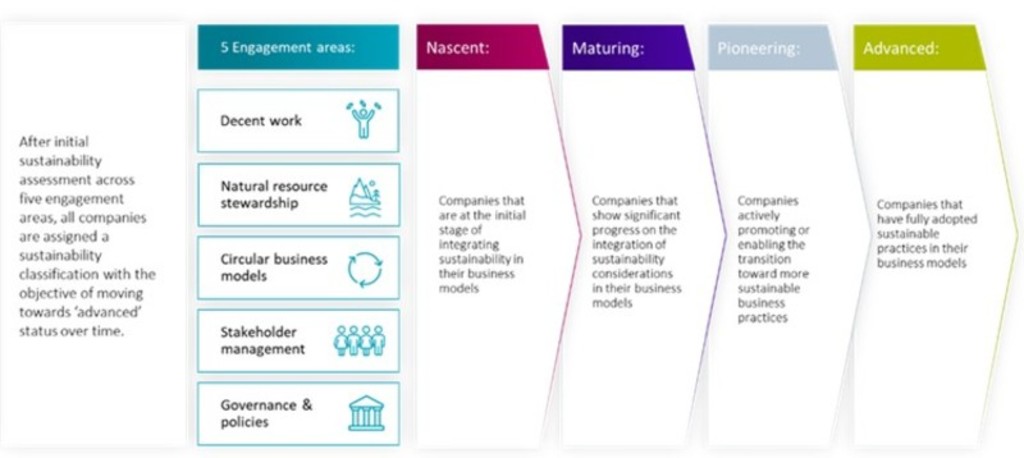
“Our proprietary engagement framework guides the process. Each engagement case is informed by sector-specific sustainability research, in-depth company profiles, a rich engagement history as well as Robeco’s SDG, biodiversity, and climate performance metrics. That has helped streamline the engagement focus on five key sustainability challenges – decent work, natural resource stewardship, circular models, stakeholder management, and governance & policies – which are all critical to address for a sustainable fashion future.”
In practice that can mean encouraging reduction of freshwater and pesticide use on crops, pressing manufacturers on wages and worker rights, pushing brands to improve transparency on source materials, or nudging retailers to introduce circular business models that reduce waste.
Though the elements of the process are the same, that doesn’t mean companies are treated equally. The team explains that this is necessary given that “companies face a myriad of unique constraints including access to financial resources, know-how, and technology based on their geographic location or position on the supply chain.” With this in mind, they adjust engagement expectations based on companies’ initial level of sustainability integration.
Figure 1 – A rigorous engagement concept deployed across the strategy’s holdings
Source: Robeco
What’s our Plan ‘D’?
Engagements will typically last five years and will be considered successful if companies achieve three out of five sustainability goals. But sustainability is not ‘a one and done’ process. Successful closure makes companies candidates to graduate to a more stringent engagement category with higher sustainability targets.
Moreover, interim milestones have been set to keep progress on track and increase the probability of successful outcomes. “If companies are unresponsive to reporting requests or struggling to hit targets, it signals the need for more collaboration,” they say.
They’ve also built a divestment scenario into the strategy’s design but emphasize it’s a tool of last resort when companies are stonewalling and progress is improbable. “We’re convinced that executing ‘Plan D’ will rarely be necessary in practice based on our selection criteria. This is a high-conviction strategy grounded in extensive fundamental and sustainability analysis; we select stocks where we see upsides for growth and sustainability.”
This is a high-conviction strategy grounded in extensive fundamental and sustainability analysis; we select stocks where we see upsides for growth and sustainability
The team says the goal is to work with companies to help them achieve that sustainability potential which should also help reduce risks and support long-term shareholder value.
獲取最新市場觀點
訂閱我們的電子報,時刻把握投資資訊和專家分析。
Engagement plus
In addition to engagement, exclusions and ESG integration are also used to enhance the strategy’s overall sustainability. But the team insists that these other tools will work in concert with engagement. “We aren’t looking for companies to reach a pre-established ESG score. We’re aiming for change on material issues that not only benefit society and the environment but also their bottom line. That means facilitating progress toward living wages for workers in vulnerable regions, more recycling of end-of-life products, and instituting policies that include sustainability KPIs tied to executive remuneration.”
Robeco’s SDG framework is also used to gauge how holdings are performing on critical real-world challenges. The aim is to have at least a third of holdings making positive progress on the SDGs.
The team contends that measuring engagement progress will be increasingly necessary to guard against greenwashing and to comply with stricter regulations. “As we are anticipating change, we’re working with a team of in-house sustainability experts to create an impact attribution framework that will allow us to quantify and measure the efficacy of our engagements.”
Amplified effect
But is one strategy with 40-50 holdings enough to drive sustainability in a nearly three trillion-dollar global industry? While acknowledging the enormity of the task, the team believes engagements can extend well beyond individual investee companies. “We’re investing and engaging with large, publicly listed companies with resources, networks and influence in their supply chains. Changing their sustainability practices should also impact the players in their radius.”
“In addition to engagement efforts with holdings, we’re also partnering with investor coalitions which should help amplify our demands and intensify industry pressure in a way that no single strategy ever could.”
重要資料
本網站僅供《證券及期貨條例》(香港法例第571章)及其附屬法例所界定之專業投資者瀏覽及使用。 投資涉及風險。過往表現並不代表未來表現。本網站所載資料僅供參考之用,並不構成任何投資建議,亦非作出買賣任何證券或採納任何投資策略之要約或招攬。投資者不應僅憑本網站提供之資料作出投資決定,在作出任何投資決定前,應徵詢獨立意見(包括有關稅務影響之意見)。投資者應確保完全理解投資產品的相關風險,亦應考量自身投資目標及風險承受水平。投資乃閣下之個人決定。除非銷售投資產品的中介人已向閣下告知該投資產品適合閣下,並已解釋其符合閣下投資目標之原因,否則閣下不應投資。請參閱相關發售文件或其他法律文件,以獲取包括風險因素在內的進一步詳情。 本網站由荷寶投資管理香港有限公司發布,該公司受香港證券及期貨事務監察委員會(「證監會」)規管(中央編號:APU851)。本網站未經證監會審閱。 無法保證任何投資產品可實現其投資目標。概不就任何投資產品之表現或投資回報作任何聲明或承諾。投資的價值或會波動。本網站所載過往表現、推算或預測,均不應視作未來表現之保證或指標,且概不提供任何明示或暗示之保證。本網站內容建基於相信為可靠之來源,惟因應資料傳遞技術特性及須採用多項數據來源(包括第三方內容),故概不保證其準確性。所述觀點僅乃截至上述日期,或會隨市況變化而改變,可予更改而毋須另行通知。該等意見可能有別於其他荷寶投資專業人士之意見。因使用本材料或當中所載任何評論、意見或估算而引致之直接、間接或相應損失,荷寶概不承擔法律責任。荷寶並無責任更新本網站或任何網站內容。未經荷寶事先書面許可,不得複製、分發或刊發本網站任何材料。 除非另有說明,資料來源:荷寶。