
Portfolio Manager


• 市場觀點
GLP-1 drugs give more weight to healthy living
GLP-1 drugs not only curb weight gain but also produce marked changes in eating behaviors and lifestyles. Consumption of calorie-dense packaged foods should decline while demand for healthy eating, physical fitness, and well-being should flourish, providing a boost to companies providing healthy living solutions.
作者

概要
- GLP-1 drugs mark a turning point in the fight against the obesity epidemic
- Nutritious food markets are likely to grow rapidly, at the expense of indulgent foods
- Beyond nutrition, weight-loss drugs are boosting healthy lifestyle trends
Obesity is a debilitating condition in its own right, but it can also lead to a host of serious medical conditions, from sleep apnea, osteoarthritis and impaired mobility to diabetes, hypertension, and cardiovascular disease. It can even lead to certain types of cancer. Obesity’s prevalence in populations globally has ballooned, nearly tripling since the 1970s;1 so too have healthcare expenses. In the US, annual medical costs for obese adults are nearly USD 2,000 higher than for those with healthy body weights.2 Healthcare costs as a share of national GDP are steadily rising. In the UK, it has increased from 4% in 1990 to 12% in 2022.
But escalating costs are not limited to healthcare, societal costs are also rising. Obesity reduces worker productivity and employment; it also negatively impacts educational outcomes for younger cohorts.3 The World Obesity Federation predicts that the global economic impact of overweight and obesity will reach over USD 4 trillion per year by 2035, equivalent to almost 3% of global GDP, a scale comparable to the Covid-19 impact in 2020.
GLP-1: an effective tool against obesity
The now familiar Ozempic and Wegovy are prescription drugs knowns as GLP-14 agonists that stimulate insulin secretion. Recently, they’ve been heralded in the media for their efficacy, convenience and safety, but, in fact, GLP-1 drugs are nothing new. The US FDA approved first-generation GLP-1 meds to treat diabetes as far back as 2005. Prior to its role in countering obesity, Ozempic, was approved for use in patients with type 2 diabetes in 2017.
With 15%-20% weight loss in clinical trials, these next-generation drugs also boast better results than previous drugs and diet programs.5 In addition, trials have shown a 20% reduction in cardiovascular risk for certain categories of patients.6 That makes a single weekly shot, a sweet deal for many obese patients.
GLP-1 patients will eat better as they substitute bad foods for good ones, benefiting companies with healthy food portfolios
Healthy swaps – snacks out, proteins in
GLP-1 drugs not only stimulate the release of insulin, which lowers blood sugar and helps manage type 2 diabetes, they also slow stomach emptying, which prolongs a feeling of fullness and reduces appetite. Early data suggests patients taking GLP-1 drugs consume 15-30% fewer calories from smaller meals and less snacking. Patients report reduced intake of sugary drinks, sweets and salty snacks in favor of fresh produce, protein sources and weight-loss management foods (see Figure 1).
Recent sell-offs in food and beverage stocks reflect fears that overall consumption and food volumes will take a hit as GLP-1 patients reduce caloric intake. However, reality is more nuanced. Even with a GLP-prescription base of 25 to 50 million patients (up from 1 million today), analysts predict only a low single-digit percent decline in food volumes. In addition, GLP-1 patients will eat better as they substitute bad foods for good ones, benefiting companies with healthy food portfolios. Indeed, consumer panel data shows that obese shoppers spend disproportionately more on unhealthy foods (e.g., candy, snacks and pastries) and less on healthier options (e.g., beans, legumes, lentils and grains) compared to individuals with normal body weights.7
Figure 1 – Gains from losses
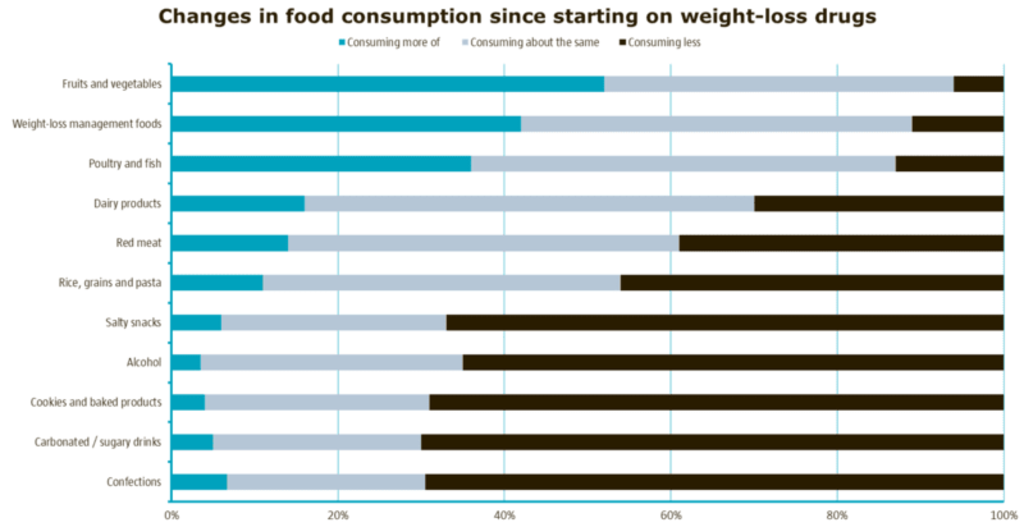
GLP-1 patients are helping accelerate positive dietary trends away from sin foods and towards healthy options.
Source: AlphaWise, Morgan Stanley Research, Downsizing Demand: Obesity Medications’ Impact on the Food Ecosystem, August 2023.
Moreover, research confirms that eating habits are heavily influenced by social context. In other words, our behavior tends to converge with those of our peers, family and friends. That means healthy behavioral changes could extend beyond GLP-1 patients to a much wider social circle, amplifying healthier eating and living across broader populations.
獲取最新市場觀點
訂閱我們的電子報,時刻把握投資資訊和專家分析。
More than a diet – real lifestyle change
Early data suggests that patients aren’t just injecting a drug but also taking charge of their long-term health. Studies show GLP-1 patients are exercising more and seeking resistance training to avoid muscle loss.8 Spending habits are following suit. A large US retailer which tracked the spending patterns of a small cohort of customers on GLP-1 drugs found that they spent less on food and more on health-enhancing products such as athletic apparel, wearables, fitness equipment, and even blenders for home-made shakes.
Less weight in the population should mean more weight into healthy living investments
Conclusion
The evidence so far strongly suggests that GLP-1 drugs will be a benefit not only to millions of patients but also a plethora of companies within the Healthy Living investment strategy. The strategy invests in companies producing and marketing natural foods including fruits and vegetables, as well as lean and high-protein meats and dairy. Its food focus also includes packaged food companies and their ingredient suppliers that have diversified into healthier food formulations and product portfolios. Both of which should benefit from creating healthier version of convenience foods that are hard to live without.
Moreover, many GLP-1 patients are making life-altering behavioral decisions that go well beyond eating to full-body health and wellness. Healthy living investments also cover companies that enable physical fitness, promote personal care and enhance overall health and well-being. And given good health is never a ‘one-and-done’ process, it also includes digital and virtual health providers that will help GLP-1 patients measure, monitor, and maintain their progress.
While near-term adoption faces supply shortages, take-up rates will accelerate as insurance coverage increases and oral forms, that replace injections, are launched. Though next-generation GLP-1 drugs are no cure-all for weight-loss, we believe prescription use will accelerate, creating steady tailwinds and long-term growth for companies that enable healthier lifestyles.
More succinctly, less weight in the population should mean more weight into healthy living investments.
Footnotes
1 https://www.who.int/news-room/fact-sheets/detail/obesity-and-overweight
2 https://www.cdc.gov/obesity/data/adult.html
3 https://www.oecd.org/health/health-systems/Heavy-burden-of-obesity-Policy-Brief-2019.pdf
4 GLP-1, Glucagon-like peptide
5 The average weight loss after a 6-month Weight Watcher program is 5%. https://www.weightwatchers.com/us/weight-loss-tips
6 With obesity and established cardiovascular diseases but no history of diabetes
7 This also aligns with research on mass-market food products that shows the majority (~70-80% of sales volumes are generated by a small sub-set (~20-30%) of consumers. The Pareto Rule for frequently purchased packaged goods: an empirical generalization. Kim, Baek Jung, Singh, V., Winer, R. Stern School of Business. New York University. 2017
8 https://www.ncbi.nlm.nih.gov/pmc/articles/PMC3969105/
https://news.harvard.edu/gazette/story/2021/04/our-co-workers-can-influence-how-we-eat-study-finds/
https://www.ncbi.nlm.nih.gov/pmc/articles/PMC7033640/
https://www.aarp.org/health/healthy-living/info-2019/friends-influence-eating-habits.html
https://www.sciencedirect.com/science/article/pii/S235215461500131X
重要資料
本網站僅供《證券及期貨條例》(香港法例第571章)及其附屬法例所界定之專業投資者瀏覽及使用。 投資涉及風險。過往表現並不代表未來表現。本網站所載資料僅供參考之用,並不構成任何投資建議,亦非作出買賣任何證券或採納任何投資策略之要約或招攬。投資者不應僅憑本網站提供之資料作出投資決定,在作出任何投資決定前,應徵詢獨立意見(包括有關稅務影響之意見)。投資者應確保完全理解投資產品的相關風險,亦應考量自身投資目標及風險承受水平。投資乃閣下之個人決定。除非銷售投資產品的中介人已向閣下告知該投資產品適合閣下,並已解釋其符合閣下投資目標之原因,否則閣下不應投資。請參閱相關發售文件或其他法律文件,以獲取包括風險因素在內的進一步詳情。 本網站由荷寶投資管理香港有限公司發布,該公司受香港證券及期貨事務監察委員會(「證監會」)規管(中央編號:APU851)。本網站未經證監會審閱。 無法保證任何投資產品可實現其投資目標。概不就任何投資產品之表現或投資回報作任何聲明或承諾。投資的價值或會波動。本網站所載過往表現、推算或預測,均不應視作未來表現之保證或指標,且概不提供任何明示或暗示之保證。本網站內容建基於相信為可靠之來源,惟因應資料傳遞技術特性及須採用多項數據來源(包括第三方內容),故概不保證其準確性。所述觀點僅乃截至上述日期,或會隨市況變化而改變,可予更改而毋須另行通知。該等意見可能有別於其他荷寶投資專業人士之意見。因使用本材料或當中所載任何評論、意見或估算而引致之直接、間接或相應損失,荷寶概不承擔法律責任。荷寶並無責任更新本網站或任何網站內容。未經荷寶事先書面許可,不得複製、分發或刊發本網站任何材料。 除非另有說明,資料來源:荷寶。