
Sector Lead
• 市場觀點
Ahead of the herd in tracking beef emissions
Beef is not only high in protein, it’s also rich in carbon emissions. Robeco’s latest sector decarbonization pathway (SDP) tracks beef producer emission reductions to help our portfolios distinguish the leaders from the laggards in the net zero transition.
作者


Analyst and Engagement Specialist
概要
- Populations and beef demand are rising globally
- Agriculture and beef, in particular, are major greenhouse gas emitters
- Decarbonizing beef and agri-activities are critical to achieving net zero targets
From the outset, tilling soils and raising livestock seem to be quite natural and environmentally harmless activities. Yet, food and agriculture are responsible for 25-30% of all greenhouse gas emissions, making it one of the most emissions-intensive sectors on the planet.1
Livestock farming is mostly to blame, and beef producers in particular. Compared to plant-based products, beef uses 20 times more land and emits 20 times more greenhouse gas emissions per gram of edible protein (see Figure 1).2 Cattle production alone is responsible for 10.15% of total man-made emissions.3
Figure 1: Beef – The most carbon intensive food
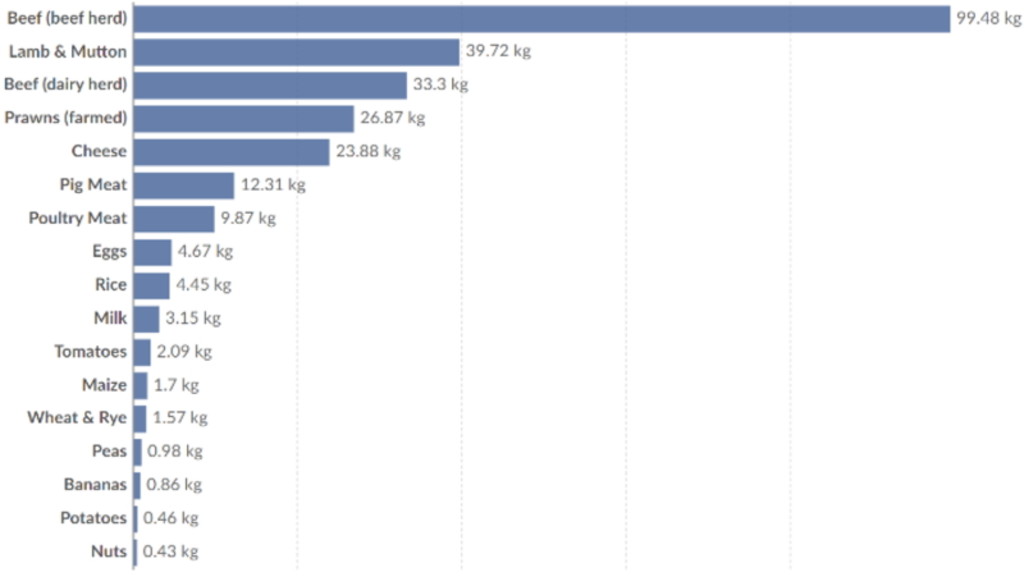
Source: Our World in Data (2020), based on Poore and Nemecek (2018), Science.
Leading the stampede
Combating upstream emissions from agri-activities will be critical in reducing portfolio as well as real-world emissions, especially with growth in populations and beef demand. With this in mind, Robeco designed the sectoral decarbonization pathway for beef.
The SDP will help our investments teams to:
Anticipate the future impact of climate-related issues on the beef sector
Assess the progress of companies in decarbonizing against science-based targets
Seize the risk-return opportunities associated with leaders and laggards in the beef sector
Decarbonize investment portfolios while maintaining diversified positions across sectors
In short, the pathway model will help us identify and invest in the firms which are leading the transformation of the beef sector a low-carbon future.
More steak puts climate targets at stake
Populations and incomes are growing in emerging markets, stoking demand for Western-sized portions and Western-styled diets. Globally, beef production has nearly doubled since 1990 and is expected to increase by another 30% through 2050. Growth left unchecked threatens to derail the 2050 climate targets outlined in the Paris Agreement.
Until now, food sector companies have lacked frameworks that help guide emission control efforts. But that is quickly changing. Last year the SBTi (Science Based Targets initiative) introduced its first-ever guidance, equipping beef producers with tools to identify, measure and ultimately reduce major sources of emissions across their supply chains and operations.
Robeco’s own SDP-beef framework draws on the SBTi’s framework as a reference guide to help standardize our analysis across beef producing companies.
What gets measured
Nearly all (97%) of the beef industry’s emissions stem from raising livestock prior to slaughter and meat processing post-slaughter. As a result, our SDP model’s analysis considers Scope 1, 2 emissions from processing but also Scope 3 emissions associated with raising the cattle. Emissions generated stem primarily from:
Deforestation, which destroys trees, plants and soil and robs the planet of carbon storage sinks. It also releases carbon stock from burned/decomposed organic matter into the atmosphere.
Fossil fuel-based fertilizers, which enrich grasslands as well as crops needed for additional feed stock. Fertilizer is produced using natural gas. It is also packed with nitrogen which, when placed on soils, reacts with oxygen in the air to produce nitrous oxide (N2O), a greenhouse gas (GHG) that is 273 times more potent than CO2.
Excess animal manure applied to crops and land as well as inappropriately stored or discarded. Manure is also rich in nitrogen, plus when stored in the open, generates methane (CH4), a GHG that is 27-30 times more potent than CO2 over a 100-year horizon.
Methane gas, which is emitted from cattle’s digestive tracts. This process, known as enteric fermentation, is the single biggest source of livestock emissions (see Figure 2).
Figure 2: Major emission sources in livestock production
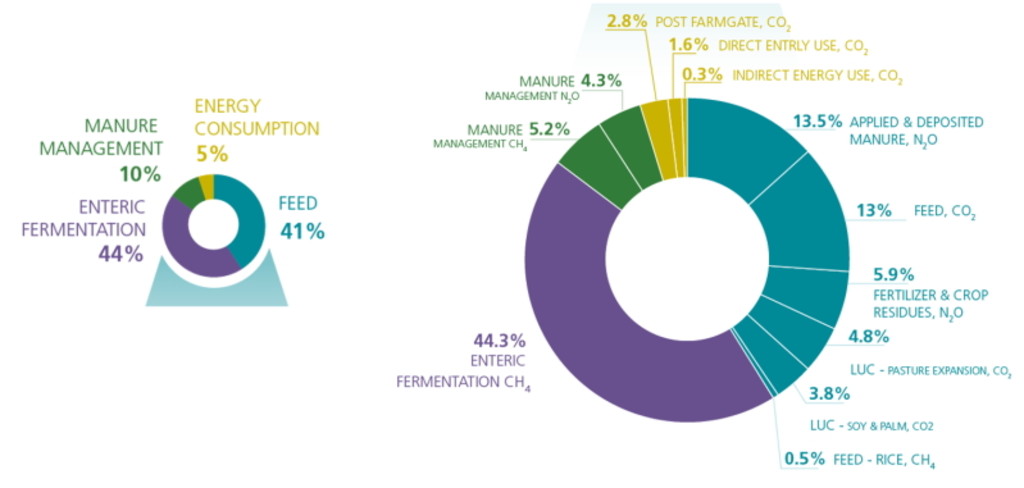
Source: UN, FAO.org
How it works
Using 2019 as our starting point, we compare companies’ current and future emission reduction plans to SBTi’s science-based emission reduction pathways for the food sector. According to SBTi guidance, beef companies must reduce their carbon emission intensities by 2.4% per year through 2030 to achieve the overall 24% reduction required from the beef industry. Measuring the gaps between company commitments and SBTi’s reduction requirements powerfully signals to investors which companies are serious about enforcing emission reductions and mitigating future transition risks.
Figure 3: Illustrative examples of beef processors’ performance
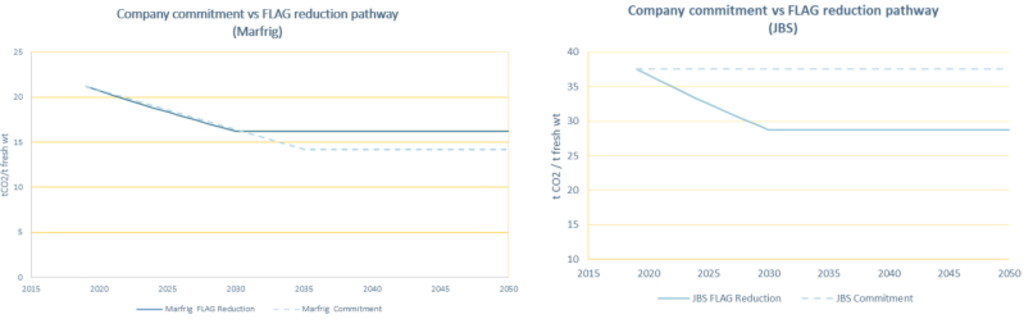
The examples show the planned carbon emission reduction pathways (company commitment path) of two Brazilian beef processors (Marfrig and JBS) versus the SBTi’s science-based emission reduction targets for forest, land and agriculture (FLAG). Marfrig is on track to achieve FLAG targets through 2050. JBS, on the other hand, is lagging, raising its net-zero transition risks.
Evaluating companies’ emission-reduction strategies
In addition to reviewing company pledges, the SDP-beef model also evaluates the how companies intend to reduce emissions. That means reviewing current and planned capex investments into technologies or practices that improve the efficiency of breeding, feeding, and caring for livestock.
We also look at how beef producers are adapting their business models, for instance, by diversifying into synthetic meat and plant-based protein products.
Use and limitations
Robeco’s beef SDP assessment framework is built and ready for use but application is still limited due to incomplete data from many beef producers.
Until now, food and agricultural companies have had little reason to act. Consumers, especially in emerging markets, spend a considerable amount of income on food and food-related products, so imposing costly regulations on producers is politically unpopular. As a result, agriculture has largely escaped regulatory pressure. As the political climate changes, we will incorporate the monetary impact of stricter policies into the beef SDP assessment model, accordingly.
Moreover, food sector decarbonization efforts are still quite new. The SBTi model was released only in 2022 and is currently the sector’s only source for scientifically backed emissions measurement guidance. Many companies are still digesting the requirements and collecting data from across fragmented supply chains. In order to perform credible, in-depth assessments, Robeco relies on multiple data sources including Bloomberg, CDP, Trucost, and MSCI.
The framework is the latest in a series of investment frameworks designed to measure the decarbonization performance of companies across high-emitting sectors. It is already being applied to investments to help analysts distinguish the beef industry’s likely leaders based on the quality of current data and projections.
獲取最新市場觀點
訂閱我們的電子報,時刻把握投資資訊和專家分析。
Footnotes
1 Our World in Data, food and greenhouse gas emissions
2 World Resources Institute
3 United Nations Food and Agriculture Organization, 2020
重要資料
本網站僅供《證券及期貨條例》(香港法例第571章)及其附屬法例所界定之專業投資者瀏覽及使用。 投資涉及風險。過往表現並不代表未來表現。本網站所載資料僅供參考之用,並不構成任何投資建議,亦非作出買賣任何證券或採納任何投資策略之要約或招攬。投資者不應僅憑本網站提供之資料作出投資決定,在作出任何投資決定前,應徵詢獨立意見(包括有關稅務影響之意見)。投資者應確保完全理解投資產品的相關風險,亦應考量自身投資目標及風險承受水平。投資乃閣下之個人決定。除非銷售投資產品的中介人已向閣下告知該投資產品適合閣下,並已解釋其符合閣下投資目標之原因,否則閣下不應投資。請參閱相關發售文件或其他法律文件,以獲取包括風險因素在內的進一步詳情。 本網站由荷寶投資管理香港有限公司發布,該公司受香港證券及期貨事務監察委員會(「證監會」)規管(中央編號:APU851)。本網站未經證監會審閱。 無法保證任何投資產品可實現其投資目標。概不就任何投資產品之表現或投資回報作任何聲明或承諾。投資的價值或會波動。本網站所載過往表現、推算或預測,均不應視作未來表現之保證或指標,且概不提供任何明示或暗示之保證。本網站內容建基於相信為可靠之來源,惟因應資料傳遞技術特性及須採用多項數據來源(包括第三方內容),故概不保證其準確性。所述觀點僅乃截至上述日期,或會隨市況變化而改變,可予更改而毋須另行通知。該等意見可能有別於其他荷寶投資專業人士之意見。因使用本材料或當中所載任何評論、意見或估算而引致之直接、間接或相應損失,荷寶概不承擔法律責任。荷寶並無責任更新本網站或任何網站內容。未經荷寶事先書面許可,不得複製、分發或刊發本網站任何材料。 除非另有說明,資料來源:荷寶。