
Head of Conservative Equities and Chief Quant Strategist


• 市場觀點
'Bear' in mind defensive stock reversals
As market trends ebb and flow, investment styles can shift in and out of favor. Recently defensive approaches – known for their focus on capital preservation and stability – have been challenged. However, 2022 served to remind us that bull markets inevitably give way to bear markets, underscoring the invaluable role defensive strategies play within diversified portfolios.
作者

概要
- Past five-year returns have predictive power for next five-year returns
- Defensive stocks tend to outperform after cyclical rallies
- The outlook for defensive equities is optimistic
Now, as the Wall Street party resumes in 2023, it is an ideal time to reconsider defensive strategies in their often overlooked context. While the returns generated by defensive stocks might not always match the returns of cyclical stocks during upward-trending markets, their added value should be considered within an overall portfolio context. Their strengths – reducing downside risk, curbing overall portfolio volatility, offering stable dividends, and diversifying portfolios – should not be underestimated.
Against this backdrop, we delve deeper into the concept of market overreaction, examining the subsequent five-year performance of defensive and cyclical stocks after their past five-year relative performance. Our research suggests that defensive stocks bounce back after a period of underperformance, allowing contrarian investors to benefit from cyclical overreaction patterns.
To understand this phenomenon, we divide the market into two parts: cyclical and defensive. We use a data-driven approach here because the cyclical/defensive classification on industries (GICS) is not useful for extended sample periods that go back more than 50 years. Assessing performance across market cycles from January 1929 to May 2023 reveals that defensive stocks are less volatile and have a lower risk profile than their cyclical counterparts.
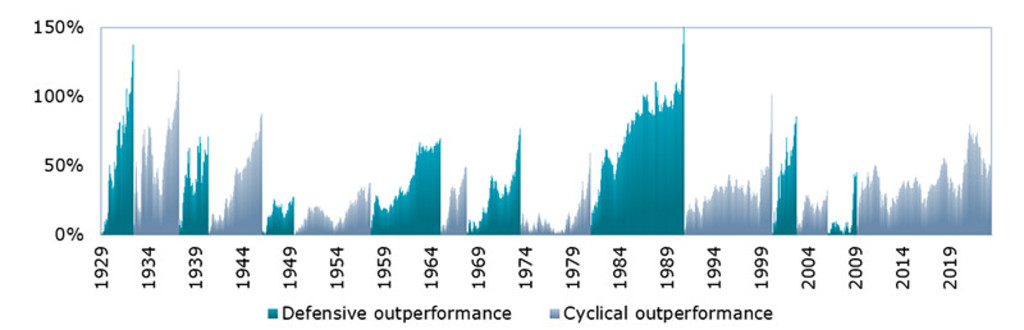
While defensive stocks outperform cyclical ones throughout our comprehensive sample, this phenomenon is not consistent over time. Each category outperforms the other approximately half the time, and the shifts in performance can be stark and lengthy. The figure below shows the relative performance through time, with cycles defined by when the style reaches an all-time relative high. Performance cycles, characterized by at least a two-and-a-half-year span with a return difference exceeding 25%, typically last between three and ten years.
Figure 1 - Relative performance of defensive and cyclical stocks over full sample period, January 1929-May 2023
Source: Robeco, 2023
Long-term reversal
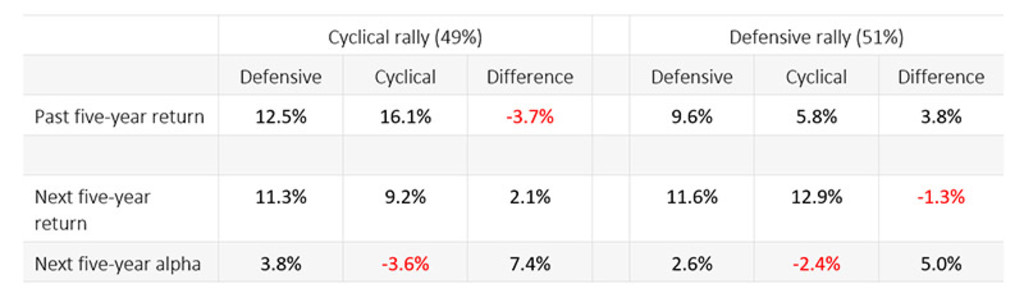
Defensive stocks outperformed cyclical ones in 51% of past five-year periods over our full sample period, with cyclical stocks leading in the remaining 49% – reflecting a broadly even split. Following a five-year period of strong performance for cyclical stocks, the subsequent five years usually favor defensive stocks. Moreover, defensive stocks have a positive alpha – measuring risk-adjusted returns – of 3.8% compared to a negative alpha of -3.6% for their cyclical peers. After a defensive rally, they continue to perform well but tend to slightly lag cyclical stocks by 1.3%. Overall, this environment is attractive for equity markets, whereas the alpha spread remains a healthy 5.0%. Similar outcomes for subsequent five-year returns are found when three-year and seven-year lookback periods are considered.
Source: Robeco, 2023
獲取最新市場觀點
訂閱我們的電子報,時刻把握投資資訊和專家分析。
Following five-year strong returns from cyclical stocks, we find that equities have somewhat lower returns the next years. Thus the relative performance of low-risk equities might also be used as a market-timing indicator, although the five-year evaluation horizon may be too long for most investors.
Shorter sample and enhanced low volatility
To ensure robustness we also assess recent data for mean-reversion patterns, including Robeco’s Conservative Equities strategy, which is designed to be less sensitive to the defensive/cyclical cycle. Using this more recent and shorter sample, we observe that cyclical return rallies were more frequent, with an accompanying, clear overreaction pattern: defensive stocks tend to perform well (poorly) following a five-year rally in cyclical (defensive) stocks. Our Conservative Equities strategy, which picks the best defensive stocks based on several factors, shows a similar pattern and also does well after cyclical rallies.
This note corroborates prior studies showing that stock markets tend to overreact, with cyclical stocks' relative performance displaying mean reversion against defensive stocks over five years. However, capitalizing on this insight is difficult due to the need for tactical allocation based on slow signals, and limited opportunities. Additionally, many investors lack ‘strong hands’, often exiting investments prematurely, which aligns with periods of subpar performance that later recover. The recent underperformance of defensive stocks compared to cyclical ones over the past three to seven years suggests a promising future for those invested in defensive stocks, and presents an opportune entry point for others.
重要資料
本網站僅供《證券及期貨條例》(香港法例第571章)及其附屬法例所界定之專業投資者瀏覽及使用。 投資涉及風險。過往表現並不代表未來表現。本網站所載資料僅供參考之用,並不構成任何投資建議,亦非作出買賣任何證券或採納任何投資策略之要約或招攬。投資者不應僅憑本網站提供之資料作出投資決定,在作出任何投資決定前,應徵詢獨立意見(包括有關稅務影響之意見)。投資者應確保完全理解投資產品的相關風險,亦應考量自身投資目標及風險承受水平。投資乃閣下之個人決定。除非銷售投資產品的中介人已向閣下告知該投資產品適合閣下,並已解釋其符合閣下投資目標之原因,否則閣下不應投資。請參閱相關發售文件或其他法律文件,以獲取包括風險因素在內的進一步詳情。 本網站由荷寶投資管理香港有限公司發布,該公司受香港證券及期貨事務監察委員會(「證監會」)規管(中央編號:APU851)。本網站未經證監會審閱。 無法保證任何投資產品可實現其投資目標。概不就任何投資產品之表現或投資回報作任何聲明或承諾。投資的價值或會波動。本網站所載過往表現、推算或預測,均不應視作未來表現之保證或指標,且概不提供任何明示或暗示之保證。本網站內容建基於相信為可靠之來源,惟因應資料傳遞技術特性及須採用多項數據來源(包括第三方內容),故概不保證其準確性。所述觀點僅乃截至上述日期,或會隨市況變化而改變,可予更改而毋須另行通知。該等意見可能有別於其他荷寶投資專業人士之意見。因使用本材料或當中所載任何評論、意見或估算而引致之直接、間接或相應損失,荷寶概不承擔法律責任。荷寶並無責任更新本網站或任何網站內容。未經荷寶事先書面許可,不得複製、分發或刊發本網站任何材料。 除非另有說明,資料來源:荷寶。