
Head of SI Thought Leadership and Climate & Biodiversity Strategist


• 市場觀點
Global Climate Survey – Investors remain committed to net zero
Investors are still on track for net zero, but implementing decarbonization is proving difficult, the 2023 Robeco Global Climate Survey has revealed.
作者

概要
- Almost half of investors have made or are making net-zero commitments
- Material impacts on portfolios underway though target-setting is slower
- More work needed on emissions reductions and low-carbon transitioning
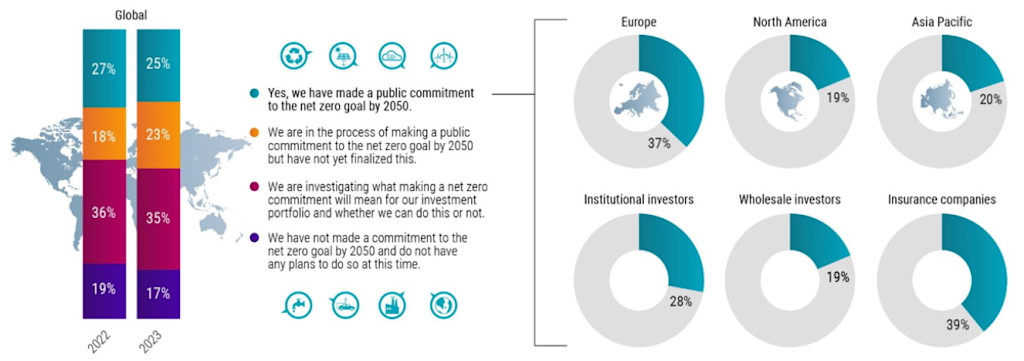
Almost half of investors are progressing their net-zero efforts in some way, rising to a total of 48% from 45% in the 2022 survey. The number of investors who have already committed to making their assets under management carbon neutral by 2050 fell slightly to 25% from 27%, while those who are in the process of committing to doing so rose to 23% from 18%.
The biggest chunk is the ‘don’t knows’, since 35% of investors are investigating what making a net-zero commitment would mean for their portfolios, and whether it is feasible for them to do so. The results were obtained from the third annual survey of 300 investors across the investment spectrum, from asset managers and owners to pension funds, insurers and banks.
The need for net zero stems from the Paris Agreement, which seeks to limit the increase in global temperatures to well below 2 degrees Celsius above pre-industrial levels by the end of this century. In order to achieve this, the world needs to become carbon neutral by 2050, principally by cutting emissions.
The Net Zero Asset Managers Initiative was signed in 2020 by global investors including Robeco who have taken the Net Zero Carbon Pledge to decarbonize all assets under management by the mid-century deadline. So far, Europe is in the lead with the pledge, with 37% of investors making a net-zero commitment, compared with 20% in the Asia Pacific region and 19% in North America.
Among investors, insurers are taking the lead, with 39% having a commitment in place, not least as the insurance sector is among the most vulnerable to climate change. This compares to 28% of institutional investors and 19% of wholesale firms.
Has your organization made a public commitment to achieving net zero greenhouse gas (GHG) emissions from its investment portfolio by 2050, or is it in the process of doing so?
The challenge of Scope 3
Emissions reductions remain key to decarbonization across three scopes. Scope 1 are generated by the company and Scope 2 from the energy used to make the product. Scope 3 are the most difficult to quantify since they occur across the entire value chain for the lifetime of the product. In the case of a motor car, for example, these could be generated for decades.
The survey showed that 55% of investors have developed a high-level understanding of the largest material impacts of portfolios on emissions, while 42% have actually calculated the carbon footprint using Scope 1 and 2 data. However, only 20% are measuring Scope 3. This may improve as the International Sustainability Standards Board (ISSB) has announced plans to make Scope 3 disclosures mandatory later in 2023.
What is also key is the level of transitioning – companies that currently have high emissions but are making a real effort to decarbonize. Only 27% said they have obtained a forward-looking view of what emissions pathway investee companies are on, which is key for understanding which firms are credible ‘transitioners’. The laggards can often be identified for engagement.
Cutting emissions
While the enthusiasm for net zero is rising, actually implementing it is proving more troublesome, partly due to the difficulties in calculating emissions. Net zero requires decarbonization at the portfolio level of about 7% a year between now and 2050, which in turn means setting targets for investee companies, and not just relying on ‘quick fix’ divestment.
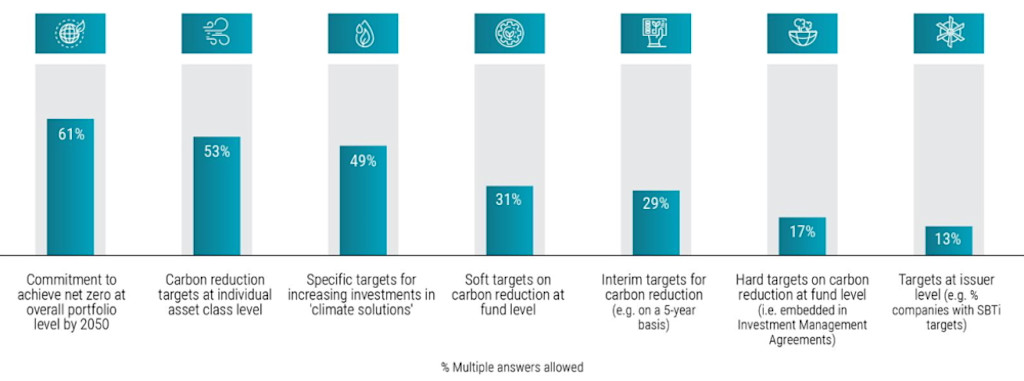
Some 53% of investors said they have set carbon-reduction targets at the asset class level, such as in an equities product. However, only 29% of those making net-zero commitments have put interim targets in place, such as over a five-year term, and only 13% have set targets at the issuer level focusing on the companies themselves.
What does your approach to net zero portfolio targets currently include? Or, if it is still being finalized, what will it include within the next 12 months?
Seeking climate solutions
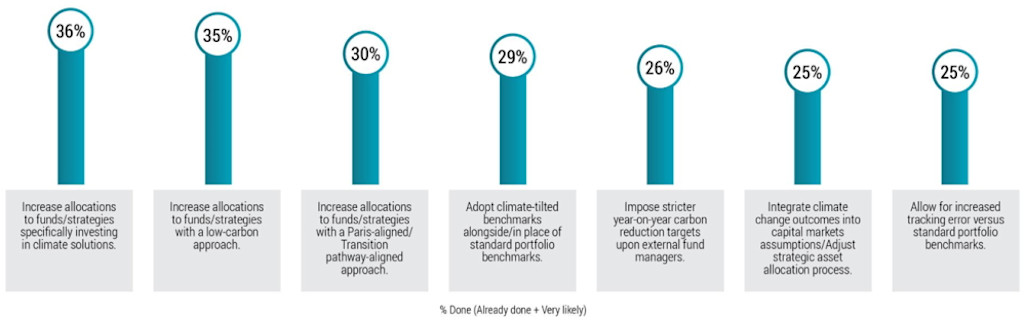
Pursuing net zero has implications for portfolio construction, led by increased demand for low-carbon investment strategies. Some 25% of investors said they are very likely to increase allocations to investment products specifically targeting climate solutions, while 11% have already done so. Similar numbers said they would increase allocations to strategies with a low-carbon approach.
In both cases, European investors are leading the way; 40% for climate solutions and 49% for low-carbon approaches, ahead of APAC and North American investors. This means large amounts of capital could be competing for limited opportunities until the climate fund pool gets bigger. Some 29% said they will move to climate-related benchmarks, which could have major implications for index-tracking mandates.
What is the likelihood that your organization will take the following measures over the next 12 months in order to decarbonize its investment portfolio?
Wider climate change
The findings are consistent with the principal question in the survey: the number of investors for whom climate change is a significant part of, or central to, their investment policy. This has remained stable at 71%, slightly down from the 75% seen in 2022, following a barrage of headwinds. The figure is, though, projected to rise to 85% over the next two years.
Sentiment was hurt by greater geopolitical uncertainty following Russia’s invasion of Ukraine. This added to inflationary pressures and triggered an energy price spike, particularly in Europe, leading some investors to pause or revise plans to move away from fossil fuels in the short term.
獲取最新市場觀點
訂閱我們的電子報,時刻把握投資資訊和專家分析。
重要資料
本網站僅供《證券及期貨條例》(香港法例第571章)及其附屬法例所界定之專業投資者瀏覽及使用。 投資涉及風險。過往表現並不代表未來表現。本網站所載資料僅供參考之用,並不構成任何投資建議,亦非作出買賣任何證券或採納任何投資策略之要約或招攬。投資者不應僅憑本網站提供之資料作出投資決定,在作出任何投資決定前,應徵詢獨立意見(包括有關稅務影響之意見)。投資者應確保完全理解投資產品的相關風險,亦應考量自身投資目標及風險承受水平。投資乃閣下之個人決定。除非銷售投資產品的中介人已向閣下告知該投資產品適合閣下,並已解釋其符合閣下投資目標之原因,否則閣下不應投資。請參閱相關發售文件或其他法律文件,以獲取包括風險因素在內的進一步詳情。 本網站由荷寶投資管理香港有限公司發布,該公司受香港證券及期貨事務監察委員會(「證監會」)規管(中央編號:APU851)。本網站未經證監會審閱。 無法保證任何投資產品可實現其投資目標。概不就任何投資產品之表現或投資回報作任何聲明或承諾。投資的價值或會波動。本網站所載過往表現、推算或預測,均不應視作未來表現之保證或指標,且概不提供任何明示或暗示之保證。本網站內容建基於相信為可靠之來源,惟因應資料傳遞技術特性及須採用多項數據來源(包括第三方內容),故概不保證其準確性。所述觀點僅乃截至上述日期,或會隨市況變化而改變,可予更改而毋須另行通知。該等意見可能有別於其他荷寶投資專業人士之意見。因使用本材料或當中所載任何評論、意見或估算而引致之直接、間接或相應損失,荷寶概不承擔法律責任。荷寶並無責任更新本網站或任何網站內容。未經荷寶事先書面許可,不得複製、分發或刊發本網站任何材料。 除非另有說明,資料來源:荷寶。