
Investment writer


• Active ETF in focus
Making the most of small caps
NextGen Global Small-Cap Equity ETF
Active ETFs are reshaping global investment markets, offering investors a flexible and transparent way to access active strategies. As adoption accelerates, however, the expanding range of solutions also raises a more practical question: where and how can they add the most value in portfolios?
In this series, we explore that question by focusing on specific areas of the market where structural inefficiencies or evolving dynamics create a compelling investment case. For each, we examine the opportunity itself, before considering how a systematic active approach can help capture it more effectively.
Authors

Anna Heldring

Jessica Monkivitch
Investment Writer
Small caps represent over 10% of global free-float market capitalization, yet remain under-allocated in many portfolios. While historically they have delivered attractive long-term returns and meaningful diversification versus large caps, the post-pandemic period saw prolonged relative underperformance for the segment.
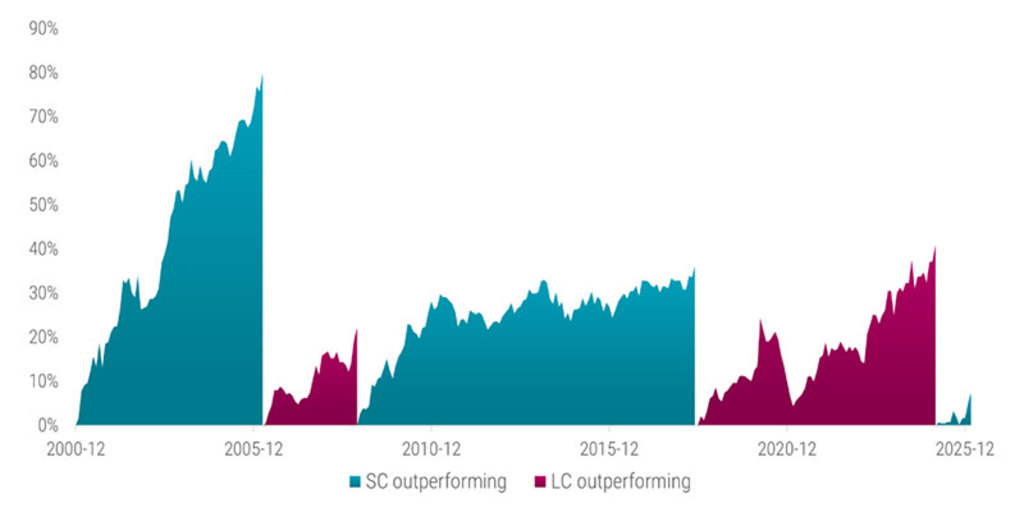
More recently, however, the relative performance between small and large caps has started to shift.
Figure 1 | Relative performance of small vs. large caps
Past performance is no guarantee of future returns. The value of your investments may fluctuate.
Source: Robeco, LSEG, MSCI. The figure shows the relative performance of the MSCI World Index versus the MSCI World Small Cap Index. A new cycle begins after the peak of the previously outperforming market, once the previously underperforming market has outperformed by at least 20% from its preceding low (except for the last small-cap cycle, which started in February 2025). Performance is based on end-of-month total return indices in USD. The sample period spans from December 2000 to February 2026.
The chart illustrates the cyclical nature of relative returns, with periods of outperformance often extending over time as leadership rotates. Importantly, valuation has played a central role in this cycle: while small caps historically traded at a premium of up to 30% versus large caps, this has reversed in recent years. Today, they trade at a discount of around 30%1 , a level not seen in over two decades, and represent a powerful opportunity.
A complex market to access
Capturing this opportunity is not straightforward. The global small-cap universe spans nearly 4,000 stocks, characterized by lower analyst coverage, higher dispersion, and more varied business models. This creates fertile ground for alpha, but also makes traditional stock picking difficult to scale. At the same time, passive approaches may lead to unintended exposure to lower-quality companies. As a result, accessing small caps efficiently requires a more selective and systematic approach.



Engineered to filter market noise
Our Active Quant strategy is designed to be highly effective by analyzing vast amounts of potential opportunities and exploiting market inefficiencies resulting from predictable patterns.
A more advanced approach is needed
These challenges have driven the evolution of more systematic approaches to small-cap investing. In particular, the combination of quantitative techniques with machine learning is increasingly relevant in this segment. By moving beyond traditional linear models2 , it becomes possible to better identify patterns in noisy and less structured data, and adapt more efficiently to changing market conditions. This allows us to better capture the diverse opportunities more consistently, while maintaining a disciplined and scalable investment process.
Robeco’s NextGen Global Small-Cap Equity ETF is designed to navigate this complexity, combining the breadth of the universe with an innovative and evidence-based approach.
How the investor benefits

1. Disciplined access to small caps
The quant engine powering this ETF systematically processes the global small-cap universe, applying proven signals such as value, quality, momentum and earnings revisions in a consistent and unbiased way

2. AI-enhanced robustness
Our NextGen approach builds on this foundation by incorporating machine learning. This helps identify non-linear relationships and interaction effects between signals, allowing the model to adapt to different company characteristics and market conditions: an important advantage in the diverse small-cap universe.

3. Meaningful diversification
In an environment of increasing market concentration, small caps offer a differentiated source of return. With an average expected long term tracking error of 3%, this ETF is positioned as a diversified allocation, aiming to capture a broad set of small-cap opportunities without excessive concentration.
NextGen Global Small-Cap Equity UCITS ETF USD Acc
- SFDR (31-8)
- Article 8
- Dividend Paying (31-8)
- No
- Current Price (30-9)
- 5.35
- Inception date (31-8)
Past performance is no guarantee of future results. The value of the investments may fluctuate.
Designed for a complex market
Small caps offer a compelling opportunity, but one that is difficult to access efficiently, calling for a more advanced and systematic approach. Robeco’s NextGen Global Small-Cap Equity ETF is designed to meet this need, combining broad market exposure with a disciplined, data-driven process.
Footnotes
1 Source: Robeco, ‘Small caps, enhanced signals: Our new NextGen ETF’. Valuation based on a composite of valuation metrics including price-to-book, forward price-to-earnings, price-to-cash earnings, and price-to-dividend ratios.
2 Linear models assume that each investment signal has a fixed and independent effect on returns. In reality, relationships between signals are often more complex: their impact can change depending on context and interactions with other factors. Machine learning helps capture these non-linear patterns, allowing for a more flexible and adaptive model.
Our core strengths