

Head of Conservative Equities and Chief Quant Strategist


• Insight
Quant chart: Rethinking risk – what bond drawdowns reveal
Even traditionally ‘safe’ assets like government bonds haven’t protected real wealth this century. Understanding their drawdown behavior sheds light on risk in multi-asset portfolios.
Authors

Every asset class, including savings, bonds, stocks, and even gold, has episodes where real purchasing power was eroded deeply. In his blog ‘No asset is safe – but some lose less’, Pim van Vliet takes a larger historical perspective, emphasizing that it’s not the absence of risk but the different shapes of risk that matter..
In this quant chart, we focus on the modern ‘bond winter’ as the latest chapter in that story, where inflation and rate cycles collide to produce real losses for fixed income investors. Examining the deeply held belief that bonds are a reliable hedge against loss, the chart offers a close up of how real drawdowns1 have shaped the experience of long-term bond holders, as well as touching upon the Total Portfolio Approach.
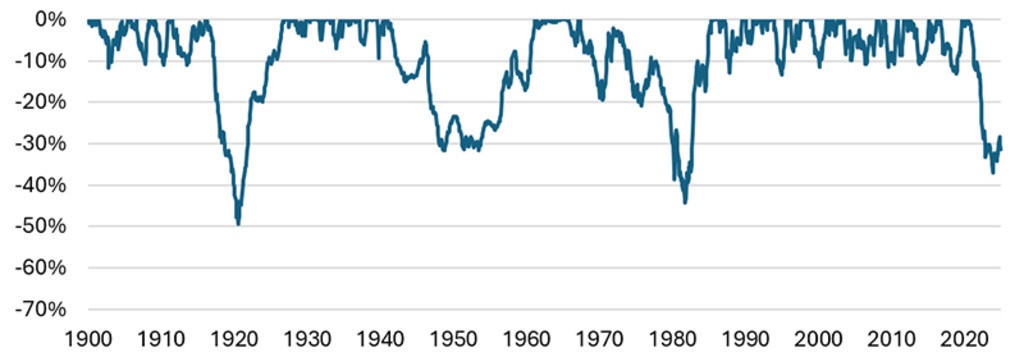
The chart captures the peak-to-trough real drawdowns in US government bonds over an extended period, essentially answering the question: ‘If I had bought bonds at the worst possible moment, how far would I have fallen, after accounting for inflation?’
Figure 1 – Real drawdowns US government bonds, 1900-2025
Source: McQuarrie (2024)2 and Robeco
While government bonds are often seen as safe, their real drawdown history tells a more nuanced story. In periods where inflation rises sharply and interest rates adjust upward, bond prices can fall while inflation simultaneously erodes value: a double hit for investors.
The 1970s and early 1980s stand out as a severe example, with real losses approaching 50%. But the experience of the early 2020s shows this is not just ancient history. Even recently, bond investors faced real drawdowns of around 30%, challenging the idea that bonds reliably protect wealth in all environments.
The key insight is not that bonds are inherently unsafe, but that nominal stability over short horizons does not guarantee real safety over long horizons. Risk that looks benign at a one-month frequency can accumulate quietly and painfully when inflation persists.
QI Global Conservative Equities D EUR
- performance ytd (31-8)
- 11.73%
- Performance 3y (31-8)
- 12.74%
- morningstar (31-8)
- SFDR (31-8)
- Article 8
- Dividend Paying (31-8)
- No
Past performance is no guarantee of future results. The value of the investments may fluctuate. Annualized (for periods longer than one year). Performances are net of fees and based on transaction prices.
A more nuanced narrative
This horizon-dependent view of risk sits at the heart of the increasingly discussed Total Portfolio Approach. Rather than assigning assets to rigid ‘safe’ or ‘risky’ buckets, it focuses on how the entire portfolio behaves across economic regimes and over long investment horizons, with particular attention to downside risk in real terms.
From that perspective, bonds are not always the low-risk anchor they are often assumed to be. Conversely, equities, especially defensive equities, can look less risky than commonly believed when evaluated on long-term real drawdowns rather than short-term volatility. While equities are more volatile month to month, low-risk stocks have historically exhibited real drawdown profiles that are not dramatically worse than those of bonds, while offering better participation in economic growth and inflation adjustment over time.
Real losses impair recovery in a way nominal returns often obscure: a 30% loss in purchasing power requires more than a 40% gain just to break even. This asymmetry matters for long-horizon investors. Bond drawdowns illustrate that portfolio risk is not symmetric across asset classes. While equities may be volatile, they tend to grow with inflation over time, whereas bonds can be caught flat-footed when rising yields and inflation erode real value simultaneously.
A total portfolio perspective naturally accommodates thinking beyond traditional risk buckets and incorporates real return perspectives, especially in environments with elevated inflation and rate volatility. As Van Vliet notes in the full blog, diversification remains a key defense. Putting all your capital in a savings account increases long-term inflation risk. Putting everything in equities increases both short- and long-term drawdowns. A steady portfolio, including, for example, a meaningful allocation to low volatility, conservative equities, can offer a compelling combination of inflation protection, market stability, and long-term return.
Footnotes
1Real drawdowns here refers to declines in purchasing power after inflation.
2McQuarrie, E.F. (2024b) ‘Introducing a New Monthly Series of US Government Bond Returns 1793–2023’. working paper 4899187, SSRN
Get the latest insights
Subscribe to our newsletter for investment updates and expert analysis.