
Portfolio Manager


• 月度展望
The strange case of Dr Equity and Mr HY-de
A rare disconnect between the likely performance of equities and high yield bonds means stocks will be greatly preferred going into 2026, says multi-asset investor Mathieu van Roon.
作者

概要
- Equities and high yield bonds are normally on the same side of the risk coin
- Stocks are expected to see robust earnings growth in a positive macro backdrop
- HY bonds face rising credit stress, a demand imbalance and super-tight spreads
He says the different sides offered by what is usually the same risk-on or risk-off trade draws a parallel with the gothic horror story ‘The Strange Case of Dr Jekyll and Mr Hyde’. In the 19th century tale, the mild-mannered scientist Dr Jekyll drinks a potion and turns into the monstrous Mr Hyde. Both are the same man, but with very different sides.
“As we near the end of the year and start to look ahead to 2026, we see a clear bifurcation in the downside versus the upside risks between equity and equity-like asset classes,” says Van Roon, Portfolio Manager with Robeco Investment Solutions.
“Whereas normally we expect high yield bonds and equities to be on the same side of the risk on/off coin, and to perform in the same type of circumstances, for 2026 we fear high yield could show its ugly side. You might call it the Strange Case of Dr Equity and Mr HY-de.”
Van Roon says the bifurcation lies in the macroeconomic factors facing each asset class that will turn out positive for Dr Equity and negative for poor Mr HY-de. “On the one hand, US and European equity markets and large investment grade corporates are full of optimism, fueled by robust earnings, aggressive buybacks and the promise of AI-driven productivity gains,” he says.
“On the other hand, the real economy – especially in the US – and leveraged high yield issuers are burdened by deteriorating fundamentals and increasing macro risks.”
“This dichotomy in views on the asset classes is striking, as historically, high yield bond and equity prices have had a strong correlation, with both dependent on positive economic and company growth expectations.”
“But in 2026, the macro and technical environment might worsen for high yield, whereas equity has a bigger chance to continue to ride the wave of earnings strength and technological optimism, similar to the last throes during the tech bubble of the late 1990s.”
獲取最新市場觀點
訂閱我們的電子報,時刻把握投資資訊和專家分析。
Growth from spending and AI
The giant economies of both the US and Europe are expected to grow in the coming year, though for different reasons. Europe’s growth is related to fiscal spending, including on defense and infrastructure, and pent-up savings. The growth expectation in the US is driven by AI-related capital expenditure, and potential productivity gains from AI and upper-income consumption. This is further aided by fiscal support from the One Big Beautiful Bill Act and bumper tax refunds.
“This growth is, however, not without tension,” Van Roon warns. “President Trump’s tariffs are expected to impact US growth and/or company earnings, while inflation is expected to remain sticky. The Fed is in a tough position to remain either too restrictive in an already fragile labor market, or to potentially start too soon with easing, which could un-anchor inflation expectations.”
“Add to that political uncertainty with mid-term elections coming up in November 2026, and a potential change at the Fed’s helm when Chairman Jerome Powell’s term ends in May. The aforementioned AI boom is also expected to continue to reshape the labor market, as fewer people are needed to produce the same output.”
“These developments can impact consumer spending negatively. Alternatively, efficiencies will lead to more leisure time; Henry Ford used the efficiency of car assembly lines to allow workers the concept of a ‘weekend’, in the belief that this would boost car usage and adoption.”
Dr Equity
Given this backdrop, Van Roon says US equities are expected to benefit from robust earnings growth, seen at about 14% for the S&P 500, with half of that coming from sectors outside the tech sector. EU companies stand to gain as well, due to fiscal stimulus and the broadening of growth beyond the US. The AI productivity gains are expected to broaden out over the other sectors, such as healthcare and retail, thus supporting the rally.
“Current valuations are high, but thanks to strong company fundamentals (margins, free cash flows, low leverage levels), they are not at extremes,” Van Roon says. “Last but not least, the flows into equities remain robust and diversified, with retail, passive and institutional investors across the spectrum continuing to buy stocks.”
Mr HY-de
This contrasts quite starkly with the high yield bond market. “Whereas the outlook for equities is rather optimistic, the outlook for high yield is much more cautious,” Van Roon says. “Compared to large investment grade companies, the lower-rated, smaller and more highly leveraged companies are struggling with tighter lending standards and rising refinancing rates.”
“The macro landscape with more political/tariff/inflation uncertainty and AI-related job cuts is expected to weaken consumer demand, which these types of companies rely on.”
“Supply-wise, a net increase is expected, driven by AI-related capex, M&A and refinancing, whereas it is expected that inflows are unlikely to keep pace with this supply. Recent worries about rising stress in private credit might spill over into public high yield markets, especially if sector-specific shocks (such as AI disruption in software) trigger a negative feedback loop, where bonds with lower ratings such as B or CCC are more vulnerable.”
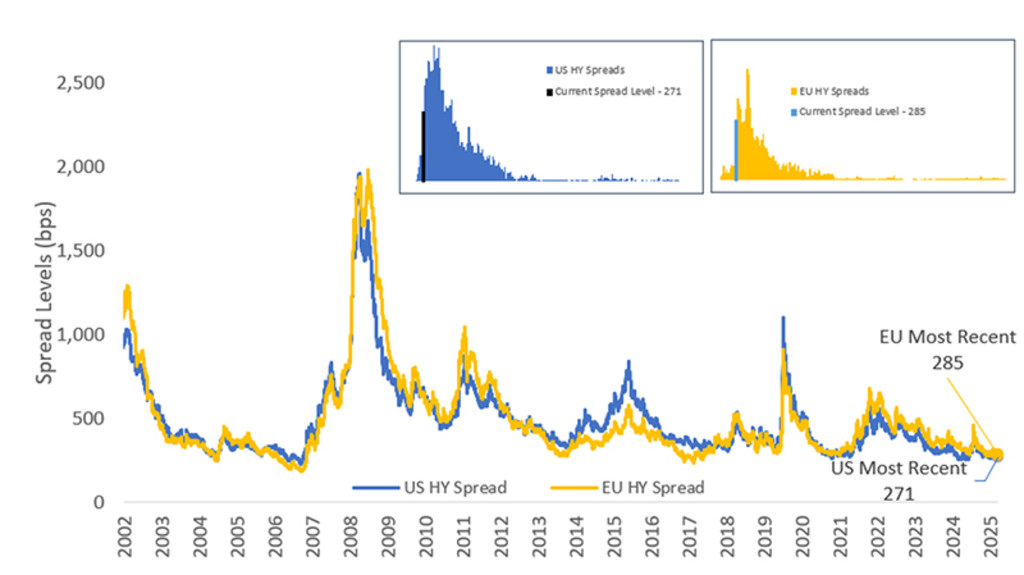
“Just as in equities, current valuations in high yield are rich, as spreads are hovering around historically low levels.” This can be seen in the chart below.
Figure 1 – Historic high yield spread development
Source: Bloomberg, Robeco
Brighter outlook for stocks
“Investors are not asking for much additional compensation to invest in high yield bonds. While further spread tightening is possible, it is relatively limited. The attractiveness of this asset class is thus mostly the sizeable carry returns gained from holding these bonds.”
In all, Van Roon says the trade-off between risk and returns is much more constructive for equities than for high yield. “The tight spreads, rising supply and challenging macro environment make us more cautious for high yield, but the asset class can still deliver attractive carry returns going forward, especially relative to other fixed income sectors,” he says.
“Equities stand to benefit from fiscal support, AI-driven earnings and robust flows, and have more upside. We thus take sides with ‘Dr Equity’.”
重要資料
本網站僅供《證券及期貨條例》(香港法例第571章)及其附屬法例所界定之專業投資者瀏覽及使用。 投資涉及風險。過往表現並不代表未來表現。本網站所載資料僅供參考之用,並不構成任何投資建議,亦非作出買賣任何證券或採納任何投資策略之要約或招攬。投資者不應僅憑本網站提供之資料作出投資決定,在作出任何投資決定前,應徵詢獨立意見(包括有關稅務影響之意見)。投資者應確保完全理解投資產品的相關風險,亦應考量自身投資目標及風險承受水平。投資乃閣下之個人決定。除非銷售投資產品的中介人已向閣下告知該投資產品適合閣下,並已解釋其符合閣下投資目標之原因,否則閣下不應投資。請參閱相關發售文件或其他法律文件,以獲取包括風險因素在內的進一步詳情。 本網站由荷寶投資管理香港有限公司發布,該公司受香港證券及期貨事務監察委員會(「證監會」)規管(中央編號:APU851)。本網站未經證監會審閱。 無法保證任何投資產品可實現其投資目標。概不就任何投資產品之表現或投資回報作任何聲明或承諾。投資的價值或會波動。本網站所載過往表現、推算或預測,均不應視作未來表現之保證或指標,且概不提供任何明示或暗示之保證。本網站內容建基於相信為可靠之來源,惟因應資料傳遞技術特性及須採用多項數據來源(包括第三方內容),故概不保證其準確性。所述觀點僅乃截至上述日期,或會隨市況變化而改變,可予更改而毋須另行通知。該等意見可能有別於其他荷寶投資專業人士之意見。因使用本材料或當中所載任何評論、意見或估算而引致之直接、間接或相應損失,荷寶概不承擔法律責任。荷寶並無責任更新本網站或任何網站內容。未經荷寶事先書面許可,不得複製、分發或刊發本網站任何材料。 除非另有說明,資料來源:荷寶。