

Head of Multi Asset & Equity Solutions, Co-Head Investment Solutions


• 月度展望
Full steam ahead: The US economic pressure cooker
An overheating US economy should be ringing alarm bells for investors as it may bring headwinds for both equities and bonds, says multi-asset investor Colin Graham.
作者

概要
- US economy has little slack to absorb the stimulus led by tax cuts
- Fed is cutting rates even though inflation remains above its 2% target
- Equities face a mixed outlook with headwinds for government bonds
A combination of both fiscal and monetary stimulus is occurring while there is little spare capacity in the world’s largest economy. It leaves little room for the pressure cooker to blow off steam and may end with an unwelcome bang, says Graham, co-head of Robeco Investment Solutions.
This kind of scenario pressures both developed and emerging market equities along with long-duration government bonds, though commodities tend to do well, as seen in the recent gold rally, he warns.
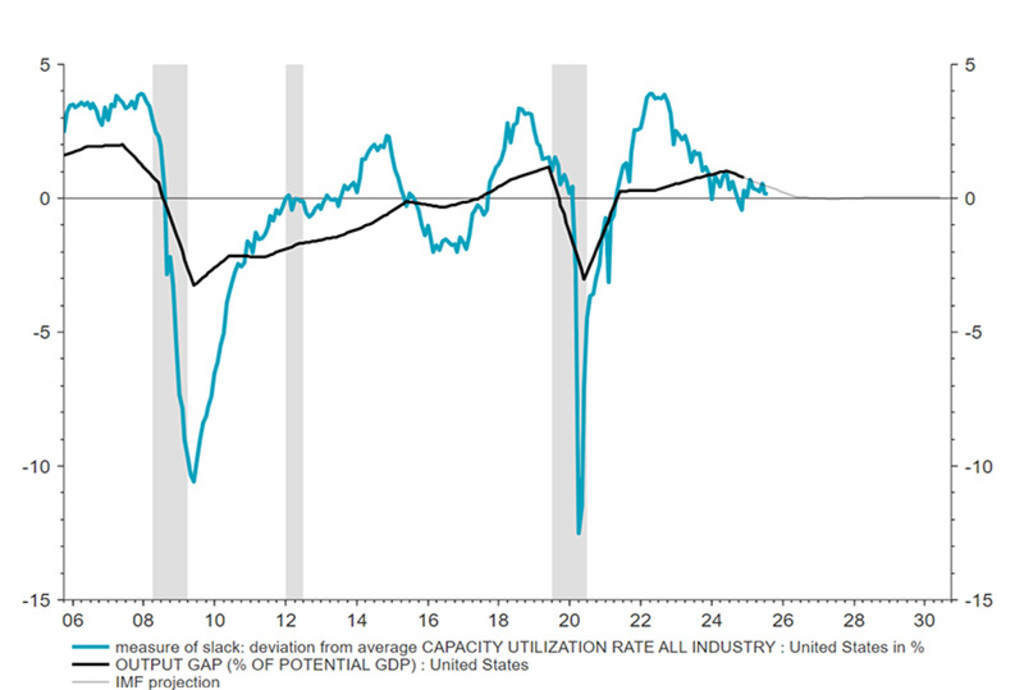
“Over recent years, the US has increasingly exhibited characteristics of a high-pressure economy – a scenario where robust growth with full employment meets limited economic slack, and is further pumped up by policy stimulus through tax cuts and lower interest rates,” Graham says.
“The additional stopper, to prevent pressure release, is tariffs, as this will prevent importing the deflation dynamic we saw in previous bull markets of the 1990s and 2000s. This environment presents both opportunities and risks that are reshaping the macroeconomic landscape and investor behavior.”
“While this is not our core scenario, the signposts of lower rates to come, a delayed tariff impact and more tax cuts mean there is an increasing probability that financial markets will price this in. We are not at that point yet, but the fiscal and monetary largesse is turning up the heat on the US economic pressure cooker, without a means of blowing off steam.”
“We believe that this scenario will end with a bang, though whether that is before the end of 2025 or 2026 or beyond is uncertain.”
Figure 1: There is little slack in the US economy, as the deviation trend is close to zero
Source: LSEG Datastream Robeco, October 2025.
How we got here
A high-pressure economy arises when economic activity operates at or above its potential output, leaving little slack in labor and supply chains, and potentially leading to rising wages and consumer prices. In the US, this condition is driven by several factors, led by pro-cyclical fiscal stimulus and accommodative monetary policy occurring at the same time.
“Government spending remains robust, as fiscal measures continue to boost consumer and business demand,” Graham says. “This stimulus supports consumption and investment, and pushes the economy against the full capacity limit.”
“At the same time, the Federal Reserve has maintained historically low interest rates for an extended period, encouraging borrowing and investment, despite inflation climbing above target levels. This stance has contributed to sustaining elevated demand in selected parts of the economy. The central bank is now embarking on further rate cuts while inflation remains above target and without widespread weakness in economic data.”
Labor markets and supply chains
Meanwhile, the US unemployment rate is near historic lows, exerting upward pressure on wages, while restrictions on migrant labor means lower payroll growth is required to maintain full employment.
“And persistent disruptions in global supply chains, shortages of key inputs, and logistical bottlenecks are limiting the ability of producers to keep pace with demand – further contributing to inflationary pressures,” Graham says.
“While costs can be passed through in the short term, we assume that 50% of the tariff increases will end up in the prices of consumer goods. Longer-term margins will be pressured unless there are productivity gains from artificial intelligence.”
“These elements combine to create an economic pressure cooker with no outlet.”

2026年展望報告:同步轉變
多年不確定性過後,2026年有望迎來一場罕見而短暫的復甦。
Rate cuts alarm bell
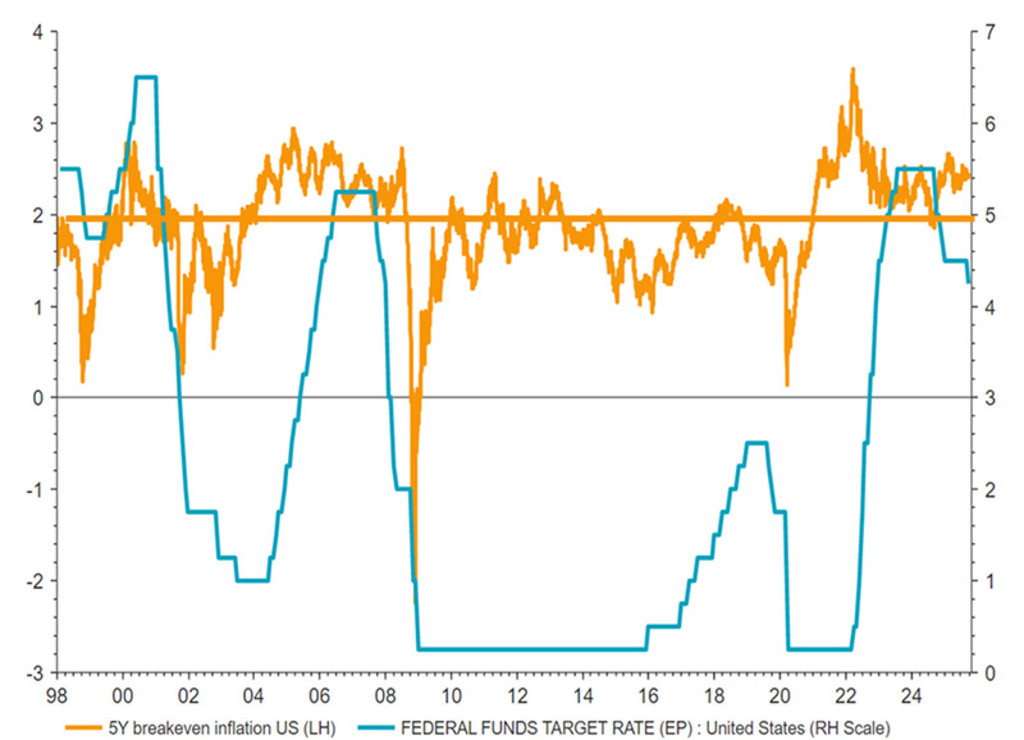
One alarm bell has been the Fed cutting rates – possibly under pressure from President Trump – while inflation is still above the central bank’s long-standing 2% target. Lower rates tend to encourage borrowing and spending, which can drive inflation even higher.
“The persistence of inflation in a high-pressure economy complicates the Fed’s policy decisions,” Graham warns. “If inflation expectations become unanchored, the Fed may be forced into a more aggressive tightening cycle, involving rapid interest rate hikes and possibly balance sheet reduction.”
Figure 2: The Fed is cutting rates while inflation remains above the 2% target
Source: LSEG Datastream, Robeco, October 2025.
Asset class implications
For investors, this increases market volatility and heightens the risk of policy-driven economic slowdowns or recessions. The implications for asset classes are:
Equities: In a high-pressure economy, equities often face a mixed outlook. On the one hand, strong economic growth and corporate earnings support equity valuations, particularly for sectors with pricing power and those involved in the AI revolution. Conversely, sectors reliant on low rates and thin margins, such as consumer stocks, may experience heightened downside risk.
Bonds: Rising inflation and interest rates pose headwinds for traditional fixed income, especially long-duration government bonds. Usually, investment grade credit and selective high yields with strong fundamentals can offer better risk-adjusted returns than sovereign bonds. However, spreads are already at historic lows, so they offer lower protection this time around.
Emerging markets: The prospect of Fed tightening and a stronger US dollar tends to pressure emerging markets via capital outflows and currency depreciation. This is contrary to Robeco’s longer-term view in Expected Returns of a greenback derating from expensive valuation levels.
Commodities: Commodities and real assets such as gold, which has reached record highs lately, tend to perform well amid inflationary pressures, benefiting from robust demand and supply bottlenecks.
“From our vantage point, when you extend time horizons, there is significant divergence in returns across asset classes when inflation rises and monetary policy does not turn the heat down by raising interest rates,” Graham says.
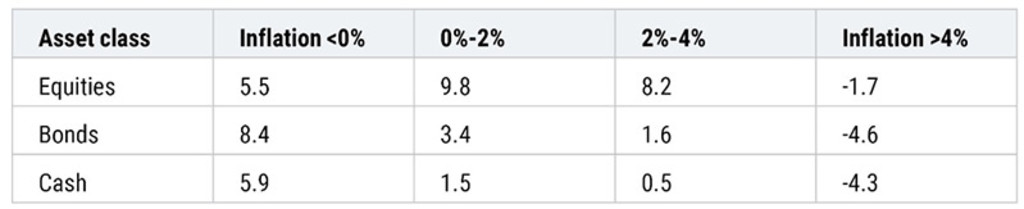
As the table below shows, when inflation is in the ‘ideal’ 0-2% range, average historic equity returns are at their highest at 9.8% on an annualized basis. But when it is above 4%, equity returns become negative at -1.7% as stock markets fall. Bonds also decline by 4.6% and cash by 4.3% due to the higher inflation eating into returns.
Table 1: Asset class returns, 1875-2021
Past performance is no guarantee of future results. The value of your investments may fluctuate.
Source: Robeco
“The US high-pressure economy reflects a delicate balance of strong demand, constrained supply, and evolving pro-cyclical policy responses,” Graham concludes. “While it supports near-term growth, the persistent inflation risks necessitate vigilant monitoring of monetary policy and economic indicators.”
“For investors, understanding this regime’s nuances is critical to navigating asset allocation and managing risk effectively and assessing when the pressure cooker is about to blow.”
獲取最新市場觀點
訂閱我們的電子報,時刻把握投資資訊和專家分析。
重要資料
本網站僅供《證券及期貨條例》(香港法例第571章)及其附屬法例所界定之專業投資者瀏覽及使用。 投資涉及風險。過往表現並不代表未來表現。本網站所載資料僅供參考之用,並不構成任何投資建議,亦非作出買賣任何證券或採納任何投資策略之要約或招攬。投資者不應僅憑本網站提供之資料作出投資決定,在作出任何投資決定前,應徵詢獨立意見(包括有關稅務影響之意見)。投資者應確保完全理解投資產品的相關風險,亦應考量自身投資目標及風險承受水平。投資乃閣下之個人決定。除非銷售投資產品的中介人已向閣下告知該投資產品適合閣下,並已解釋其符合閣下投資目標之原因,否則閣下不應投資。請參閱相關發售文件或其他法律文件,以獲取包括風險因素在內的進一步詳情。 本網站由荷寶投資管理香港有限公司發布,該公司受香港證券及期貨事務監察委員會(「證監會」)規管(中央編號:APU851)。本網站未經證監會審閱。 無法保證任何投資產品可實現其投資目標。概不就任何投資產品之表現或投資回報作任何聲明或承諾。投資的價值或會波動。本網站所載過往表現、推算或預測,均不應視作未來表現之保證或指標,且概不提供任何明示或暗示之保證。本網站內容建基於相信為可靠之來源,惟因應資料傳遞技術特性及須採用多項數據來源(包括第三方內容),故概不保證其準確性。所述觀點僅乃截至上述日期,或會隨市況變化而改變,可予更改而毋須另行通知。該等意見可能有別於其他荷寶投資專業人士之意見。因使用本材料或當中所載任何評論、意見或估算而引致之直接、間接或相應損失,荷寶概不承擔法律責任。荷寶並無責任更新本網站或任何網站內容。未經荷寶事先書面許可,不得複製、分發或刊發本網站任何材料。 除非另有說明,資料來源:荷寶。